
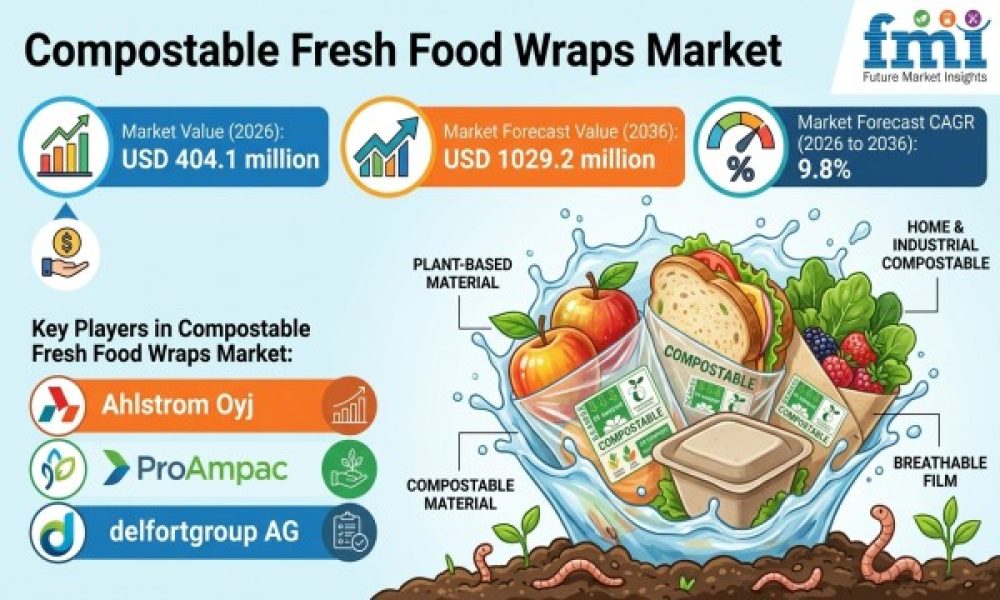
The global Compostable Fresh Food Wraps Market is projected to grow from USD 404.1 million in 2026 to USD 1,029.2 million by 2036, advancing at a 9.8% CAGR, according to Future Market Insights (FMI). Demand is being supported by foodservice and grocery operators seeking alternatives to conventional wraps that can manage grease and food residue while fitting documented organics-management routes.
Fresh-Food Packaging Demand Moves Beyond Material Selection
Fresh-food wraps face a practical challenge after use. Grease and food residue can reduce recovery options for flexible packaging, directing foodservice programs toward biodegradable and compostable formats.
The commercial question, however, extends beyond whether a wrap is compostable. Collection facilities apply different feedstock rules across service territories, meaning a certified product may still require site-specific acceptance before it can be adopted across a multi-location account.
The United States Environmental Protection Agency reported in March 2025 that its Excess Food Opportunities Map covered more than 960,000 potential generators and 15,000 recipient sites nationwide. For wrap suppliers and buyers, the breadth of this network highlights why local collection arrangements remain part of the purchasing decision.
Get detailed market forecasts, competitive benchmarking, and pricing trends:
https://www.futuremarketinsights.com/reports/sample/rep-gb-34601
Certified Paper Wraps Hold a Key Product Position
Certified compostable paper wraps are projected to account for 34.0% of product type demand in 2026. Their familiar sheet and roll formats support existing folding and dispensing practices across deli and foodservice environments.
Paper-fiber is estimated to capture 44.0% of the material category in 2026. Manufacturers can work with established printing, cutting and converting processes, although grease resistance, wet strength and fold performance still require application-level validation.
Sandwiches and delis represent 26.0% of application demand in 2026. Frequent handling, secure folding and resistance to grease migration make peak-period trials particularly relevant before a wrap moves into recurring commercial supply.
Industrial compostable formats are forecast to represent 56.0% of certification demand in 2026. Defined treatment conditions provide a basis for commercial testing, although certification does not itself guarantee acceptance by an individual composting facility.
Local Collection Rules Remain a Commercial Constraint
Market adoption varies according to how packaging is collected and treated.
In March 2026, the Ministry of the Environment counted 1,740 municipalities with five-year packaging collection plans. Planned collection covered 82.4% of plastic packaging and 51.9% of paper packaging. These differences reinforce the need to distinguish material performance from actual local disposal routes.
For foodservice chains, grocery retailers and packaging suppliers, this creates an additional qualification step. A successful commercial specification needs food-contact performance, documented certification and confirmation that the intended collection or treatment operator accepts the finished wrap.
Controlled venues such as campuses and event catering operations offer a more defined route. Purchasing, staff procedures, sorting instructions and waste contracts can be coordinated across the same locations, reducing some of the uncertainty associated with distributed foodservice networks.
Analyst Perspective
“Compostable fresh food wraps earn approval once barrier performance and disposal acceptance are proven for the same use case. Material producers and converters that verify both conditions reduce qualification risk and protect repeat orders across distributed foodservice sites.”
Nandini Roy Choudhury, Principal Consultant, Future Market Insights
Regional Growth Shows Different Market Conditions
The five profiled countries show CAGRs ranging from 10.3% in Brazil to 8.3% in Japan through 2036.
Brazil is forecast to expand at 10.3% CAGR, while the United Kingdom follows at 9.9%. Germany is projected at 9.6%, the United States at 9.1%, and Japan at 8.3%.
These markets differ in collection infrastructure, foodservice purchasing structures and treatment requirements. In the United Kingdom, dedicated collection arrangements remain relevant because compostable packaging cannot enter routine food-waste recycling. Germany combines established paper conversion with biological treatment capacity, while the United States faces state labeling and local feedstock differences.
Japan’s market places emphasis on freshness protection and documented collection routes. Its organized food-recycling targets also create requirements for precise barrier data and converter-level validation.
Competitive Landscape
The market includes material producers, film developers, paper manufacturers and converted-wrap suppliers. The eight profiled companies are Ahlstrom Oyj, ProAmpac, Futamura Group, TIPA Corp. Ltd., Novolex, Novamont S.p.A., BASF SE and delfortgroup AG.
Ahlstrom Oyj, ProAmpac and delfortgroup AG focus on paper development and food-contact conversion requirements. Futamura Group, TIPA Corp. Ltd. and Novamont S.p.A. participate in cellulose film and compostable biopolymer platforms. Novolex and BASF SE address converted packaging or barrier-coating applications.
Report Scope
The FMI study analyzes the Compostable Fresh Food Wraps Market by product type, material, certification, application, end use, sales channel and region.
Product types include certified compostable paper wraps, PLA-coated wraps, cellulose film wraps, natural-wax wraps and others. Materials include paper-fiber, regenerated cellulose film, PLA-biopolymer, cotton plus plant wax and others.
The study covers North America, Latin America, Europe, East Asia, South Asia and Pacific, and the Middle East and Africa, with Brazil, the United Kingdom, Germany, the United States and Japan among the profiled countries.
Gain Comprehensive Knowledge—Read the Entire Report Now!
https://www.futuremarketinsights.com/reports/compostable-fresh-food-wraps-market
FMI Custom Research: Strategic Intelligence for Confident Decision-Making
In today’s rapidly evolving business environment, leadership teams need more than market data—they need clear, actionable intelligence tailored to their strategic objectives. FMI’s Custom Research solutions are designed around the specific business questions organizations need answered, enabling executives to evaluate growth opportunities, validate investments, assess competitive dynamics, and reduce uncertainty before making critical decisions. By combining deep industry expertise, primary research, and proprietary market intelligence, FMI delivers insights that help organizations move from assumptions to evidence-based strategies with greater speed and confidence.
Business Impact
FMI helps organizations transform market complexity into strategic clarity, enabling leadership teams to identify growth opportunities faster, optimize resource allocation, strengthen competitive positioning, and make high-stakes business decisions with confidence.
To explore how FMI Custom Research can support your strategic priorities, please connect with our team at – [email protected]
About Future Market Insights (FMI)
Future Market Insights, Inc. (FMI) is an ESOMAR-certified, ISO 9001:2015 market research and consulting organization, trusted by Fortune 500 clients and global enterprises. With operations in the U.S., UK, India, and Dubai, FMI provides data-backed insights and strategic intelligence across 30+ industries and 1200 markets worldwide.



