
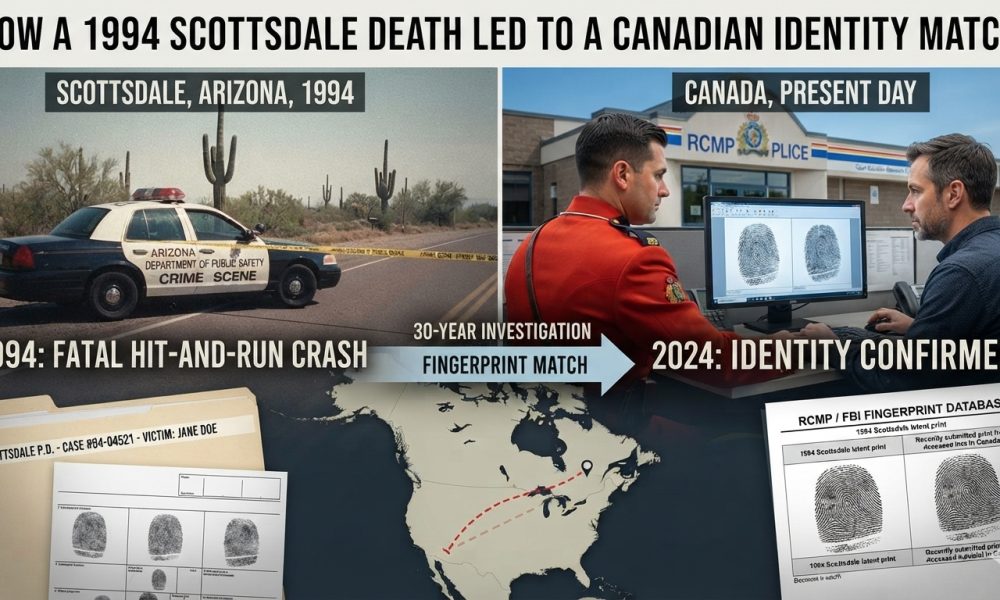
Nearly three decades after impaired driver Gloria Schulze killed college student Angela Maher, investigators connected an assumed name in Canada to preserved fingerprints, establishing what happened to the fugitive while leaving her victim’s family without the sentencing they had awaited.
WASHINGTON, DC, September 30, 2026 — The Gloria Schulze case began with the death of a young woman helping a friend get home safely. It ended with investigators establishing that the convicted driver had died in Canada under another name.
Scottsdale police publicly announced the resolution on May 29, 2024, after an international fingerprint comparison connected Schulze to Kate Dooley, a woman who had lived in Yellowknife, Northwest Territories, and died of cancer on December 1, 2019.
The announcement answered the central question surrounding a prolonged fugitive investigation. However, it could not produce an arrest, a return to Arizona, or the courtroom reckoning that Angela Maher’s relatives had sought since the fatal collision.
Viewed chronologically, the case brings together a missed court appearance, a conviction in absentia, renewed public appeals, an unexpected family lead, and a records comparison that finally connected two names across an international border.
July 1994: A Designated Driver Never Comes Home
On July 29, 1994, Angela Maher, a 21-year-old college student visiting home, set out to pick up a friend who needed a ride from a bar, putting into practice the concern about impaired driving that had already shaped her young life.
Schulze, then 31, collided with Maher’s vehicle in Scottsdale while driving after drinking and using marijuana, beginning a criminal case whose consequences would extend far beyond the crash scene and remain unresolved for Maher’s family for decades.
The account preserved by Unsolved Mysteries describes Maher’s involvement in Students Against Drunk Driving and her willingness to remain sober when friends drank, placing her final journey within a broader pattern of trying to protect others.
Her death gives the chronology its essential human context, because the subsequent mystery concerned someone who escaped accountability for taking a life. At the same time, the young woman at its center lost every opportunity to continue her own.
1994–1995: Criminal Proceedings Give Way to a Fugitive Search
Authorities pursued manslaughter and three endangerment charges against Schulze, who remained out of custody. At the same time, proceedings continued, creating the period between the fatal collision and trial during which she ultimately disappeared from the Arizona justice system.
The historical Unsolved Mysteries account dates her arraignment to September 6, 1994. It describes release conditions involving regular drug testing and telephone reporting, details that help distinguish the early court process from the later search.
When Schulze failed to appear for the scheduled September 15, 1995, pretrial hearing, the case acquired a second urgent problem: authorities needed to locate the defendant as well as continue addressing the criminal charges arising from Maher’s death.
The missed appearance became a defining milestone for the family, marking the point at which expectations of an approaching resolution gave way to uncertainty about whether Schulze would ever return to face the consequences in person.
1996: National Attention Expands the Search
The case reached a national audience through Unsolved Mysteries in 1996, carrying the circumstances of Maher’s death and Schulze’s disappearance beyond Arizona and inviting people with potentially relevant knowledge to bring that information to investigators.
Television coverage gave the search a public dimension. Still, the eventual chronology shows that widespread recognition of a case and a confirmed location for its fugitive are separate outcomes, with no assurance that one promptly produces the other.
For readers revisiting the story through archived broadcasts, the distinction between the original appeal and the eventual resolution matters, because an older program can preserve the uncertainty of its production date long after investigators obtain answers.
The continued availability of those broadcasts also gives the case an unusual afterlife, allowing audiences to encounter Maher’s story as an open mystery even though police publicly explained the outcome of the fugitive investigation in 2024.
May 2001: A Conviction Without the Defendant
On May 3, 2001, a jury convicted Schulze in absentia on the manslaughter and endangerment counts, establishing a decisive courtroom outcome while leaving authorities with the separate task of finding the person responsible for the crime.
That milestone prevents a misleading reading of the subsequent investigation, because the unresolved question was no longer simply whether prosecutors could establish guilt, but whether authorities could locate Schulze and bring her back into custody.
The conviction also separates two timelines that often become blurred in accounts of long-running cases: the progression of criminal proceedings and the effort to identify a fugitive’s whereabouts can reach significant milestones at very different times.
For Maher’s relatives, a verdict could establish responsibility without delivering the experience of seeing the convicted driver return, creating a gap between a formal judicial result and the personal accountability they continued to seek afterward.
2009: A Canadian Arrest Leaves an Important Record
In 2009, Canadian authorities arrested the woman known as Kate Dooley for impaired driving in Yellowknife, taking fingerprints that would later become central to establishing her connection with the much older criminal case in Scottsdale.
Available reporting does not establish why authorities failed to connect the Canadian encounter with Schulze’s Arizona record at the time, so it is inappropriate to assign the delay to a particular database, officer, or institutional failure.
The later comparison shows something more limited and concrete: investigators eventually located a Canadian fingerprint record associated with the assumed name. They used it to resolve the identity question the name alone could not answer.
The importance of that arrest therefore lies in the evidence it preserved for a later inquiry, rather than in any demonstrated explanation of how Schulze entered Canada, established her circumstances there, or avoided Identification during the intervening years.
2018–2019: A Renewed Appeal and an Unrecognized Death
Renewed publicity, including an age-enhanced Image circulated in 2018, sought to account for the years since Schulze’s disappearance and help members of the public recognize someone whose appearance might have changed substantially since the original investigation.
Such an Image serves as an investigative aid rather than independent proof of identity, a distinction that became especially relevant when investigators later considered whether a photograph associated with a Canadian obituary resembled the missing fugitive.
On December 1, 2019, the woman known in Yellowknife as Kate Dooley died of cancer, bringing Schulze’s life to an end before the Arizona investigators publicly connected that name and death with their longstanding fugitive case.
Her death changed what any subsequent breakthrough could accomplish, because identifying her afterward could resolve uncertainty and correct the historical record. Still, it could no longer bring her back to an Arizona courtroom.
2020: A Family Conversation Opens a New Direction
According to KTAR’s account of the investigation, an analyst took over the case in 2020 and learned from Schulze’s brother that an anonymous caller had reported his sister’s death from cancer in Yellowknife, Canada.
That information gave investigators a specific place and reported event to examine, narrowing an otherwise expansive search into an inquiry that could test whether a death recorded under another name belonged to the person they wanted.
The lead eventually drew attention to an obituary for Kate Dooley, and the photograph associated with the Canadian woman appeared sufficiently similar to the age-progressed Image of Schulze to justify further investigation by the authorities.
A tip and a resemblance could support a working hypothesis. Still, neither established identity on its own, leaving investigators with the essential task of obtaining corroborating evidence before announcing that the long search had reached an endpoint.
April 2024: Fingerprints Connect the Two Names
The Canadian arrest record provided that opportunity, and investigators coordinated across agencies to compare fingerprints associated with Dooley against the historical Schulze record, moving the inquiry from a plausible biographical connection toward an independently supported Identification.
KTAR reported that the FBI handled the fingerprint request through INTERPOL and that the comparison confirmed the match on April 17, 2024, a date that preceded Scottsdale’s public announcement by approximately six weeks rather than coinciding with it.
That distinction clarifies the timeline without changing its central finding: authorities identified the woman who had died in Yellowknife as the same person convicted in Arizona after the fatal collision that killed Angela Maher in 1994.
The case therefore illustrates a sequence in which human information identified a promising direction, publicly accessible material strengthened the lead, and an official comparison of biometric records supplied the confirmation needed to resolve the identity question.
What International Record Sharing Contributed
The FBI’s explanation of fingerprint and criminal history information sharing states that authorities may disclose such information to foreign or international agencies consistently with applicable international arrangements when the disclosure can assist a law enforcement function.
That general framework helps explain how a local investigation can draw upon evidence held abroad, while avoiding the mistaken assumption that every arrest record immediately circulates through every national and international system without further action.
INTERPOL separately describes fingerprint comparison as a means of confirming or disproving identity, including in cases involving false identities, with the usefulness of a comparison depending on the availability and quality of the records authorities examine.
Read together with the reported Schulze chronology, these explanations support a measured conclusion: international cooperation mattered because investigators used it to connect relevant records, not because the case shows continuous global monitoring of one person.
May 2024: Answers Reach the Public and the Family
On May 29, 2024, the public learned that Scottsdale’s long search had ended with confirmation of Schulze’s death, bringing a definitive answer to the whereabouts question that had shadowed Maher’s family since the defendant disappeared.
In FOX 10 Phoenix’s reporting on the case resolution, Angela’s brother, Don Maher, described the outcome as bittersweet and explained that their mother had died before learning what had happened to the woman responsible for her daughter’s death.
His response underscored the emotional difference between obtaining reliable information and receiving the outcome a family originally hoped for, particularly when years of uncertainty consume time that no later announcement can restore to those affected.
The resolution belongs within that complicated reality, acknowledging the value of investigators’ persistence while recognizing that an accurate final answer did not allow every grieving relative to hear it or produce a sentence Schulze would serve.
What the Timeline Does Not Establish
The confirmed Identification does not provide a complete account of Schulze’s years outside Arizona, and the reporting reviewed for this chronology leaves unanswered questions about her movements, documentation, and the precise circumstances surrounding her life in Canada.
Nor does an assumed name, by itself, establish whether someone obtained particular immigration documents, acquired citizenship, used stolen records, or received help from another person, since each of those claims would require its own supporting evidence.
That limit matters when a case attracts renewed online attention, where a verified discovery can quickly acquire speculative additions that sound plausible but go beyond what investigators or reliable contemporary reporting have established publicly.
The same caution applies to people who knew her in Canada or relatives who remained elsewhere, because acquaintance and family connection alone do not show knowledge of a fugitive’s history or participation in concealing it.
A fuller reconstruction would require additional verified records and attributable testimony, particularly before assigning responsibility for specific decisions or suggesting that any individual knowingly assisted her, since the established Identification alone cannot settle those separate questions.
A First Responder Recalls the Original Crash
Subsequent reporting by Arizona’s Family returned to the crash scene through the recollections of a Scottsdale fire captain, reminding readers that the case also remained vivid for emergency personnel who had encountered its consequences firsthand.
The captain described the lasting impact of the incident and recalled speaking with Maher’s mother, adding another perspective to a story that later became dominated by questions about the driver’s disappearance and eventual Identification abroad.
His recollections broaden the account beyond the search itself, showing why a decades-old case can retain significance for people whose involvement began and ended at a particular moment, long before the final investigative breakthrough arrived.
Including that perspective also helps preserve the distinction between the dramatic discovery of an assumed identity and the original event that made the investigation necessary, keeping the consequences of impaired driving visible throughout the story.
Identity Questions Require Evidence and Careful Advice
For readers considering lawful relocation or changes to personal documentation, this case offers a reason to examine identity claims carefully, particularly when a provider’s language appears to promise certainty about matters that require government records or legal review.
The services listed by Amicus International Consulting include identity-related consulting and second-passport inquiries, subjects readers should assess against the specific requirements of the relevant jurisdiction rather than by comparing them to a fugitive’s assumed identity.
A responsible assessment should ask what process applies, which authority makes the decision, what evidence supports eligibility, and what qualified counsel can verify, keeping the discussion tied to documented facts instead of promises about an untraceable future.
Readers seeking to discuss such questions can use the Amicus International Consulting contact page to describe their circumstances, while evaluating any proposed assistance according to its documented scope, relevant professional qualifications, and the decisions reserved for public authorities.
The Lasting Significance of Angela Maher’s Case
The strongest lesson from this chronology concerns the relationship between persistence and evidence: a case can remain unresolved for years before a useful lead gives investigators a reason to compare records that already exist elsewhere.
Its resolution also shows why the language of success needs care, since identifying a deceased fugitive can answer a legitimate public question while leaving the consequences of the original crime and the family’s lost years untouched.
For Angela Maher, the most meaningful starting point remains the young woman who went to help a friend, bringing her commitment to preventing impaired driving into an ordinary act of care on an otherwise familiar evening.
The final timeline runs from that fatal July night in 1994 to the April 2024 Identification and May announcement, connecting Arizona and Canada through preserved evidence while returning attention to the life that the collision ended.




