
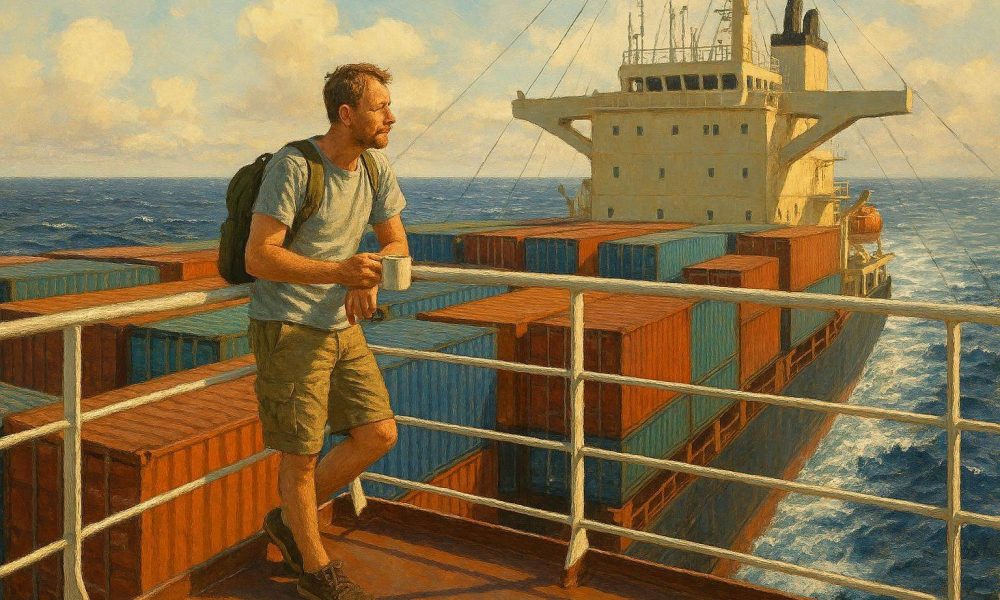
The slow, unplugged, and highly autonomous routine of living in a working maritime environment reveals a travel experience shaped by shared meals, practical comfort, quiet decks, and self-directed time.
WASHINGTON, DC, June 3, 2026, A day aboard a cargo ship begins without hotel bustle, airport announcements, or cruise-ship programming, because the passenger wakes inside a working maritime environment where the sea, the crew, and the cargo set the rhythm.
Morning begins with the sound of the vessel already working.
A cargo ship passenger does not wake to a resort itinerary, but to the steady vibration of engines, the soft movement of water, and the awareness that the ship has continued its work through the night.
The cabin becomes the passenger’s private base, usually practical rather than ornate, with enough room to sleep, read, write, organize documents, and prepare for another day shaped by routine instead of urgency.
There is something quietly grounding about beginning the morning in a vessel that does not exist to entertain, because the passenger is reminded immediately that this journey belongs to trade, weather, and navigation.
A thoughtful discussion of freighter travel, privacy, and slow mobility explains why this quieter form of movement appeals to travelers seeking lawful discretion, reduced public exposure, and a more deliberate relationship with distance.
The day begins slowly because the ship does not ask the passenger to rush, and that absence of immediate pressure may be one of the voyage’s most unexpected luxuries.
Breakfast creates the first social rhythm of the day.
Meals are often the main structure aboard a freighter, because breakfast, lunch, and dinner give shape to long sea days that might otherwise stretch without clear markers.
A passenger entering the mess room may share space with officers, crew members, or a small number of fellow travelers, creating a social atmosphere that feels informal, practical, and grounded in routine.
The food is usually simple and functional rather than theatrical, but the meal matters because it places the passenger inside the living rhythm of a working ship rather than outside it as a passive observer.
Conversation may turn toward weather, port timing, cargo operations, previous routes, or the small details of maritime life, although passengers should always remember that crew members are working professionals before they are social companions.
The shared table becomes one of the voyage’s quiet institutions, offering enough human contact to prevent isolation while preserving the privacy and personal space that many passengers came aboard to find.
The ship’s routine teaches passengers to become self-directed.
After breakfast, the passenger quickly learns that freighter travel requires autonomy because there are no entertainment directors, excursion desks, daily activity sheets, or staff members assigned to fill every empty hour.
This absence can feel strange at first for travelers trained by modern tourism to expect guidance, scheduling, and constant stimulation, but it can become liberating once the passenger accepts responsibility for the day.
Reading, writing, walking, stretching, journaling, studying a language, reviewing personal plans, or simply watching the horizon becomes the passenger’s own chosen itinerary.
A recent news account of cargo travel’s limited revival described how rare and specialized this form of travel has become, and that scarcity helps explain why passengers who do secure a berth often value quiet over convenience.
The freighter passenger must learn to make meaning without constant programming, which is why the voyage often feels less like a vacation and more like a private retreat inside global movement.
Deck time becomes the passenger’s window into the world.
A permitted deck walk can become the most important part of the morning, as the passenger steps out of the cabin and directly encounters the scale of the sea.
The horizon changes slowly, clouds move across open water, the ship’s wake marks steady progress, and distant vessels appear like reminders that the ocean is not empty but quietly inhabited by trade.
Unlike a cruise promenade, the deck exists inside a working vessel, which means passengers must respect safety boundaries, restricted zones, and crew instructions before treating any outdoor space as their own.
That discipline does not reduce the pleasure of deck time, because the awareness of being aboard a real working ship makes every permitted view feel more authentic.
The deck is where the passenger understands that the voyage is not a simulation of maritime life, but a temporary place inside the actual machinery that connects ports, goods, and people.
Onboard facilities vary, but modest comforts can matter greatly.
Some cargo vessels may offer lounges, libraries, gyms, saunas, small pools, or recreational spaces, while other ships may provide only basic shared areas and limited passenger amenities.
Because facilities differ by vessel, route, and operator, passengers should confirm available features before booking rather than assuming that one traveler’s experience represents every freighter voyage.
A small gym can be important during long sea days because passengers may need more than deck walks to maintain energy, mood, and physical comfort.
A lounge can become a quiet reading room, a sauna can become a restorative ritual when available, and even a simple chair near a window can feel unusually valuable at sea.
The comfort is not lavish, but it is meaningful because the passenger has fewer distractions and therefore notices simple amenities with more gratitude than ordinary travel often allows.
The middle of the day belongs to slow attention.
By midday, the passenger often begins to feel the ship’s deeper rhythm, where time is measured by meals, light, weather, engine sound, and the subtle changes of sea conditions.
This is when freighter travel can become psychologically powerful, because the traveler has fewer interruptions and begins to recover the ability to concentrate for longer periods.
A book that felt difficult to finish on land may become immersive, a notebook may fill more easily, and a personal project may finally receive uninterrupted attention.
The ship does not make the passenger productive by force, but it removes many of the conditions that prevent sustained attention, especially constant messaging, public movement, and decision fatigue.
For people taking sabbaticals, recovering from burnout, or planning a major life transition, the middle hours of a sea day can become the hidden treasure of the voyage.
Lunch brings another small return to the community.
The second shared meal of the day often feels different from breakfast because the passenger has already settled into the ship’s rhythm and may arrive with observations, questions, or quiet familiarity.
Crew members may speak briefly about weather, operations, or port expectations, while fellow passengers may compare reading plans, deck walks, or the strange calm that follows several hours without digital interruption.
The meal remains practical, but its repetition creates a small social fabric that would be difficult to reproduce in faster forms of travel.
The passenger begins to understand that community aboard a freighter is not built through entertainment, but through repeated ordinary encounters that grow comfortable precisely because they are unforced.
This gentle social rhythm helps the voyage feel balanced, giving privacy-minded travelers human contact without the exhausting pressure of crowded tourism or constant conversation.
The afternoon can become a personal retreat.
After lunch, many passengers return to their cabins, lounges, or permitted deck spaces for the longest quiet block of the day, when the ship’s motion and limited connectivity create a natural retreat.
A traveler may write, nap, organize photographs, review documents, work offline, meditate, stretch, or simply sit with the horizon until the mind stops demanding novelty.
This is where the autonomy of freighter travel is most visible: the ship gives the passenger time, but the passenger must decide how to use it.
The best approach is usually gentle rather than ambitious, because a cargo voyage can support meaningful work without becoming another productivity contest disguised as recovery.
A passenger who allows room for rest, boredom, and reflection may discover that the voyage’s deepest value lies in the hours that appear uneventful from the outside.
Bridge visits and crew interaction require humility.
If a bridge visit is permitted, the passenger may see charts, navigation systems, weather monitoring, and the calm concentration of officers responsible for moving a massive vessel through open water.
This experience can be unforgettable because it turns the ship from a place of personal retreat into a professional command environment where judgment, training, and discipline protect everyone aboard.
Passengers should treat such access as a privilege, not an entitlement, and should avoid interrupting watchkeeping, photographing restricted equipment, or asking questions when crew attention is needed elsewhere.
The same principle applies to every interaction with crew, because kindness aboard a freighter should never be mistaken for a duty to entertain passengers.
The most welcome guests are usually those who are curious but restrained, friendly but respectful, and aware that the voyage depends on other people’s work.
Safety rules shape freedom rather than limiting it.
A cargo vessel includes ladders, working decks, machinery, mooring equipment, cargo zones, and restricted areas, all of which require passengers to understand safety procedures from the outset.
The U.S. State Department’s maritime safety guidance reminds travelers that international sea travel requires preparation, especially when routes involve remote waters, industrial ports, or changing security conditions.
Passengers should attend safety briefings carefully, learn muster procedures, follow crew instructions, and understand that restricted spaces are not negotiable, even if the ship feels quiet.
This discipline protects personal freedom because a passenger who behaves responsibly is less likely to create concern, require supervision or disrupt the crew’s working rhythm.
Safety awareness also supports privacy because the traveler who follows rules calmly draws less attention than the traveler who treats boundaries as obstacles to curiosity.
Dinner often feels like the day’s social anchor.
By evening, the mess room can feel almost familiar, especially after several days when faces, seats, meal times, and small habits have become part of the passenger’s routine.
The conversation may be sparse or lively depending on the crew’s workload, the passengers’ personalities, and the day’s conditions, but the meal still offers a sense of connection after long personal hours.
This balance of solitude and sociability is central to freighter travel because passengers can spend much of the day alone without feeling entirely cut off from human presence.
Dinner also reminds the traveler that the ship is a community, even if that community is temporary, disciplined, and built around work rather than leisure.
For some passengers, these modest shared meals become more memorable than formal dining experiences because they feel honest, limited, and deeply connected to the voyage itself.
Evening brings the strongest sense of being away.
After dinner, the ship often feels quieter, the light softens, the sea darkens, and the passenger may return to the deck or cabin with a heightened awareness of distance.
This is when the voyage can feel most separate from ordinary life because there are no city lights, no restaurant decisions, no commuting noise, and no pressure to prove the day was productive.
A passenger may read, journal, listen to downloaded music, watch the horizon, or prepare for sleep while the vessel continues moving through darkness toward the next port.
For privacy-minded travelers, this evening quiet can feel especially powerful because the world has narrowed to a lawful, contained, and low-profile passage through open water.
For those seeking broader discretion after travel, anonymous living planning can support compliant privacy strategies that continue beyond the voyage without confusing quiet movement with evasion.
Entertainment is made, not provided.
The freighter passenger learns quickly that entertainment must be self-directed, which means books, notebooks, offline films, music, language lessons, sketching, photography, exercise, and conversation become essential tools.
This can be difficult for travelers who rely on constant external stimulation, but it can be rewarding for people who want to recover attention, creativity, and the ability to be alone without discomfort.
The ship’s limited programming is not a failure because the absence of entertainment allows the passenger to rediscover slower forms of leisure that require participation rather than consumption.
A traveler who arrives prepared with offline materials will usually enjoy the voyage more than someone who assumes internet access or shipboard amusement will fill every empty hour.
The reward is a day that feels personally authored because the passenger chooses what matters rather than being carried along by a schedule designed by someone else.
Night at sea closes the day without spectacle.
A cargo ship night is usually simple, with the engine vibration, ship movement, and darkness giving the passenger a sense that the vessel’s work continues even while personal activity fades.
The cabin becomes private again, the day’s notes may be reviewed, the next port may be considered, and the passenger may sleep with the strange comfort of knowing the ship remains in motion.
This is one of the quietest pleasures of freighter travel, because progress happens without the passenger needing to manage, monitor, or accelerate it.
The ship continues through the night because crew members maintain watches, systems operate, and navigation proceeds according to professional routines that the passenger only partially sees.
That realization can be humbling, because the passenger’s peaceful day has been made possible by a working world that never fully stops.
The bottom line is that a cargo ship passenger lives slowly, privately, and independently.
A day in the life of a cargo ship passenger is built from practical cabins, shared meals, deck walks, limited facilities, self-made entertainment, and long stretches of autonomous time inside a working maritime environment.
The routine may feel sparse to travelers expecting cruise-style programming, but it can feel deeply restorative to people seeking privacy, concentration, slow movement, and fewer interruptions.
Passengers must respect crew duties, safety rules, restricted spaces, and the reality that cargo always comes before personal preference aboard a freighter.
The experience rewards those who can balance solitude with ordinary courtesy, personal projects with rest, and curiosity with restraint inside a small shipboard community.
For the public record, life on the high seas is not glamorous in the usual travel sense, but for the right passenger, it can be richer than spectacle, because every ordinary hour carries the rare luxury of time.




