
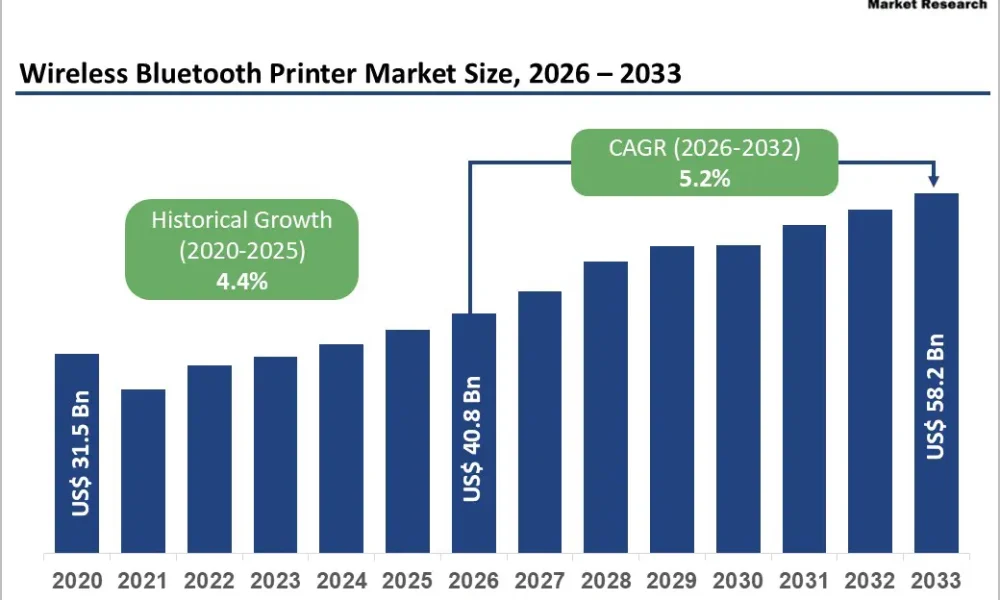
The global wireless Bluetooth printer market is undergoing a steady transformation as businesses and consumers increasingly shift toward mobile, flexible, and digitally integrated printing solutions. Valued at US$ 40.8 billion in 2026, the market is projected to reach US$ 58.2 billion by 2033, expanding at a CAGR of 5.2% during the forecast period.
This growth trajectory reflects the evolving nature of modern work environments, the rapid expansion of e-commerce and logistics, and technological advancements in wireless connectivity. As organizations embrace hybrid work models and mobile-first operations, wireless Bluetooth printers are emerging as indispensable tools for seamless, on-demand printing.
Market Overview
Wireless Bluetooth printers enable users to print documents directly from smartphones, tablets, and laptops without requiring physical connections or complex network setups. Their portability, ease of use, and compatibility with multiple devices make them ideal for both professional and personal use.
From printing shipping labels in warehouses to generating invoices on delivery routes, these printers are redefining efficiency across industries. Additionally, the rise of compact home offices and remote work setups has significantly increased the demand for cordless and user-friendly printing devices.
Key highlights shaping the market include:
- North America leading with ~32% market share
- Asia-Pacific as the fastest-growing region with 8.9% CAGR
- Thermal printers dominating with ~45% revenue share
- E-commerce channels emerging as the fastest-growing sales segment
Key Market Drivers
Rise of Remote and Hybrid Work Models
The global shift toward remote and hybrid work has significantly influenced printing needs. Employees working from home or co-working spaces require compact and wireless devices that can seamlessly connect across multiple platforms.
Wireless Bluetooth printers eliminate the need for wired infrastructure, making them highly suitable for flexible work environments. These devices allow professionals to print documents from anywhere, improving productivity without compromising convenience.
Organizations are also investing in decentralized printing infrastructure to support distributed teams. This trend ensures that employees have access to reliable printing solutions regardless of location.
Expansion of E-Commerce and Logistics
The explosive growth of e-commerce has created a strong demand for mobile printing solutions, particularly in logistics and supply chain operations.
Wireless Bluetooth printers play a critical role in:
- Printing shipping labels and barcodes
- Generating invoices and receipts
- Producing proof-of-delivery documents
Warehouse workers and delivery personnel rely on portable Bluetooth printers to print documents instantly at the point of operation. This reduces errors, enhances efficiency, and speeds up order fulfillment processes.
With the increasing adoption of same-day and next-day delivery services, the need for real-time printing capabilities continues to grow.
Advancements in Wireless Connectivity
Technological advancements in Bluetooth and wireless communication have significantly improved printer performance. Modern Bluetooth printers offer:
- Faster data transfer speeds
- Improved connectivity stability
- Enhanced battery efficiency
These innovations make wireless printers more reliable and suitable for high-demand environments such as retail stores, hospitals, and logistics hubs.
Elevate your business strategy with comprehensive market data. Request a sample report now: https://www.persistencemarketresearch.com/samples/19150
Market Restraints
High Initial Costs
Despite their benefits, wireless Bluetooth printers often come with higher upfront costs compared to traditional wired printers. For small businesses and budget-conscious consumers, this can be a barrier to adoption.
Additionally, the total cost of ownership may increase due to:
- Mobile app integrations
- Cloud service subscriptions
- Maintenance and support requirements
Compatibility Challenges
Ensuring seamless compatibility across various devices and operating systems remains a challenge. Users may encounter issues related to:
- Driver installation
- Device pairing
- Connectivity disruptions
Such challenges can hinder adoption, especially among non-technical users or organizations with legacy systems.
Data Security Concerns
Wireless connectivity introduces potential security risks, particularly when handling sensitive data. Bluetooth-enabled devices may be vulnerable to:
- Unauthorized access
- Data interception
- Network breaches
To mitigate these risks, organizations must invest in secure printing solutions, encryption technologies, and compliance frameworks, which can increase operational complexity.
Emerging Opportunities
Integration of AI and Cloud-Based Print Management
One of the most promising opportunities in the market is the integration of artificial intelligence (AI) and cloud-based platforms into printing ecosystems.
AI-powered print management systems can:
- Optimize print queues
- Enable predictive maintenance
- Provide cost analytics
- Improve device utilization
Cloud-based solutions further enhance functionality by allowing remote access, centralized control, and seamless integration with enterprise systems such as inventory management and logistics platforms.
Growth in Emerging Markets
Developing economies, particularly in Asia-Pacific, Latin America, and Southeast Asia, present significant growth opportunities.
Factors driving adoption include:
- Rapid urbanization
- Expansion of digital commerce
- Growth of small and medium enterprises (SMEs)
- Increasing internet and smartphone penetration
Countries like China and India are witnessing strong demand for affordable and portable printing solutions, especially in retail, logistics, and education sectors.
Category-Wise Insights
Printer Type Analysis
Thermal printers dominate the market, accounting for approximately 45% of total revenue. Their popularity is driven by:
- Low operational costs (no ink or toner required)
- High-speed printing capabilities
- Reliability in demanding environments
These printers are widely used in logistics, healthcare, and retail sectors where efficiency and cost savings are critical.
Connectivity Type Analysis
Bluetooth-only printers hold around 52% market share, primarily due to their simplicity and universal compatibility with mobile devices.
Advantages include:
- Easy pairing with smartphones and tablets
- No need for internet connectivity
- Energy-efficient operation
This makes them ideal for field operations and mobile professionals.
Sales Channel Analysis
E-commerce platforms dominate distribution, contributing nearly 45% of market revenue. Online channels offer:
- Competitive pricing
- Product comparisons
- Customer reviews
- Convenient delivery
The increasing preference for online shopping is expected to further boost sales through digital channels.
Regional Insights
North America
North America leads the global market with a 32% share, driven by:
- Advanced technological infrastructure
- High adoption of hybrid work models
- Strong presence of leading printer manufacturers
The United States, in particular, shows strong demand for home office printing solutions and enterprise-grade wireless printers.
Europe
Europe accounts for approximately 26% of the market, with growth supported by:
- Digital transformation initiatives
- Sustainability regulations
- Demand for energy-efficient printing solutions
Countries like Germany, the UK, and France are investing in smart office technologies, including wireless printing systems.
Asia-Pacific
Asia-Pacific is the fastest-growing region, expanding at a CAGR of 8.9%. Growth is fueled by:
- Rapid e-commerce expansion
- Increasing urbanization
- Rising adoption of digital technologies
China and India are key contributors, with growing demand from SMEs and logistics providers.
Competitive Landscape
The wireless Bluetooth printer market is moderately consolidated, with several global players competing through innovation and strategic expansion.
Leading companies include:
- HP Development Company
- Canon Inc.
- Seiko Epson Corporation
- Brother Industries Ltd.
- Zebra Technologies Corporation
- Honeywell International Inc.
- Ricoh Company Ltd.
- Toshiba Corporation
- Lexmark International, Inc.
These companies focus on:
- Enhancing wireless connectivity
- Integrating cloud and AI capabilities
- Expanding product portfolios
- Strengthening distribution networks
Strategic partnerships, acquisitions, and product innovations are key strategies used to maintain competitive advantage.
Recent Developments
- Logistics firms using Bluetooth thermal printers have reported improved efficiency, including reduced delivery delays and higher accuracy rates.
- Major manufacturers have launched new printer models with enhanced wireless features and productivity tools.
- Companies are increasingly targeting emerging markets with affordable and localized solutions.
Future Outlook
The future of the wireless Bluetooth printer market looks promising, driven by continuous innovation and expanding use cases. Key trends expected to shape the market include:
- Increased adoption of AI-powered printing solutions
- Growth of cloud-based print ecosystems
- Expansion of mobile-first workflows
- Rising demand for sustainable and energy-efficient printers
As businesses continue to digitize operations and prioritize mobility, wireless Bluetooth printers will play a crucial role in enabling seamless and efficient workflows.
Conclusion
The global wireless Bluetooth printer market is poised for steady growth, supported by evolving workplace dynamics, rapid e-commerce expansion, and technological advancements. While challenges such as high costs and security concerns persist, emerging opportunities in AI integration and developing markets offer significant potential for innovation and expansion.
By 2033, wireless Bluetooth printers will not only serve as essential office tools but also as integral components of connected, intelligent, and mobile-driven ecosystems.
Related Reports:




