
The digital economy is reshaping how organizations engage with customers, employees, and partners. At the center of this transformation lies the Digital Experience Platform (DXP), a unified solution that enables businesses to deliver seamless, personalized, and consistent digital interactions across multiple channels. As enterprises increasingly prioritize customer-centric strategies, DXPs are emerging as essential tools for driving engagement, loyalty, and revenue growth.
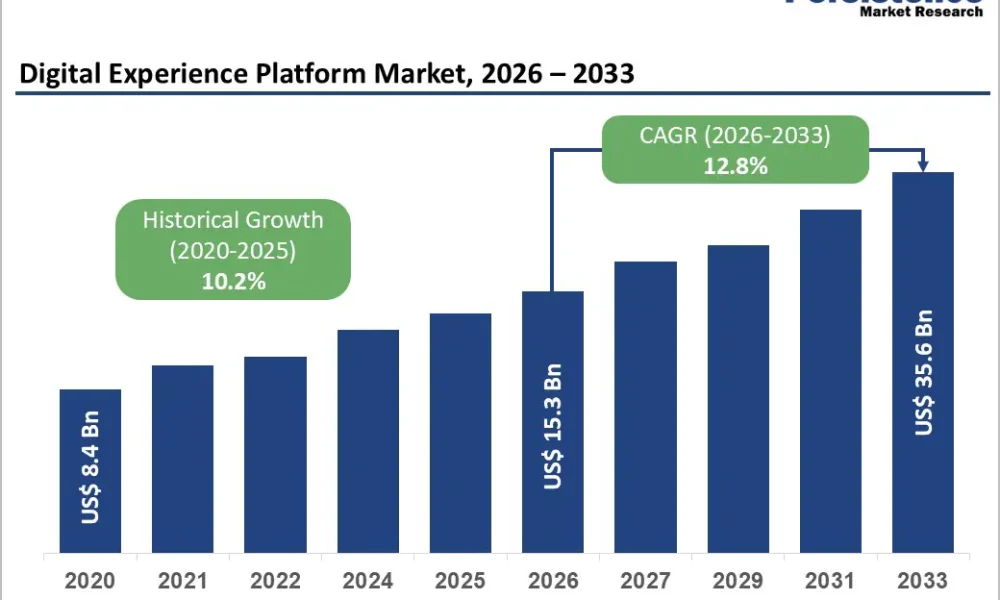
The global Digital Experience Platform market is projected to grow significantly, expanding from US$15.3 billion in 2026 to US$35.6 billion by 2033, at a compound annual growth rate (CAGR) of 12.8%. This growth is fueled by the widespread adoption of cloud computing, rising demand for omnichannel engagement, and the integration of artificial intelligence (AI) for real-time personalization.
Understanding Digital Experience Platforms (DXPs)
A Digital Experience Platform is an integrated suite of technologies designed to manage, deliver, and optimize digital experiences across various touchpoints such as websites, mobile apps, social media, and connected devices. Unlike traditional content management systems (CMS), DXPs provide advanced capabilities including:
- Customer data integration
- AI-driven personalization
- Omnichannel content delivery
- Analytics and insights
- Workflow automation
These platforms help organizations create consistent and engaging customer journeys, ultimately improving satisfaction and retention.
Market Growth Drivers
- Rise of AI and Hyper-Personalization
One of the most significant drivers of the DXP market is the integration of AI and machine learning technologies. Businesses are leveraging AI to analyze customer behavior, predict preferences, and deliver personalized experiences in real time.
By 2025, a majority of customer service organizations are expected to adopt generative AI to enhance customer interactions and improve operational efficiency. AI-powered DXPs enable:
- Real-time content recommendations
- Predictive analytics
- Sentiment analysis
- Automated customer engagement
Companies that prioritize AI-driven personalization are more likely to achieve higher returns on investment, making it a critical component of modern DXP strategies.
- Increasing Demand for Omnichannel Experiences
Today’s customers interact with brands across multiple channels before making purchasing decisions. From mobile apps and websites to social media and physical stores, the need for a consistent experience is more important than ever.
DXPs address this challenge by centralizing customer data and ensuring seamless integration across all touchpoints. This enables businesses to:
- Deliver consistent messaging
- Track customer journeys across channels
- Provide unified customer profiles
- Improve engagement and conversion rates
As customer expectations continue to evolve, omnichannel capabilities will remain a key growth driver for the DXP market.
- Regulatory Compliance and Data Governance
With increasing concerns around data privacy, regulations such as GDPR, CCPA, and HIPAA have made compliance a top priority for organizations. DXPs offer built-in tools for:
- Consent management
- Data security and encryption
- Audit trails and reporting
- Data governance
These features help businesses maintain compliance while delivering personalized experiences, making DXPs particularly valuable in highly regulated industries such as banking and healthcare.
Elevate your business strategy with comprehensive market data. Request a sample report now: https://www.persistencemarketresearch.com/samples/32606
Market Restraints
- Integration Challenges with Legacy Systems
One of the primary challenges in adopting DXPs is integrating them with existing legacy systems. Many organizations operate on outdated infrastructure that lacks modern APIs, making integration complex and time-consuming.
This often results in:
- Increased implementation costs
- Longer deployment timelines
- Dependency on third-party consultants
While modern architectures like MACH (Microservices, API-first, Cloud-native, Headless) offer solutions, they require specialized expertise that many organizations lack.
- Uncertain ROI and High Total Cost of Ownership
Measuring the return on investment for DXPs can be challenging. While benefits such as improved customer satisfaction and engagement are evident, quantifying them in financial terms is not always straightforward.
Additionally, hidden costs related to:
- Customization
- Integration
- Training
- Maintenance
can significantly increase the total cost of ownership, making decision-makers cautious about large-scale investments.
Emerging Opportunities
- Composable Architecture and Low-Code Platforms
The shift toward composable DXPs is creating new opportunities for both vendors and enterprises. Composable architectures allow organizations to select and integrate best-of-breed components rather than relying on monolithic systems.
Benefits include:
- Faster time-to-market
- Greater flexibility
- Reduced implementation complexity
- Lower costs
Low-code and no-code platforms further enhance accessibility by enabling non-technical users to design and manage digital experiences.
- Growth in Healthcare Digital Transformation
Healthcare is emerging as a high-growth sector for DXPs. Patients now expect digital experiences similar to those offered by retail and eCommerce platforms.
DXPs enable healthcare providers to:
- Offer online appointment scheduling
- Integrate patient records
- Enable telehealth services
- Provide personalized communication
With increasing adoption of digital health technologies and stringent regulatory requirements, DXPs are becoming indispensable in delivering patient-centric care.
Category-wise Market Insights
Solution Segment
The platform segment dominates the market, accounting for over 66% share in 2026. Organizations prefer integrated solutions that provide end-to-end capabilities, including content management, analytics, and personalization.
Meanwhile, the services segment is the fastest-growing, driven by the need for:
- Implementation support
- Customization
- Integration services
- Ongoing maintenance
Deployment Segment
On-premises deployments hold a significant share, particularly among large enterprises that prioritize data security and regulatory compliance. These organizations often rely on legacy systems that require tight integration.
However, cloud-based DXPs are witnessing the fastest growth due to:
- Scalability
- Cost efficiency
- Remote accessibility
- Continuous updates
As businesses embrace digital transformation, cloud adoption is expected to accelerate further.
Application Segment
Customer experience management leads the market, accounting for over 25% share. Organizations are focusing on improving customer journeys through:
- Personalized interactions
- Real-time engagement
- Omnichannel consistency
Customer data and personalization applications are also growing rapidly, driven by the need for tailored experiences.
Industry Segment
Retail and eCommerce dominate the DXP market, as these sectors rely heavily on personalized and seamless customer interactions to drive sales and loyalty.
Key use cases include:
- Product recommendations
- Dynamic content delivery
- Targeted marketing campaigns
Healthcare, on the other hand, is the fastest-growing industry, driven by the need for digital patient engagement and integrated healthcare services.
Regional Analysis
North America
North America leads the global DXP market, accounting for over 35% share in 2026. The region benefits from:
- Advanced IT infrastructure
- High cloud adoption
- Early adoption of AI technologies
Organizations in the region prioritize customer experience as a key competitive differentiator, driving strong demand for DXPs.
Asia Pacific
Asia Pacific is the fastest-growing region, with a CAGR of 18.6% through 2033. Growth is driven by:
- Rapid digitalization
- Expanding eCommerce sector
- Increasing internet penetration
- Government-led digital initiatives
Countries like India and China are witnessing significant adoption of cloud-native and headless DXP solutions.
Europe
Europe is expected to hold over 24% market share by 2033. The region’s growth is supported by:
- Strong regulatory frameworks
- High digital adoption
- Investments in digital infrastructure
The emphasis on privacy and data protection is encouraging the adoption of secure and compliant DXP solutions.
Competitive Landscape
The DXP market is moderately fragmented, with a mix of global technology giants and niche players competing for market share. Companies differentiate themselves through:
- AI-driven capabilities
- Integrated solutions
- Strong partner ecosystems
- Continuous innovation
Strategic collaborations, acquisitions, and product innovations are common strategies used to strengthen market position.
Recent Industry Developments
Recent advancements highlight the growing importance of AI in DXPs:
- Vendors are introducing agentic AI capabilities to automate content creation and optimize customer experiences.
- Platforms are incorporating AI copilots and workflows to enhance scalability and personalization.
- Innovations in customer data platforms and analytics are enabling deeper insights into customer behavior.
These developments are transforming DXPs into intelligent systems capable of delivering highly contextual and dynamic experiences.
Future Outlook
The future of the Digital Experience Platform market looks highly promising, driven by continuous technological advancements and evolving customer expectations. Key trends that will shape the market include:
- Increased adoption of generative AI
- Expansion of composable architectures
- Growing importance of first-party data
- Integration of immersive technologies such as AR/VR
- Enhanced focus on privacy and security
As businesses continue to prioritize digital transformation, DXPs will play a crucial role in enabling seamless and personalized experiences.
Conclusion
The Digital Experience Platform market is on a strong growth trajectory, fueled by the convergence of AI, cloud computing, and customer-centric strategies. With the market expected to reach US$35.6 billion by 2033, organizations across industries are recognizing the value of investing in DXPs to stay competitive in the digital age.
Despite challenges such as integration complexity and ROI uncertainty, the benefits of improved customer engagement, operational efficiency, and scalability far outweigh the drawbacks. As technology continues to evolve, DXPs will remain a cornerstone of digital transformation, empowering businesses to deliver exceptional experiences in an increasingly connected world.
Related Reports:




