
The global peripheral vascular devices market is poised for substantial growth, with an estimated market value of US$12.6 billion in 2026, projected to reach US$17.5 billion by 2033, registering a CAGR of 4.8% during the forecast period 2026–2033. The expansion of the market is primarily driven by increased focus on the prevention and treatment of peripheral arterial disease (PAD) in low- and middle-income economies. Rising prevalence of PAD, coupled with the growing adoption of interventional cardiology procedures, has fueled demand for peripheral vascular devices. Patients with chronic cardiovascular conditions often undergo angioplasty as a primary intervention method. According to the Centers for Disease Control and Prevention, approximately 8.5 million Americans, including 12% to 20% of individuals over 60, are affected by PAD. Factors such as aging populations, the prevalence of cardiovascular and peripheral vascular diseases, and rising healthcare expenditure in developing regions are expected to further drive market growth.
Download Your Free Sample & Explore Key Insights: https://www.persistencemarketresearch.com/samples/33159
Key Industry Highlights
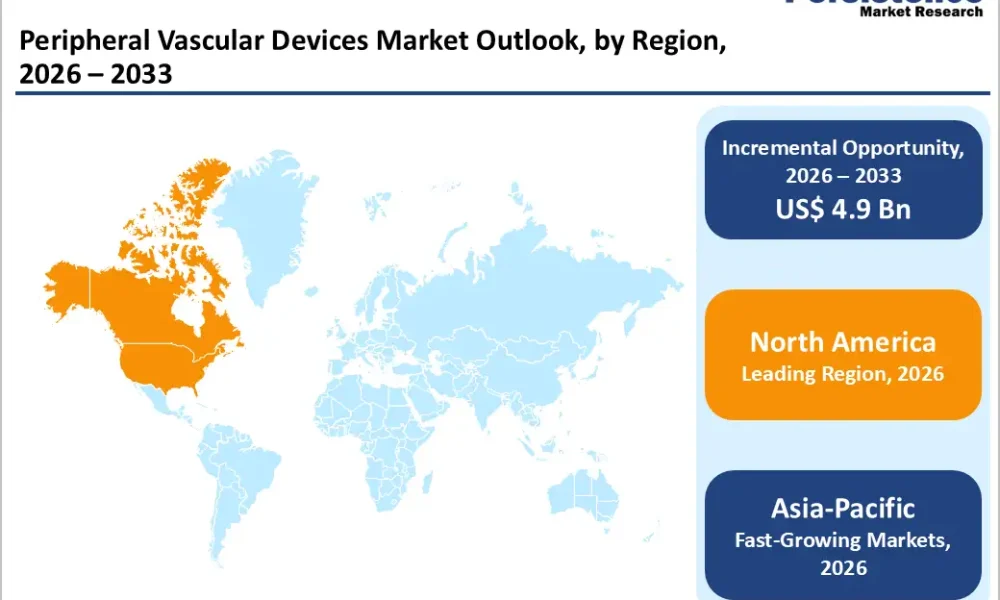
Peripheral vascular stents dominate the product category, holding roughly 30% of the global market share, supported by the increasing burden of cardiovascular diseases, preference for minimally invasive treatments, and ongoing technological advancements. Endovascular aneurysm repair (EVAR) stent grafts represent the fastest-growing segment due to benefits such as reduced hospital stays, faster recovery, improved long-term durability, and lower restenosis rates. Geographically, North America leads the global market with over 30% of total share, driven by advanced healthcare infrastructure, technological innovation, and rising prevalence of cardiovascular conditions. Asia Pacific emerges as the fastest-growing region, expanding at a 5.5% CAGR through 2033, fueled by robust government initiatives, expanding healthcare infrastructure, and growing awareness of minimally invasive interventions. Smart vascular devices integrating AI-driven imaging, remote monitoring, and connected platforms present significant growth opportunities by enabling real-time outcome tracking, personalized treatments, and improved long-term patient care.
Market Dynamics
Drivers
The increasing prevalence of vascular diseases and growing preference for minimally invasive procedures are primary drivers of market growth. Conditions such as PAD are becoming more common due to aging populations, sedentary lifestyles, diabetes, and hypertension. Globally, PAD affected approximately 200 million people in 2021, making it one of the most prevalent cardiovascular diseases. PAD contributed to an estimated 74,000 deaths worldwide in the same year, highlighting its role as a significant contributor to cardiovascular mortality. Despite being underdiagnosed, PAD complications such as critical limb ischemia, stroke, and myocardial infarction drive demand for advanced therapeutic solutions, including stents, angioplasty balloons, catheters, and vascular grafts.
Minimally invasive procedures have transformed the treatment of vascular diseases. Unlike traditional open surgeries requiring large incisions and extended recovery periods, these procedures employ catheters, guidewires, stents, and balloons inserted through small access points, reducing trauma, shortening hospital stays, and minimizing complications. Image-guided technologies such as intravascular ultrasound (IVUS) and optical coherence tomography (OCT) allow real-time vessel visualization, enabling precise device deployment, reducing restenosis, and improving long-term outcomes. Technological innovations like drug-eluting stents and bioresorbable scaffolds further enhance minimally invasive treatment adoption.
Advances in Imaging and Navigation Technologies
Technological progress has significantly improved treatment outcomes for PAD and other vascular diseases. Drug-eluting stents and balloons, which deliver medication at the site of arterial blockages, help reduce restenosis and maintain long-term vessel patency. Bioresorbable scaffolds provide temporary vessel support before dissolving, minimizing long-term complications. Advanced imaging and navigation technologies such as IVUS and OCT enable precise interventions, reducing complications and improving patient outcomes. Catheter-based systems have also become more sophisticated, allowing minimally invasive procedures that lower hospital stays, recovery time, and healthcare costs. Integration of AI and machine learning into these platforms offers predictive analytics and decision support, enhancing clinical efficiency and driving market adoption.
Restraints
Despite growth prospects, the peripheral vascular devices market faces challenges, including the increasing risk of product recalls. Device malfunctions, safety issues, and regulatory non-compliance can significantly affect patient safety and company reputation. Complex devices such as stents, catheters, balloons, and grafts used in critical interventions require strict quality adherence. Even minor defects can cause restenosis, thrombosis, or device failure. Regulatory authorities such as the FDA and EMA mandate rigorous testing and post-market surveillance, with deviations from quality standards triggering recalls. Advanced technologies like drug-eluting stents and bioresorbable scaffolds also introduce risks related to durability, drug delivery, and long-term performance.
Opportunities
Technological innovations present significant opportunities for the peripheral vascular devices market. Breakthroughs like drug-eluting stents, bioresorbable scaffolds, drug-coated balloons, and advanced imaging systems enhance patient outcomes by reducing restenosis, improving durability, and enabling precise interventions. Endovascular procedures, using stents, grafts, and catheters, are increasingly preferred over open surgeries due to shorter recovery times, reduced complications, and lower healthcare costs. Digital integration is revolutionizing peripheral vascular care, allowing AI-powered imaging, advanced sensors, and connected platforms to provide continuous patient data. AI tools can analyze intravascular images in real time, enabling rapid, accurate clinical decisions. Remote monitoring helps identify complications early, supporting personalized treatment plans. Over time, predictive analytics shifts care toward proactive prevention, improving outcomes and reducing readmissions and costs.
Get Custom Insights Designed for Your Businecss: https://www.persistencemarketresearch.com/request-customization/33159
Category-wise Analysis
Product Type Insights
Peripheral vascular stents account for approximately 30% of the global market. They remain the cornerstone of peripheral vascular procedures due to their ability to maintain consistent, durable results. Unlike balloon angioplasty alone, which may result in vessel recoil or restenosis, stents act as mechanical scaffolds to keep arteries open, ensuring sustained blood flow. Continuous advancements in design, materials, and drug-eluting technology have reduced restenosis rates and improved long-term outcomes. Challenges such as in-stent thrombosis and high device costs, however, may limit widespread adoption, particularly in emerging markets.
Application Insights
Peripheral artery disease continues to dominate the market, representing approximately 50% of the global share. Estimates suggest 7 to 12 million individuals in the U.S. and 200 million worldwide are affected by PAD. Increasing prevalence of diabetes, obesity, and smoking has expanded the patient pool requiring vascular interventions. Minimally invasive procedures, including stent placement, balloon angioplasty, and atherectomy, are preferred in hospitals and ambulatory surgical centers due to faster recovery times and fewer complications. Advancements in device technology, such as drug-eluting stents and improved balloon catheters, further reinforce PAD treatment as the primary application, ensuring sustained market growth globally.
Regional Insights
North America
The United States dominates the North American peripheral vascular devices market, accounting for over 70% of the regional value. Advanced healthcare infrastructure, established reimbursement frameworks, and high adoption of medical technologies drive market growth. Hospitals and ambulatory surgical centers with skilled interventional radiologists and vascular surgeons ensure widespread device usage. An aging population, coupled with rising prevalence of diabetes, hypertension, obesity, and smoking, increases the incidence of peripheral vascular diseases, fueling demand for minimally invasive interventions.
Europe
Europe exhibits steady growth in the peripheral vascular devices market, projected at a CAGR of 5.1% through 2033. Aging populations, rising cardiovascular risks, technological advances, and supportive healthcare systems contribute to growth. Strong regulatory frameworks, including EMA oversight, encourage clinical adoption. Screening programs and awareness campaigns for aneurysms and venous disorders support early diagnosis, expanding the patient pool. Countries such as the U.K., Germany, and France rely heavily on stents, balloon catheters, and endovascular grafts for arterial diseases, while venous interventions are increasingly supported by stents and ablation technologies.
Asia Pacific
Asia Pacific is the fastest-growing region, driven by innovations such as drug-eluting stents, bioresorbable scaffolds, and next-generation angioplasty balloons that improve vessel patency and reduce restenosis. Advanced imaging technologies like 4D intravascular ultrasound enhance procedural accuracy. Digital integration and smart connectivity improve device performance and monitoring. In countries including India, China, Japan, and Australia, aging populations and rising cardiovascular risk factors have increased the burden of PAD and venous disorders. Stents, balloon catheters, venous stents, and ablation systems are widely used, supported by growing healthcare infrastructure.
Checkout Now & Download Complete Market Report: https://www.persistencemarketresearch.com/checkout/33159
Competitive Landscape
The peripheral vascular devices market is highly competitive, dominated by global companies while smaller regional firms strive to differentiate themselves. Market leaders such as Medtronic, Boston Scientific, Abbott, and Cook Medical maintain significant shares through extensive product lines, robust distribution networks, and clinical credibility. Companies compete across stents, balloon catheters, embolic protection devices, and atherectomy systems, leveraging scale to sustain pricing and market dominance. Emerging companies such as Penumbra and Cardinal Health focus on thrombectomy and embolism management, offering advanced aspiration-based systems and leveraging distribution networks to expand access. AI integration and robotic-assisted interventions are providing a competitive edge for precision procedures.
Key Market Developments
In September 2025, Imperative Care received FDA 510(k) clearance for its Symphony thrombectomy system for pulmonary embolism treatment. In December 2024, Terumo Interventional Systems expanded its radial-to-peripheral (R2P) portfolio with the R2P NaviCross peripheral support catheter in the U.S. In October 2024, Becton, Dickinson and Company launched the BD® Intraosseous Vascular Access System, enabling rapid fluid or medication delivery in critical emergencies. In April 2024, Penumbra received FDA clearance for Lightning Flash 2, a next-generation computer-assisted vacuum thrombectomy system for venous thrombus and pulmonary embolism treatment.
Companies Covered
- Medtronic plc
- Boston Scientific Corporation
- Abbott Laboratories
- Becton, Dickinson and Company
- Terumo Corporation
- Cook Medical, Inc.
- Cardinal Health / Cordis
- AngioDynamics, Inc.
- BIOTRONIK SE & Co. KG
- Teleflex Incorporated
- OrbusNeich
- Lepu Medical
- Nipro Corporation
The global peripheral vascular devices market is set to expand steadily over the coming years, driven by the increasing prevalence of PAD, rising adoption of minimally invasive procedures, technological innovations in stents, grafts, and imaging systems, and growing investments in healthcare infrastructure across emerging economies. Digital integration, AI-powered imaging, and remote monitoring are redefining patient care, creating opportunities for precision treatment and long-term outcome improvements. While regulatory challenges and product recall risks exist, continuous innovation and regional growth, particularly in Asia Pacific, position the market for sustained expansion through 2033.




