
The global DC torque tool market is witnessing steady growth as industries increasingly prioritize precision fastening, automation, and digital quality control in manufacturing processes. DC torque tools, which include electric nutrunners, screwdrivers, and torque wrenches, are widely used in automotive, aerospace, electronics, and heavy machinery assembly. These tools deliver controlled torque and angle measurement, ensuring that fasteners are tightened accurately to avoid structural failures and product defects.
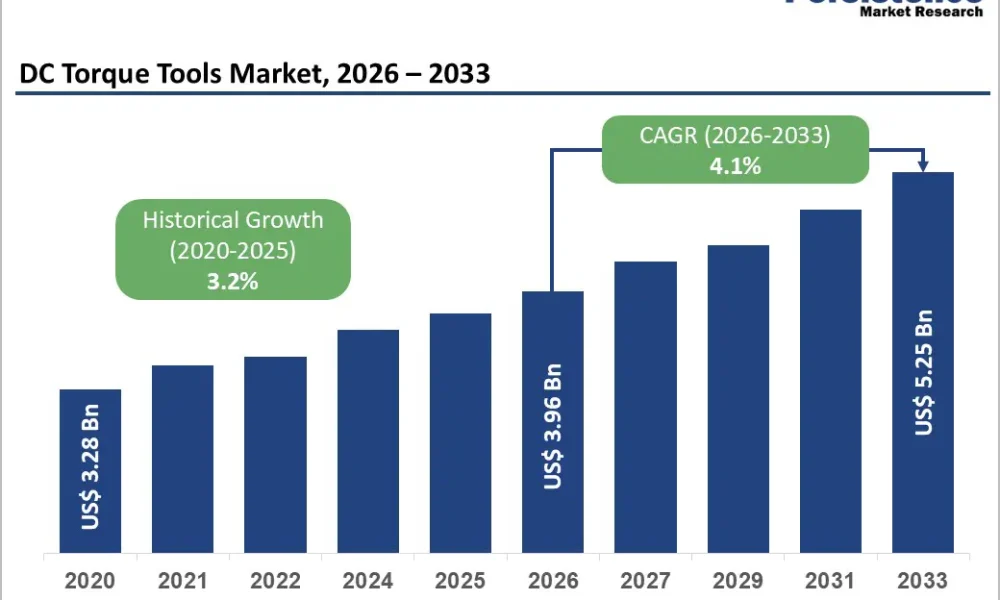
According to market estimates, the global DC torque tool market is expected to be valued at US$3.96 billion in 2026 and is projected to reach US$5.25 billion by 2033, expanding at a CAGR of 4.1% between 2026 and 2033. The growth trajectory is primarily fueled by the increasing adoption of automation, the rapid expansion of electric vehicle manufacturing, and the shift toward Industry 4.0 and smart factory environments.
As manufacturers aim to improve productivity, reduce assembly errors, and ensure regulatory compliance, the role of digitally controlled torque tools becomes even more critical. This article explores the key market trends, drivers, restraints, opportunities, regional dynamics, and competitive landscape shaping the future of the DC torque tool industry.
DC Torque Tool Market Overview
DC torque tools are electrically powered fastening tools that provide precise torque and angle control during assembly operations. Unlike traditional pneumatic tools, DC torque tools offer advanced features such as programmable torque settings, data logging, traceability, and integration with manufacturing execution systems.
The shift from pneumatic to DC-powered fastening systems is largely driven by the need for improved precision and digital connectivity in modern manufacturing environments. These tools help ensure consistent fastening quality and reduce operator variability, which is especially important in safety-critical applications such as automotive engine assembly, aircraft manufacturing, and renewable energy infrastructure.
Additionally, the integration of torque tools with digital systems enables real-time monitoring and process documentation. This capability helps manufacturers maintain strict quality standards, improve operational efficiency, and minimize costly product recalls or warranty claims.
Market Dynamics
Increasing Precision Requirements in Electric Vehicle Battery Assembly
One of the most important factors driving the DC torque tool market is the rapid expansion of the electric vehicle (EV) industry. EV battery packs require extremely precise fastening to ensure safe and reliable electrical connections.
In fastening applications, only about 10% of the applied torque actually stretches the bolt to create preload, while the remaining 90% is lost to friction. Because of this, achieving accurate torque control is essential for maintaining structural integrity and preventing mechanical failures.
EV battery assemblies involve high-voltage connections that must be tightened with exact torque specifications. Improper torque can lead to serious issues such as increased contact resistance, overheating, insulation failure, or even battery damage. As a result, manufacturers are increasingly deploying advanced DC torque tools equipped with digital monitoring systems to ensure proper fastening.
With global EV production growing rapidly and new battery manufacturing plants emerging worldwide, the demand for high-precision torque tools is expected to continue rising.
Industry 4.0 and Smart Factory Adoption
Another major driver of the DC torque tool market is the growing implementation of Industry 4.0 and smart factory initiatives. Modern manufacturing environments rely heavily on connected devices that collect and analyze production data in real time.
DC torque tools play a crucial role in this digital ecosystem because they generate valuable process data during fastening operations. Each tightening cycle can be recorded, timestamped, and linked to specific product identification numbers such as vehicle VINs or aircraft tail numbers.
This traceability ensures that every fastener in a product has been tightened according to required specifications. If quality issues arise later, manufacturers can easily trace the assembly process and identify the root cause.
Integration with manufacturing execution systems also allows torque tools to support predictive maintenance and error-proofing systems. For example, tools can be programmed to prevent operators from tightening bolts in the wrong sequence or using incorrect torque values.
Such capabilities significantly reduce production errors, improve product quality, and enhance overall manufacturing efficiency.
Market Restraints
High Initial Investment Compared to Pneumatic Systems
Despite their technological advantages, DC torque tools often require a higher upfront investment than traditional pneumatic tools. A complete DC fastening system, including controllers, software, and cabling, can cost five to ten times more than pneumatic alternatives.
For large manufacturing companies, the long-term benefits such as energy efficiency, lower maintenance costs, and improved quality justify the investment. However, small and medium-sized enterprises may find the initial capital expenditure difficult to manage.
In many developing economies, pneumatic tools remain popular because they are durable, affordable, and easy to repair. This cost factor can slow the adoption of advanced electronic torque systems, especially in industries where precision fastening is not strictly regulated.
Integration Complexity and Cybersecurity Concerns
As DC torque tools become increasingly connected to factory networks, they introduce new technical challenges related to system integration and cybersecurity.
Integrating these tools with legacy IT systems can be complex and may require specialized expertise. Misconfigurations or software errors can disrupt production lines or lead to data loss.
Furthermore, connected torque tools can potentially be targeted by cyberattacks. If malicious actors gain access to tool controllers, they could alter torque specifications or disrupt assembly processes. Such vulnerabilities force manufacturers to invest in secure networks, software updates, and cybersecurity protocols, adding to operational costs.
Emerging Opportunities
Expansion of MRO Applications in Renewable Energy
One of the most promising growth opportunities for DC torque tool manufacturers lies in the maintenance, repair, and operations (MRO) sector, particularly within renewable energy infrastructure.
Wind turbines, mining equipment, and large industrial machines require periodic maintenance involving precise torque fastening. Traditionally, technicians relied on manual torque wrenches that depend heavily on operator skill and experience.
However, new cordless DC torque tools with digital accuracy are transforming field maintenance operations. These tools allow technicians to achieve factory-level precision even in remote locations such as offshore wind farms or mining sites.
Manufacturers that develop rugged, weather-resistant, high-torque cordless tools specifically designed for field applications are likely to capture a significant share of this growing market segment.
Collaborative Robotics and Automated Assembly
Another major opportunity for DC torque tool manufacturers comes from the growing adoption of collaborative robots (cobots) in industrial assembly.
Cobots are increasingly used to automate repetitive tasks such as fastening operations, particularly in industries facing labor shortages. These robotic systems require lightweight, compact torque tools that can communicate seamlessly with robotic controllers.
Tool manufacturers are collaborating with robot manufacturers to develop integrated fastening solutions that combine robotics with intelligent torque control systems. These solutions improve productivity, ensure consistent fastening quality, and reduce human error.
As automation becomes more widespread across manufacturing industries, demand for robotic-compatible DC torque tools is expected to increase significantly.
Elevate your business strategy with comprehensive market data. Request a sample report now: https://www.persistencemarketresearch.com/samples/33395
Category-Wise Market Analysis
Tool Type Insights
Handheld tools dominate the DC torque tool market, accounting for approximately 67% of the global market share. These tools are highly versatile and are commonly used in automotive assembly lines, aerospace manufacturing, and industrial machinery production.
Handheld electric nutrunners and torque screwdrivers offer ergonomic designs and precise torque control, making them ideal for tasks requiring accuracy and flexibility.
Technological innovations such as torque-angle monitoring and real-time diagnostics have further enhanced the performance of these tools. These features help manufacturers detect issues like defective fasteners or misaligned components during assembly.
Power Source Insights
Cordless torque tools are gaining strong popularity and currently account for about 58% of the market share. Advances in lithium-ion battery technology have significantly improved the performance, reliability, and runtime of cordless power tools.
These tools eliminate the need for air compressors or electrical cords, providing greater mobility and flexibility in assembly operations. They are particularly useful in large-scale manufacturing environments such as shipbuilding, railway maintenance, and aircraft assembly.
Cordless tools also improve workplace safety by reducing tripping hazards caused by pneumatic hoses or power cables. Although they require higher initial investments, their lower maintenance costs and operational efficiency make them attractive for industrial users.
Industry Insights
The automotive industry represents the largest end-use segment for DC torque tools, accounting for nearly 48% of total market demand.
Automobiles contain thousands of threaded fasteners, many of which are classified as safety-critical components. Accurate torque fastening is essential to ensure structural integrity and prevent mechanical failures.
Automotive manufacturers were among the earliest adopters of electric fastening technology, replacing pneumatic systems with digital torque tools to improve quality control and reduce assembly errors.
With the ongoing transition to electric vehicles and advanced vehicle architectures, assembly processes are becoming more complex. This complexity is driving the need for programmable torque tools capable of handling diverse materials and fastening requirements.
Regional Insights
North America Market Trends
North America holds the largest share of the DC torque tool market, accounting for 37.8% of the global market. The region benefits from a strong manufacturing ecosystem, particularly in automotive, aerospace, and energy sectors.
The United States is a key contributor to regional growth due to its advanced industrial infrastructure and increasing adoption of automation technologies. Growing EV production in North America is also fueling demand for high-precision torque tools used in battery assembly and vehicle manufacturing.
In addition, strict safety and quality regulations encourage manufacturers to adopt advanced torque verification systems that provide documentation and traceability.
Europe Market Trends
Europe represents a mature market for DC torque tools, supported by its strong automotive and aerospace industries.
Countries such as Germany, France, and the United Kingdom have well-established manufacturing sectors that require highly accurate fastening technologies. European manufacturers are also leaders in Industry 4.0 adoption, integrating torque tools with smart factory systems to improve efficiency and quality monitoring.
Sustainability initiatives across Europe are further driving the demand for energy-efficient cordless tools and recyclable materials in industrial equipment.
Asia Pacific Market Trends
Asia Pacific is the fastest-growing regional market for DC torque tools. Rapid industrialization, expanding manufacturing capacity, and strong government support for industrial development are fueling growth in countries such as China, India, Japan, and Southeast Asia.
The region is experiencing significant growth in automotive production, electronics manufacturing, and aerospace assembly. These industries require high-precision fastening solutions, creating strong demand for DC torque tools.
In addition, rising aircraft production and increasing passenger traffic across Asia are boosting demand for torque tools used in aircraft manufacturing and maintenance.
Competitive Landscape
The DC torque tool market is moderately consolidated, with several global manufacturers competing through innovation, product performance, and strong distribution networks.
Leading companies are investing heavily in research and development to introduce advanced features such as smart connectivity, real-time monitoring, and improved battery technology.
Strategic partnerships, acquisitions, and expansion into emerging markets are common growth strategies among industry players. Companies also focus on providing comprehensive after-sales services, including tool calibration, maintenance, and software support.
Major companies operating in the DC torque tool market include:
- Atlas Copco AB
- Apex Tool Group, LLC
- Makita Corporation
- Techtronic Industries Co. Ltd.
- Robert Bosch GmbH
- Ingersoll-Rand plc
- Uryu Seisaku Ltd
- Gedore Werkzeugfabrik GmbH
- Stanley Black & Decker Inc.
- Hilti Corporation
These companies continue to innovate and expand their product portfolios to maintain competitive advantages in the global market.
Conclusion
The global DC torque tool market is expected to experience steady growth over the coming years as industries demand higher precision, improved automation, and digital integration in manufacturing processes.
Rising electric vehicle production, smart factory adoption, and increasing demand for accurate fastening solutions are key drivers shaping the market. At the same time, challenges such as high initial investment and system integration complexity may slow adoption in certain regions.
However, emerging opportunities in renewable energy maintenance, collaborative robotics, and cordless tool technology present strong growth potential for manufacturers.
As industries continue to prioritize efficiency, safety, and quality control, DC torque tools will remain an essential component of modern manufacturing and industrial assembly operations worldwide.
Related Reports:




