
The rapid proliferation of smartphones, mobile applications, and connected digital ecosystems has fundamentally reshaped how businesses interact with customers. Mobile devices are now the primary channel for communication, commerce, entertainment, and financial transactions worldwide. As a result, organizations increasingly rely on advanced analytics to understand how users interact with their mobile applications and optimize digital experiences.
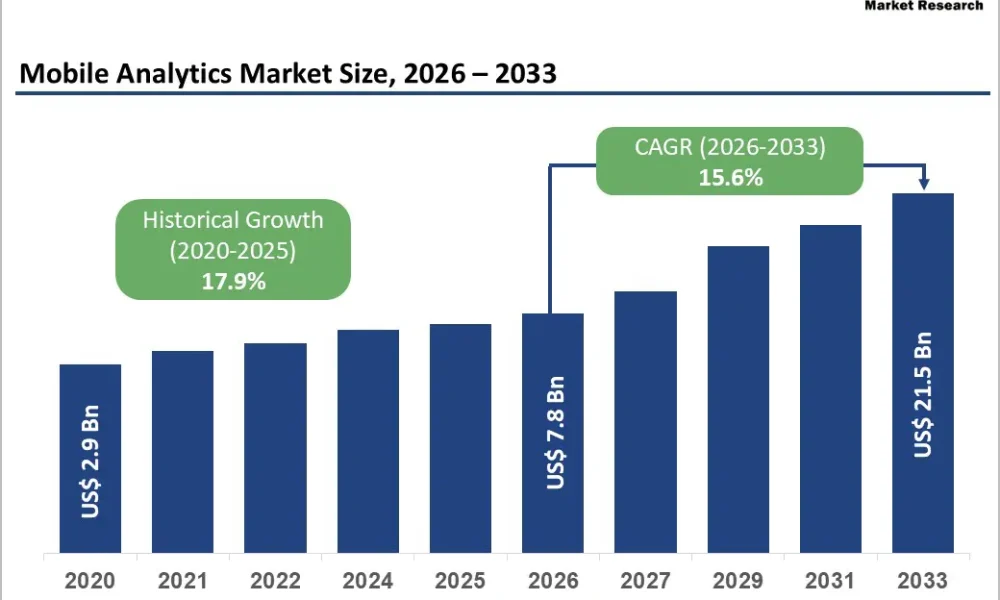
The global mobile analytics market reflects this transformation. The market is expected to reach US$7.8 billion in 2026 and grow to US$21.5 billion by 2033, expanding at a compound annual growth rate (CAGR) of 15.6% between 2026 and 2033.
This strong growth trajectory highlights the growing importance of mobile analytics platforms in helping organizations track user behavior, optimize marketing performance, monitor application performance, and personalize customer experiences in real time.
Industries such as banking, e-commerce, healthcare, and media are investing heavily in analytics tools to derive actionable insights from mobile data. With the expansion of 5G networks, increasing mobile advertising expenditure, and the growing dominance of mobile commerce, mobile analytics has become a critical component of modern digital transformation strategies.
Mobile Analytics Market Overview
Mobile analytics refers to technologies and platforms used to collect, analyze, and interpret data generated through mobile devices, mobile applications, and mobile web interactions. These solutions allow organizations to understand user behavior, track engagement patterns, and measure the effectiveness of mobile marketing campaigns.
Companies rely on mobile analytics to monitor several key metrics, including:
- Application installs and downloads
- User engagement and retention rates
- Session duration and in-app navigation patterns
- Conversion rates and customer lifetime value
- Application performance metrics such as crashes and latency
By transforming raw behavioral data into meaningful insights, mobile analytics helps organizations optimize product design, improve user experiences, and increase revenue from digital channels.
The growth of the mobile analytics market is closely linked to the rising number of smartphone users globally and the increasing reliance on mobile platforms for everyday activities such as banking, shopping, streaming, and social communication.
Key Industry Highlights
Several important trends characterize the current landscape of the mobile analytics market.
North America currently dominates the market, accounting for roughly 40% of global revenue share in 2025. The region benefits from advanced cloud infrastructure, a strong mobile application ecosystem, and large investments in digital advertising.
Meanwhile, Asia Pacific is expected to be the fastest-growing region during the forecast period due to rapid smartphone penetration, increasing mobile commerce, and the widespread use of super-apps in countries such as China and India.
In terms of solution segments, mobile marketing and advertising analytics hold approximately 40% market share, driven by the rapid growth of mobile advertising spending, which now exceeds US$400 billion globally.
Another major trend is the increasing adoption of cloud-based analytics platforms, which represent about 75% of deployments due to their scalability, flexibility, and integration with artificial intelligence services.
Looking ahead, AI-powered analytics solutions are expected to represent the most significant growth opportunity, enabling predictive insights, automated optimization, and privacy-compliant measurement techniques.
Market Growth Drivers
Rapid Growth of Mobile Usage and the App Economy
One of the primary drivers of the mobile analytics market is the explosive growth of mobile devices and the global app economy.
Today, billions of people worldwide rely on smartphones for daily activities ranging from messaging and social networking to online shopping and financial transactions. Mobile applications now account for a significant share of internet traffic, with users spending several hours per day on mobile apps.
The mobile app economy generates hundreds of billions of dollars annually through:
- In-app purchases
- Subscription services
- Advertising revenue
At the same time, mobile advertising has become one of the largest segments of the digital advertising industry. Brands invest heavily in app-based advertising campaigns to reach highly engaged audiences.
To ensure these investments generate strong returns, businesses rely on mobile analytics platforms to track campaign performance, analyze user acquisition sources, and measure customer lifetime value.
Without analytics tools, organizations would struggle to understand user behavior or optimize marketing spending across multiple digital channels.
Demand for Real-Time Mobile Performance Monitoring
Another key growth driver is the increasing demand for real-time application performance monitoring (APM).
Modern users expect mobile applications to deliver seamless experiences, fast loading speeds, and reliable functionality. Even small performance issues can significantly impact user engagement and revenue.
Research suggests that:
- A one-second delay in page loading can reduce conversion rates by 7–10%.
- App crash rates above 1% can lead to substantial declines in user retention.
To address these challenges, organizations are adopting mobile analytics tools that monitor application performance metrics such as latency, crash rates, and API response times.
Advanced analytics platforms combine technical performance monitoring with user behavior insights, enabling organizations to quickly identify problems and improve the overall app experience.
These capabilities are particularly important for industries such as banking, e-commerce, gaming, and media streaming, where application reliability directly affects customer satisfaction and revenue.
Elevate your business strategy with comprehensive market data. Request a sample report now: https://www.persistencemarketresearch.com/samples/9143
Market Restraints
Data Privacy Regulations and Platform Restrictions
Despite strong growth potential, the mobile analytics market faces significant regulatory challenges related to data privacy and consumer protection.
Global data protection regulations such as the General Data Protection Regulation (GDPR) in Europe and the California Consumer Privacy Act (CCPA) in the United States have introduced strict rules governing how companies collect and process user data.
In addition, major technology platforms have implemented privacy-focused policies that limit third-party tracking.
One example is Apple’s App Tracking Transparency (ATT) framework, which requires applications to obtain explicit user consent before tracking activity across other apps or websites.
These changes have reduced the availability of device identifiers and limited traditional user-level tracking methods used in mobile advertising analytics.
As a result, companies must adopt new analytics approaches such as:
- Aggregated data analysis
- Probabilistic attribution models
- Privacy-preserving measurement frameworks
While these changes improve consumer privacy, they also increase the complexity of implementing mobile analytics systems.
Talent Shortage and Implementation Challenges
Another challenge facing the mobile analytics market is the shortage of skilled professionals capable of managing complex analytics environments.
Deploying mobile analytics solutions often involves integrating software development kits (SDKs) across multiple platforms, including:
- iOS applications
- Android applications
- Mobile web interfaces
Organizations must also ensure consistent event tracking and data governance across various systems.
Without strong analytical expertise and proper data management practices, companies may struggle to derive meaningful insights from their analytics platforms.
This skills gap can limit the effectiveness of mobile analytics deployments and slow adoption among smaller organizations.
Emerging Market Opportunities
AI-Driven Predictive Analytics
Artificial intelligence and machine learning technologies are opening new opportunities within the mobile analytics market.
Traditional analytics tools primarily focus on analyzing historical data to understand past behavior. However, AI-powered analytics platforms can predict future trends and recommend optimal actions.
Examples of AI-driven capabilities include:
- Predicting user churn risk
- Identifying high-value customer segments
- Detecting unusual application behavior
- Delivering personalized recommendations in real time
These predictive insights allow businesses to optimize user engagement strategies and improve customer retention.
As organizations increasingly adopt AI technologies, demand for advanced mobile analytics platforms is expected to grow significantly.
Industry-Specific Analytics Solutions
Another major opportunity lies in the development of vertical-specific mobile analytics solutions tailored to particular industries.
In the banking and financial services sector, mobile analytics supports fraud detection, customer segmentation, and regulatory compliance reporting.
In e-commerce and retail, analytics tools help businesses optimize product discovery, manage promotional campaigns, and recover abandoned shopping carts.
The healthcare industry is also emerging as an important market for mobile analytics, particularly with the growth of telemedicine applications and remote patient monitoring platforms.
Healthcare providers rely on analytics to track patient engagement, monitor treatment adherence, and improve clinical outcomes.
By developing industry-specific solutions that address unique regulatory and operational requirements, analytics vendors can capture significant market opportunities.
Deployment Trends
Cloud-based mobile analytics platforms have become the dominant deployment model across industries.
Cloud infrastructure allows organizations to process massive volumes of mobile data efficiently without investing in costly on-premise hardware.
Benefits of cloud-based analytics include:
- Elastic scalability
- Faster deployment times
- Reduced operational costs
- Integration with AI and machine learning services
These advantages make cloud platforms particularly attractive for businesses with fluctuating traffic levels, such as e-commerce companies, media streaming platforms, and mobile gaming developers.
Although on-premise deployments remain relevant for highly regulated sectors such as government and financial services, most organizations are shifting toward cloud-first architectures.
Regional Market Insights
North America
North America remains the largest mobile analytics market globally. The region’s leadership is supported by strong digital infrastructure, widespread smartphone adoption, and the presence of major technology companies.
Enterprises across industries such as retail, media, and banking are heavily investing in analytics tools to enhance customer experiences and optimize digital marketing strategies.
Europe
Europe represents the second-largest regional market for mobile analytics. The region’s growth is strongly influenced by strict data protection regulations that emphasize privacy-compliant analytics solutions.
Organizations are increasingly adopting platforms that support anonymized data processing and aggregated reporting while maintaining analytical accuracy.
Asia Pacific
Asia Pacific is expected to record the fastest growth during the forecast period. Rapid smartphone adoption, affordable mobile data, and the popularity of super-apps are generating enormous volumes of mobile data across the region.
Countries such as China, India, and Indonesia are experiencing rapid expansion in mobile commerce, digital payments, and fintech services, all of which rely heavily on advanced analytics capabilities.
Competitive Landscape
The mobile analytics market features a mix of large enterprise software providers, cloud service companies, and specialized analytics platforms.
Competition is driven by factors such as:
- Product functionality
- Integration with cloud ecosystems
- Artificial intelligence capabilities
- Industry-specific analytics features
Leading vendors are increasingly incorporating machine learning algorithms, automation tools, and privacy-focused data management capabilities into their platforms.
Strategic partnerships with mobile app developers, advertising platforms, and cloud providers are also helping analytics companies expand their market presence.
Conclusion
The mobile analytics market is experiencing rapid expansion as organizations increasingly rely on mobile channels to engage with customers and generate revenue.
With the market expected to grow from US$7.8 billion in 2026 to US$21.5 billion by 2033, analytics platforms will play an increasingly critical role in helping businesses understand user behavior, optimize digital experiences, and improve marketing effectiveness.
Emerging technologies such as artificial intelligence, predictive analytics, and privacy-preserving measurement frameworks will further enhance the capabilities of mobile analytics platforms.
As mobile usage continues to grow worldwide and digital ecosystems become more complex, organizations that invest in advanced mobile analytics will be better positioned to compete in the data-driven digital economy.
Related Reports:




