
The global display device market is entering a transformative phase driven by technological breakthroughs, rising digital consumption, and the electrification of multiple industries. Display technologies have evolved from simple visual interfaces to sophisticated platforms delivering immersive experiences, intelligent interactions, and real-time data visualization. From smartphones and televisions to automotive dashboards and medical imaging systems, displays have become an integral component of modern digital ecosystems.
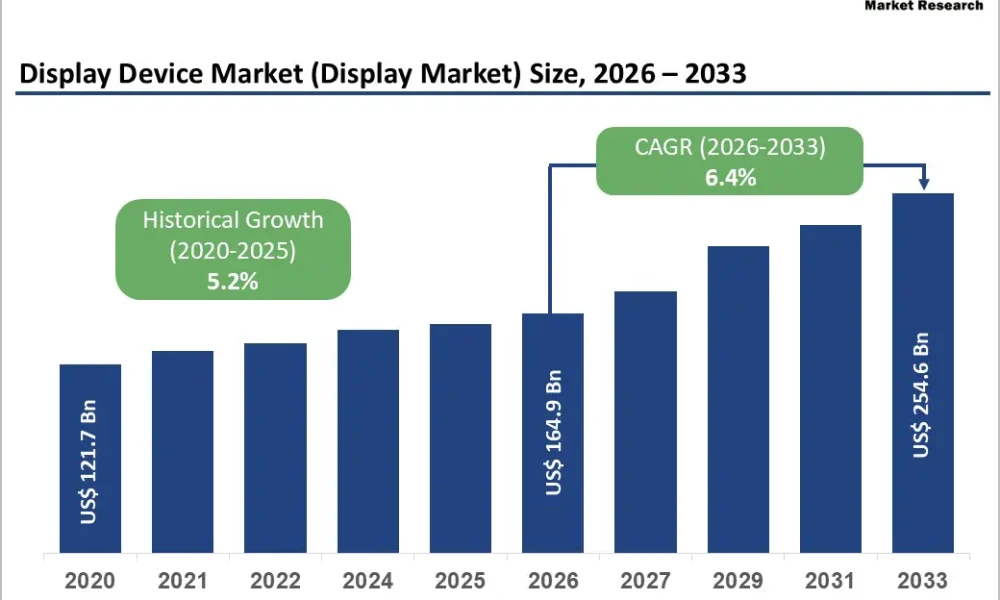
According to market projections, the global Display Device Market is expected to reach US$164.9 billion in 2026 and grow to US$254.6 billion by 2033, expanding at a compound annual growth rate (CAGR) of 6.4% during the forecast period.
Unlike earlier growth phases that relied primarily on consumer electronics replacement cycles, the present expansion is driven by structural technological shifts. The transition from LCD to OLED, the emergence of foldable displays, and the rising use of advanced displays in electric vehicles and healthcare systems are reshaping market dynamics. These developments are creating new revenue opportunities while simultaneously transforming competitive strategies across the display manufacturing ecosystem.
This article explores the major trends, growth drivers, restraints, opportunities, and regional developments shaping the display device market over the next decade.
Market Overview
Display devices play a crucial role in modern electronics, enabling communication between digital systems and users through visual interfaces. These technologies are widely used across consumer electronics, automotive systems, healthcare diagnostics, advertising displays, and industrial monitoring equipment.
The market’s growth trajectory is being influenced by three major technological trends:
- Rapid adoption of OLED technology
- Integration of displays in electric vehicles and smart mobility
- Emergence of flexible, foldable, and wearable display devices
The increasing demand for high-resolution screens, energy-efficient panels, and innovative form factors is encouraging manufacturers to accelerate research and development investments. At the same time, improvements in manufacturing processes are reducing production costs, making advanced display technologies accessible to a wider consumer base.
Key Industry Highlights
Several major insights define the current state and future direction of the display device industry:
- Asia Pacific dominates the global market, accounting for nearly 40% of global share in 2025 due to strong panel manufacturing capacity.
- LCD technology remains dominant with approximately 48.5% market share, though OLED adoption is growing rapidly.
- Wearable display devices represent the fastest-growing product category.
- Medical diagnostic displays are emerging as a high-margin opportunity due to strict calibration and regulatory requirements.
- Consumer electronics account for over 75% of OLED demand, maintaining the largest share among end-use industries.
These factors collectively indicate that while the industry remains strongly tied to consumer electronics, emerging sectors such as healthcare and automotive are becoming major growth contributors.
Major Growth Drivers
OLED Technology Transition Accelerating Market Growth
One of the most significant drivers of the display device market is the rapid adoption of Organic Light Emitting Diode (OLED) technology. OLED displays offer several advantages over traditional LCD panels, including higher contrast ratios, improved color accuracy, faster refresh rates, and thinner designs.
The most important catalyst behind OLED adoption is manufacturing cost convergence with LCD technology. Historically, OLED displays were significantly more expensive, limiting their adoption to premium devices. However, improvements in manufacturing efficiency and economies of scale have dramatically reduced production costs.
Major display manufacturers have expanded OLED fabrication capacity, enabling mass production for smartphones, televisions, laptops, and wearable devices. As OLED panels achieve price parity with advanced LCD technologies such as Mini-LED, consumer preference is shifting rapidly toward OLED displays.
Additionally, OLED technology enables flexible and foldable displays, which are driving innovation in smartphones, tablets, and wearable electronics. These new form factors are creating premium product categories with higher profit margins for manufacturers.
Electric Vehicles Driving Automotive Display Demand
Another powerful growth driver is the rapid expansion of display systems in modern vehicles. The shift toward electric vehicles (EVs) is transforming automotive interiors, increasing demand for advanced digital interfaces.
Unlike traditional vehicles that relied on mechanical gauges and simple dashboards, modern EVs incorporate multiple display systems for:
- Battery performance monitoring
- Energy consumption tracking
- Charging infrastructure visualization
- Advanced driver assistance system (ADAS) feedback
- Infotainment and connectivity services
These requirements are creating a new category of digital cockpits, where large high-resolution displays replace conventional instrumentation.
The automotive display market is projected to grow faster than the overall display industry, with increasing integration of heads-up displays, augmented reality interfaces, and panoramic dashboard screens.
As EV production expands worldwide, display devices will become essential components of next-generation vehicle design.
Market Restraints
Pricing Pressure and Margin Compression
Despite strong shipment growth, display manufacturers are facing increasing pricing pressure and declining profit margins.
This trend is largely driven by rapid manufacturing expansion among Chinese panel producers. As new production lines come online, supply is rising faster than demand, resulting in oversupply conditions in several display segments.
Consequently, average selling prices (ASPs) of display panels are declining even as shipment volumes increase. This dynamic is especially evident in the LCD segment, where commoditization has intensified competition among manufacturers.
The industry historically experiences cycles of oversupply followed by consolidation and capacity adjustments. Analysts expect the current pricing pressure cycle to continue until supply-demand balance stabilizes in the coming years.
Supply Chain Concentration and Geopolitical Risks
The display manufacturing ecosystem is heavily concentrated among a limited number of major companies. This concentration introduces supply chain vulnerabilities, particularly in the context of geopolitical tensions and intellectual property disputes.
For example, flexible OLED production is largely dominated by a few manufacturers with specialized fabrication capabilities. If supply disruptions occur due to trade restrictions, legal disputes, or manufacturing yield challenges, global electronics manufacturers could face production delays.
Additionally, certain key materials required for advanced displays—such as ultra-thin glass and flexible substrates—are produced by only a handful of suppliers. This limited supply base increases the risk of bottlenecks that could slow market expansion.
Emerging Market Opportunities
Medical Diagnostic Imaging Displays
One of the most promising opportunities in the display device market lies in medical diagnostic imaging systems.
Medical displays used in radiology, oncology, and advanced imaging applications must meet strict performance standards for brightness, contrast accuracy, and color calibration. These requirements allow manufacturers to command significantly higher prices compared to consumer displays.
The medical display segment is projected to grow at a CAGR of around 14% through 2033, supported by several factors:
- Aging populations in developed economies
- Increasing demand for advanced diagnostic imaging
- Expansion of healthcare infrastructure in emerging markets
- Integration of artificial intelligence in medical imaging
Manufacturers that secure regulatory approvals and long-term supply agreements with healthcare providers can benefit from stable, high-margin revenue streams.
Foldable Display Innovation
Foldable displays represent one of the most exciting frontiers in display technology. These displays allow devices to transform between compact and expanded formats, creating entirely new product categories.
Currently, foldable smartphones remain relatively expensive due to complex manufacturing processes and lower production yields. However, ongoing innovations in ultra-thin glass technology, hinge engineering, and protective coatings are gradually improving durability and reducing costs.
As manufacturing yields improve and production volumes increase, foldable devices are expected to become more affordable and accessible to mainstream consumers. Early suppliers that establish strong technological capabilities in this area may gain long-term competitive advantages.
Technology Trends
LCD Technology Gradually Declining
Liquid Crystal Display (LCD) technology continues to hold a large share of the display market, particularly in televisions and monitors. However, the segment is experiencing gradual structural decline due to several limitations.
Compared to newer technologies, LCD displays typically consume more power and provide lower contrast performance. As OLED and MicroLED technologies mature, many manufacturers are shifting their focus toward these next-generation solutions.
In addition, LCD manufacturing has become highly commoditized, with production concentrated among large-scale manufacturers. This has reduced opportunities for technological differentiation and profit growth.
4K Resolution Becoming the Standard
Another key trend shaping the display industry is the widespread adoption of 4K Ultra HD resolution.
With significant reductions in panel production costs and increasing availability of 4K content through streaming platforms and gaming systems, 4K displays have become the new baseline standard for televisions and monitors.
By 2025, 4K displays accounted for roughly 42% of television shipments globally. As prices continue to decline, Full HD displays are gradually being replaced by 4K alternatives across multiple device categories.
Meanwhile, 8K displays are emerging as a premium segment targeted at professional broadcasting, luxury consumer electronics, and high-end entertainment systems.
Product Segment Analysis
Smartphones and Tablets Dominate Market Revenue
Smartphones and tablets represent the largest product segment in the display device market, accounting for over 31% of global revenue in 2025.
Frequent device upgrade cycles and continuous improvements in display performance are sustaining strong demand for advanced panels. Manufacturers are increasingly introducing features such as:
- Higher refresh rates
- Improved brightness levels
- Edge-to-edge screen designs
- Enhanced energy efficiency
These innovations are strengthening the role of display technology as a key differentiator in mobile device competition.
Wearable Displays Growing the Fastest
Wearable electronics such as smartwatches, fitness trackers, and medical monitoring devices are emerging as the fastest-growing display product segment.
Rising consumer interest in health monitoring, fitness tracking, and connected lifestyle devices is driving strong demand for compact and energy-efficient displays. Flexible OLED technology is particularly well suited for wearable devices due to its lightweight and curved design capabilities.
Elevate your business strategy with comprehensive market data. Request a sample report now: https://www.persistencemarketresearch.com/samples/20434
Regional Market Insights
Asia Pacific Leads Global Production and Demand
The Asia Pacific region dominates the global display device market, accounting for approximately 40% of global market share.
Countries such as China, South Korea, Japan, and Taiwan host some of the world’s largest display manufacturing companies and advanced fabrication facilities. Strong government support for semiconductor and electronics manufacturing has further strengthened the region’s competitive position.
China has emerged as a major hub for LCD and OLED panel production, while South Korea remains a global leader in next-generation technologies such as microLED and quantum-dot displays.
India is also becoming an important market due to rising smartphone adoption and national initiatives promoting domestic electronics manufacturing.
North America Focuses on Premium Display Segments
North America represents a mature but lucrative market characterized by high consumer spending on premium electronics.
Demand for 8K televisions, gaming monitors, and automotive display systems is particularly strong in the United States. The region also plays a key role in technology innovation, with major technology companies driving the development of advanced display applications.
Europe Advancing Sustainable Display Technologies
Europe’s display market is influenced by strong regulatory frameworks promoting environmental sustainability.
European manufacturers and automakers are increasingly adopting energy-efficient OLED and microLED technologies to comply with environmental standards. Additionally, smart city initiatives and public infrastructure projects are expanding the deployment of digital signage and information displays across transportation networks and urban environments.
Competitive Landscape
The display device market is moderately consolidated, with a small group of global manufacturers controlling a significant portion of production capacity.
Leading companies are focusing on strategies such as:
- Expansion of OLED manufacturing capacity
- Investment in microLED research
- Vertical integration across supply chains
- Strategic partnerships with device manufacturers
In addition to hardware innovation, many companies are exploring new business models involving software integration, AI-driven display calibration, and content optimization services.
These approaches are enabling manufacturers to differentiate themselves in an increasingly competitive marketplace.
Conclusion
The global display device market is entering a new era of innovation and diversification. While consumer electronics will continue to provide the foundation for market demand, emerging sectors such as automotive digital cockpits, wearable devices, and medical imaging systems are creating powerful new growth opportunities.
The transition from LCD to OLED, the emergence of foldable displays, and the increasing integration of displays into electric vehicles are fundamentally transforming industry dynamics.
Despite challenges related to pricing pressure and supply chain risks, the market’s long-term outlook remains strong. With the global market expected to reach US$254.6 billion by 2033, display technologies will remain central to the evolution of digital experiences across industries.
Manufacturers that successfully invest in next-generation technologies, optimize manufacturing efficiency, and expand into high-value applications will be best positioned to capture the next wave of growth in the global display device market.
Related Reports:




