
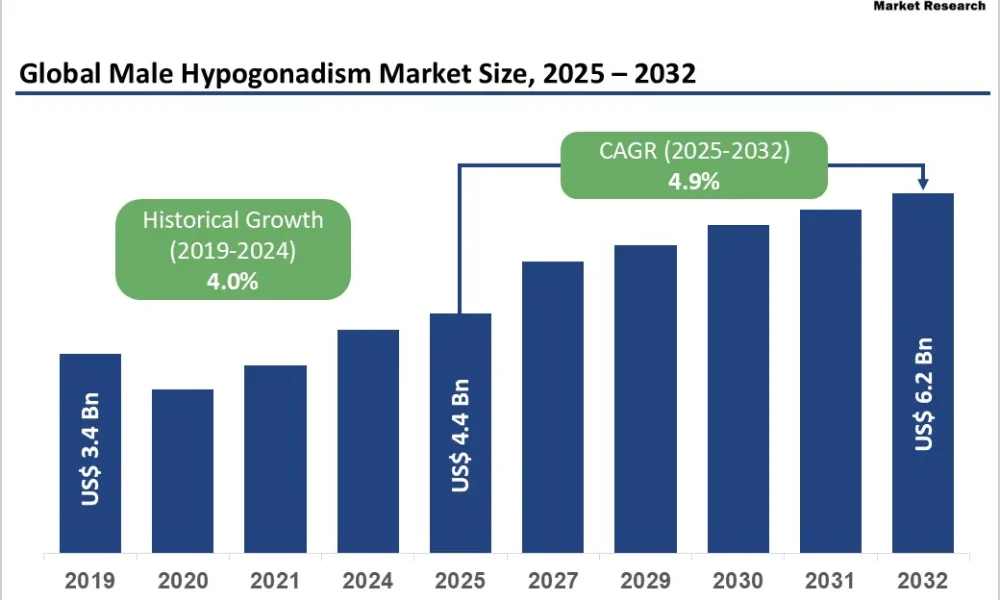
The global male hypogonadism market is entering a phase of steady expansion, driven by increasing awareness of testosterone deficiency, improved diagnostic protocols, and advancements in testosterone replacement therapy (TRT) delivery systems. The market is estimated to be valued at US$ 4.4 billion in 2025 and is projected to reach US$ 6.2 billion by 2032, expanding at a CAGR of 4.9% during the forecast period. Male hypogonadism, characterized by inadequate testosterone production due to testicular or hypothalamic-pituitary dysfunction, is increasingly recognized as a major public health issue, particularly among aging men and individuals with obesity or type 2 diabetes. Rising health consciousness, expanding endocrinology and urology services, and broader insurance coverage are collectively reinforcing therapy adoption rates. The market’s growth is further strengthened by innovations in oral testosterone formulations and digital hormone monitoring platforms that enhance patient adherence and long-term disease management.
Injectable testosterone formulations dominate the product landscape, accounting for approximately 54.4% of total market share, primarily due to their long-acting profiles, cost-effectiveness, and strong physician preference. From a therapy standpoint, Testosterone Replacement Therapy (TRT) commands nearly 79.7% of the market, reflecting its established efficacy in restoring hormone levels and alleviating symptoms such as low libido, fatigue, and mood disturbances. Geographically, North America leads the market with about 41.2% of global revenue, supported by robust healthcare infrastructure, strong diagnostic capabilities, and higher treatment uptake rates. Meanwhile, the Asia Pacific region is emerging as the fastest-growing market due to increasing healthcare expenditure, expanding aging populations, and improving access to specialized hormonal care services. These dynamics collectively position the male hypogonadism treatment market for sustained medium-term growth.
Download Your Free Sample & Explore Key Insights: https://www.persistencemarketresearch.com/samples/22303
Key Highlights from the Report
• The global male hypogonadism market is projected to grow from US$ 4.4 billion in 2025 to US$ 6.2 billion by 2032 at a CAGR of 4.9%.
• Injectable testosterone products dominate with approximately 54.4% market share due to long-acting efficacy and cost advantages.
• Testosterone Replacement Therapy (TRT) accounts for nearly 79.7% of total therapy adoption worldwide.
• North America leads the global market with 41.2% revenue share supported by advanced diagnostic infrastructure.
• Asia Pacific represents the fastest-growing regional market driven by rising obesity rates and aging demographics.
• Emergence of oral testosterone formulations and telehealth-enabled hormone monitoring platforms is expanding treatment accessibility.
Market Segmentation Analysis
The male hypogonadism market is segmented primarily by product type, therapy type, and end-user categories, each contributing uniquely to the overall industry landscape. By product type, injectable testosterone formulations remain the dominant segment. These include short-acting and long-acting testosterone esters administered intramuscularly or subcutaneously. Their popularity stems from lower costs, predictable pharmacokinetics, and extended dosing intervals ranging from one to three weeks. Compared to daily gels or transdermal patches, injectables require less frequent administration and reduce the risk of accidental skin transfer, a common concern with topical therapies. The long-standing clinical familiarity of injectables among endocrinologists and urologists further solidifies their leading position.
Topical and transdermal products, including gels, creams, and patches, represent another significant segment. These formulations offer non-invasive administration and stable daily testosterone levels but often require strict adherence to prevent interpersonal transfer and skin irritation. Although patient-friendly in theory, compliance challenges and higher costs limit their broader dominance compared to injectables. The emergence of oral testosterone capsules is reshaping the product landscape by addressing many drawbacks of existing delivery systems. Oral formulations improve convenience, eliminate injection discomfort, and minimize transfer risks, thereby appealing to younger demographics and first-time TRT users.
By therapy type, Testosterone Replacement Therapy (TRT) overwhelmingly dominates the treatment spectrum. TRT directly compensates for deficient testosterone levels and remains the only broadly approved pharmacological intervention for both primary and secondary hypogonadism. Alternative treatments such as gonadotropin therapy or off-label hormone stimulation protocols account for a relatively smaller share and are typically reserved for specific fertility-preserving indications. The high adoption rate of TRT reflects strong clinical guidelines supporting its use in confirmed hypogonadism cases.
In terms of end-users, hospitals and specialty clinics account for a substantial proportion of therapy initiation due to advanced diagnostic tools and endocrinology expertise. However, telehealth platforms and outpatient clinics are rapidly expanding their footprint. Digital healthcare providers are offering remote consultations, hormone monitoring, and prescription fulfillment services, increasing patient convenience and discretion. This shift is redefining care delivery models within the male hormonal therapy market and is expected to drive incremental market expansion over the forecast period.
Regional Insights
North America continues to dominate the male hypogonadism market due to high disease awareness, advanced laboratory diagnostics, and favorable reimbursement frameworks. The United States in particular demonstrates high prescription rates for testosterone therapy across various age groups. Increased screening for testosterone deficiency and growing public awareness regarding age-related hormonal decline contribute significantly to the region’s leading position. Additionally, strong pharmaceutical presence and active clinical research initiatives sustain innovation in the regional market.
Europe holds a significant share of the global market, supported by structured healthcare systems and growing physician awareness of testosterone deficiency syndrome. The European Male Ageing Study (EMAS) highlighted notable prevalence rates of symptomatic hypogonadism among aging men, reinforcing demand for targeted hormonal treatments. Countries such as Germany, France, Italy, and Spain maintain strong endocrinology networks, ensuring access to appropriate diagnostic and therapeutic interventions. Although regulatory oversight remains stringent, steady demographic aging supports long-term demand growth.
Asia Pacific is emerging as the fastest-growing regional market due to expanding healthcare access and increasing prevalence of lifestyle-associated risk factors. Rapid urbanization, rising obesity rates, and improved income levels are increasing awareness and diagnosis rates. Large population bases in China, India, Japan, and South Korea provide significant untapped potential for testosterone therapy expansion. Additionally, pharmaceutical companies are investing in introducing advanced testosterone formulations and digital health platforms across the region, accelerating market penetration.
Latin America and the Middle East & Africa represent developing markets where awareness and diagnostic rates are comparatively lower but improving gradually. Expanding healthcare infrastructure and rising male health awareness initiatives are expected to stimulate moderate growth in these regions over the coming years.
Get Custom Insights Designed for Your Business: https://www.persistencemarketresearch.com/request-customization/22303
Market Drivers
One of the most prominent drivers of the male hypogonadism market is the growing awareness of men’s health and hormonal disorders. Epidemiological data suggests that a substantial proportion of men over the age of 45 experience testosterone deficiency, particularly those with obesity or type 2 diabetes. However, diagnosis rates remain lower than actual prevalence, indicating significant untapped market potential. Increased public health campaigns, educational programs, and physician training initiatives are bridging this awareness gap. Additionally, the cultural shift toward proactive health management among men has encouraged early screening and therapy adoption. Technological advancements in diagnostic assays and standardized testosterone testing protocols have further facilitated accurate and timely diagnosis, supporting market expansion.
Market Restraints
Despite promising growth prospects, safety concerns surrounding testosterone therapy pose notable challenges to the market. Regulatory bodies have previously issued warnings regarding potential cardiovascular risks, including heart attack and stroke, particularly in off-label use cases for age-related testosterone decline. Although recent large-scale randomized trials have indicated no significant composite cardiovascular risk compared to placebo, clinicians remain cautious. Monitoring requirements, concerns regarding thromboembolic events, and blood pressure elevations add to prescribing complexity. These safety uncertainties contribute to hesitancy among physicians and patients alike, potentially limiting therapy uptake. Furthermore, reimbursement inconsistencies and varying regulatory frameworks across countries create additional barriers to uniform market expansion.
Market Opportunities
The emergence of oral testosterone formulations represents a transformative opportunity for the male hypogonadism treatment landscape. For instance, JATENZO, approved by the U.S. Food & Drug Administration in 2019, demonstrated high efficacy in achieving normalized testosterone levels in clinical trials. Similarly, KYZATREX, approved in 2022, expanded therapeutic options for adult males with confirmed hypogonadism. These innovations eliminate injection discomfort and reduce skin-transfer risks associated with gels, improving patient compliance. Additionally, partnerships between pharmaceutical firms and telehealth providers are revolutionizing hormone therapy access. AI-driven hormone monitoring tools and digital adherence platforms further enhance long-term disease management. Emerging markets with rising male health awareness offer additional opportunities for strategic expansion and localized product launches.
Checkout Now & Download Complete Market Report: https://www.persistencemarketresearch.com/checkout/22303
Company Insights
The competitive landscape of the male hypogonadism market is characterized by the presence of established pharmaceutical companies and emerging telehealth-driven healthcare providers. Market players focus on product innovation, strategic collaborations, and geographic expansion to strengthen their competitive positioning.
Key Players Operating in the Market:
• AbbVie
• Eli Lilly
• Pfizer
• Endo International
• Teva Pharmaceutical Industries
• Grünenthal
• Merck KGaA
• Ferring Pharmaceuticals
• Viatris
• Abbott Laboratories
• ANI Pharmaceuticals
• Sun Pharmaceutical Industries
• Lupin
• Zydus Lifesciences
• Marius Pharmaceuticals
• Hims & Hers
Recent developments highlight the market’s dynamic nature. In September 2025, Marius Pharmaceuticals partnered with Hims & Hers to expand access to KYZATREX capsules via telehealth platforms, significantly increasing digital accessibility to prescription testosterone therapy in the United States. Additionally, in October 2024, SK Chemicals secured exclusive marketing rights for Nebido in South Korea, strengthening its footprint in the men’s health segment through long-acting injectable testosterone distribution.
Conclusion
The male hypogonadism market is poised for consistent and structured growth between 2025 and 2032, underpinned by rising prevalence of testosterone deficiency, increasing awareness of hormonal health, and technological advancements in testosterone delivery systems. While injectable formulations and TRT continue to dominate, the emergence of oral testosterone therapies and telehealth-enabled care models is reshaping the competitive landscape. North America remains the largest regional contributor, while Asia Pacific offers the strongest growth momentum. Although safety concerns and regulatory scrutiny present ongoing challenges, continued clinical research and innovation are likely to reinforce confidence in testosterone therapy. As healthcare systems worldwide prioritize preventive and personalized medicine, the male hypogonadism treatment market is expected to evolve into a more accessible, patient-centric, and digitally integrated ecosystem over the coming decade.




