
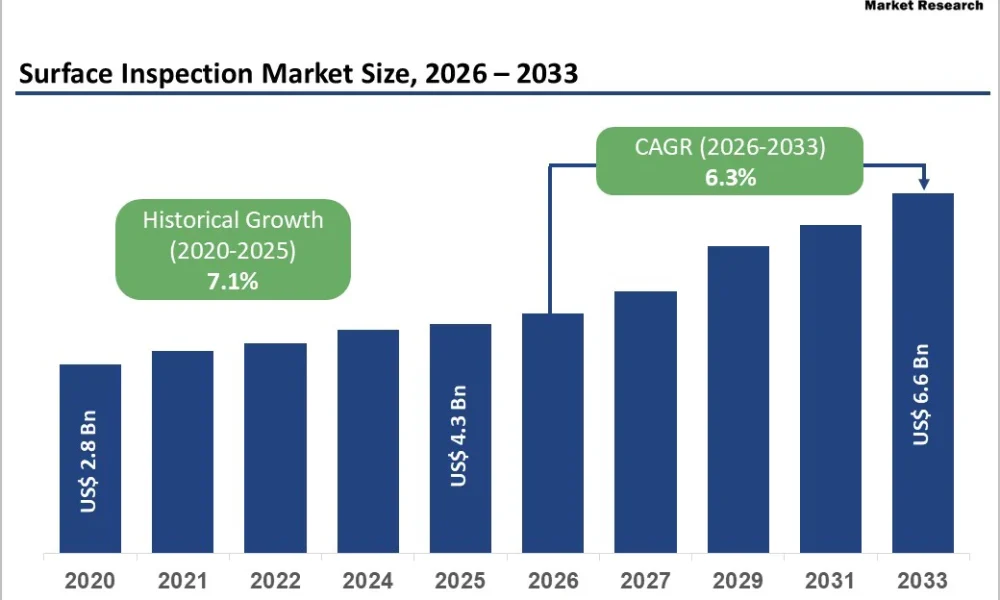
Surface Inspection Market Size and Trend Analysis
The global surface inspection market is projected to be valued at US$ 4.3 billion in 2026 and is forecast to reach US$ 6.6 billion by 2033, expanding at a CAGR of 6.3% between 2026 and 2033. The industry previously recorded a robust historical growth rate of 7.1% between 2020 and 2025, reflecting the rapid digitalization of industrial quality control systems.
Surface inspection has evolved from manual visual checks to highly automated, AI-driven systems capable of detecting microscopic and sub-pixel defects. As industries pursue zero-defect manufacturing and higher throughput rates, advanced vision-based inspection technologies are becoming a strategic necessity rather than an optional investment.
Across automotive, aerospace, semiconductors, electronics, packaging, and pharmaceuticals, manufacturers are deploying automated inspection systems to reduce defect rates—often ranging between 10–15% in manual inspection environments—and achieve yield improvements of 10–20% with intelligent systems.
Key Growth Drivers
- Automation and Quality Control Imperatives
Manufacturers worldwide are facing mounting pressure from rising labor costs, skilled workforce shortages, and inconsistent human inspection results. According to the International Federation of Robotics, industrial automation adoption is accelerating rapidly, marking a turning point for machine vision deployment.
Modern inspection systems can process 300–500 units per minute with detection accuracy reaching 97–99%, compared to human inspection accuracy of approximately 85–90%. This difference significantly reduces rework, warranty claims, and production downtime.
Additionally, the U.S. Bureau of Labor Statistics projects strong expansion in automation-related sectors through 2033, reinforcing long-term demand for intelligent quality control solutions.
Industries such as automotive, semiconductor fabrication, electronics assembly, and food processing are transitioning toward fully automated quality ecosystems to ensure compliance, efficiency, and profitability.
- AI and Deep Learning Integration
Artificial intelligence is fundamentally redefining surface inspection accuracy benchmarks.
Companies such as TSMC have reported a 30% improvement in defect detection rates after integrating deep neural networks into inspection workflows. Similarly, Samsung has achieved nearly 99% accuracy in identifying subtle surface irregularities using AI-powered systems.
Deep learning models—particularly convolutional neural networks (CNNs)—enable:
- Sub-pixel defect detection
- Adaptive anomaly classification
- Real-time processing exceeding 67,000 profiles per second
- Reduced false positive rates by 60–70%
These advancements allow inspection systems to continuously learn and improve, minimizing dependence on rigid rule-based programming.
Market Restraints
High Capital Investment Requirements
Despite compelling ROI potential, advanced inspection systems demand significant upfront investment. Complete system deployment costs can range from US$ 10,000 to over US$ 200,000, depending on configuration complexity.
Small and medium-sized manufacturers often face:
- Long payback cycles (18–36 months)
- Integration complexity
- Specialized workforce training requirements
- Production downtime during installation
Approximately 40–50% of global manufacturing facilities still rely on partial or manual inspection processes due to financial and operational constraints.
Data Security and Standardization Challenges
As inspection systems integrate into Industrial IoT networks and cloud-based analytics platforms, cybersecurity risks increase. Manufacturers must comply with multiple regional regulations, including:
- GDPR in Europe
- CCPA in the United States
- National cybersecurity frameworks in Asia
Furthermore, the absence of universal machine vision standards complicates interoperability with robotics, MES platforms, and ERP systems.
Environmental factors—such as reflective surfaces, temperature fluctuations, and inconsistent lighting—can also affect detection accuracy, occasionally increasing false positives in complex industrial environments.
Emerging Opportunities
Aerospace & Defense Expansion
The aerospace and defense sector represents a major growth opportunity, projected to expand at an 8.5% CAGR through 2032. Increasing component complexity, tight geometric tolerances, and safety-critical requirements demand near-zero defect manufacturing.
3D inspection systems are particularly essential in detecting:
- Micro-cracks
- Subsurface voids
- Dimensional inconsistencies
- Coating irregularities
Given the severe regulatory and safety implications in aerospace manufacturing, inspection technologies are becoming deeply embedded in quality assurance frameworks.
AI-Driven Industry 4.0 Integration
The convergence of Industry 4.0, machine learning, and predictive analytics is unlocking new revenue streams.
Unsupervised learning algorithms now reduce training data requirements by 60–70%, enabling faster deployment. IoT-enabled inspection systems support predictive maintenance, reducing unplanned downtime by 35–50%.
As digital transformation accelerates globally, manufacturers increasingly seek unified platforms combining:
- Optical inspection
- Thermal imaging
- X-ray inspection
- Ultrasonic analysis
This integrated approach strengthens vendor differentiation and long-term service revenues.
Category-Wise Analysis
Surface Type: 3D Inspection Dominates
3D surface inspection commands 52% market share in 2025, driven by superior topology measurement and volumetric analysis.
Using structured light and laser triangulation, 3D systems achieve sub-micron accuracy essential for:
- Aerospace components
- Semiconductor wafers
- Medical implants
- Precision automotive parts
The growing adoption of advanced semiconductor packaging, including 3D-stacked architectures, further reinforces 3D inspection demand.
Elevate your business strategy with comprehensive market data. Request a sample report now: https://www.persistencemarketresearch.com/samples/33512
Component Insights: Hardware Leads
Hardware accounts for nearly 60% of market share, reflecting its foundational role in inspection architecture.
Key hardware components include:
- High-resolution industrial cameras
- Advanced optics
- LED illumination systems
- Edge computing processors
As inspection speed and resolution requirements rise, manufacturers are investing in multi-camera configurations and high-speed image sensors.
Technology Insights: Machine Vision Leadership
Machine vision represents approximately 45% of the market, offering scalable inspection across industries.
Leading providers such as Cognex Corporation and Keyence Corporation continue advancing high-speed image processing and AI-enabled analytics.
Machine vision systems routinely achieve:
- 1,000+ frames per second
- 97–99% detection accuracy
- High adaptability across production lines
Their flexibility—from basic 2D checks to advanced multi-parameter inspection stations—cements their leadership.
End-Use Industry: Semiconductors & Electronics
Semiconductors and electronics account for approximately 38% of global demand in 2025.
As fabrication nodes shrink below 10nm, inspection systems must identify:
- Particle contamination
- Lithography defects
- Pattern misalignments
- Surface micro-scratches
Automated optical inspection and AI classification are now core yield-management strategies within semiconductor fabs.
Regional Insights
North America: Market Leader
North America commands 43–45% market share, driven by technological innovation and advanced manufacturing ecosystems.
The U.S. remains the regional growth engine, supported by government initiatives such as the CHIPS and Science Act, which promotes domestic semiconductor production.
Major automotive manufacturers—including General Motors, Ford Motor Company, and Tesla—have integrated advanced surface inspection across facilities.
The region also hosts innovation leaders like Teledyne Technologies and Zebra Technologies.
Europe: Precision Manufacturing Hub
Europe holds approximately 28% market share, with Germany, the UK, and France leading adoption.
German automation leaders such as Basler AG and ISRA Vision AG (part of Atlas Copco) anchor regional innovation.
Strict regulatory standards and quality-focused manufacturing drive strong inspection system integration across automotive and pharmaceutical sectors.
Asia Pacific: Fastest Growing Region
Asia Pacific is projected to grow at 10.5% CAGR, with China leading at 11.6% CAGR.
Rapid industrialization, semiconductor expansion, and Industry 4.0 adoption fuel growth in:
- China
- Japan
- South Korea
- India
- ASEAN nations
Electronics manufacturing dominance and competitive production environments create significant demand for high-speed, cost-efficient inspection systems.
Competitive Landscape
The surface inspection market is moderately consolidated, with established leaders offering integrated ecosystems combining hardware, AI software, and lifecycle services.
Key companies include:
- Omron Corporation
- Panasonic Corporation
- Cognex Corporation
- Teledyne Technologies
- SICK AG
Strategic priorities across the competitive landscape include:
- AI software differentiation
- Modular inspection platforms
- Robotics integration partnerships
- Cloud-connected analytics
- Mergers and acquisitions
Recent innovations include next-generation semiconductor wafer inspection systems introduced by Hitachi High-Tech Corporation.
Future Outlook: Toward Zero-Defect Manufacturing
The surface inspection market is entering a transformative era defined by:
- AI-powered autonomy
- 3D volumetric precision
- Real-time analytics
- Industry 4.0 integration
- Predictive quality control
As product complexity increases and regulatory compliance intensifies, manufacturers can no longer rely on manual or semi-automated inspection models.
Surface inspection systems are evolving into intelligent quality ecosystems capable of self-learning, predictive adaptation, and near-perfect accuracy. With projected growth to US$ 6.6 billion by 2033, the industry stands at the forefront of precision manufacturing innovation.
The next decade will likely see inspection technologies move beyond defect detection toward fully autonomous production optimization—reshaping global manufacturing competitiveness in the process.
Related Reports:




