
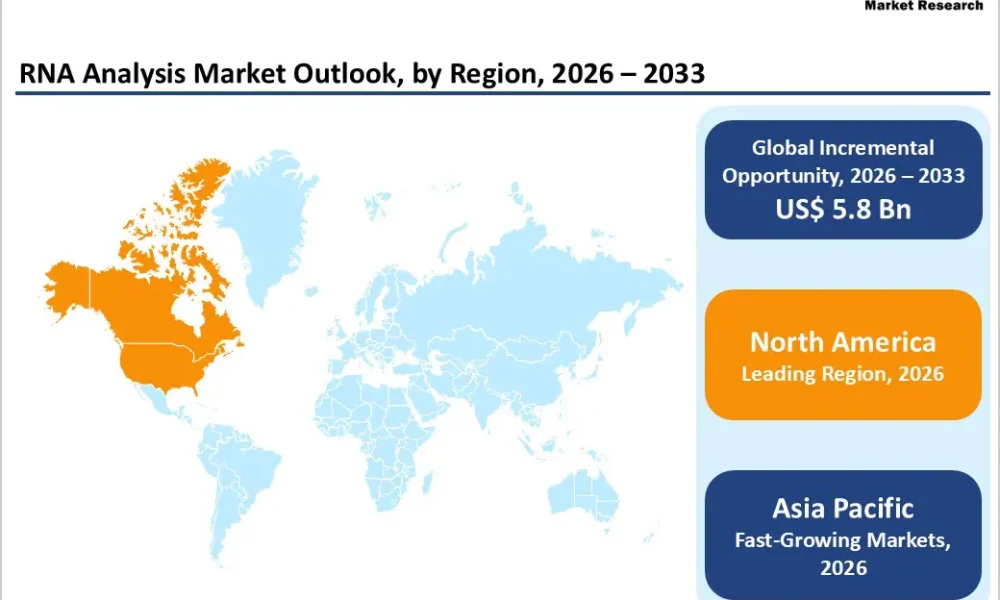
The RNA analysis market is experiencing significant growth due to an increased focus on biomedical research, precision medicine, and the expansion of transcriptomics applications in drug development. As the market continues to evolve, it reflects a broader shift in scientific research toward understanding gene expression and RNA-related pathways. By 2033, the market is projected to grow from $9.1 billion in 2026 to $14.9 billion, with a robust compound annual growth rate (CAGR) of 5.6% during the forecast period from 2026 to 2033. This growth is primarily driven by an upsurge in RNA research across clinical and academic settings, where RNA analysis plays a critical role in understanding disease mechanisms and developing RNA-based therapeutics.
Several key factors are influencing the market’s expansion, including the rising prevalence of chronic diseases such as cancer, genetic disorders, and infectious diseases. Researchers and clinicians are increasingly utilizing RNA profiling techniques like next-generation sequencing (NGS) and real-time PCR to analyze gene expression and identify biomarkers, facilitating precision medicine. Furthermore, innovations in RNA-based therapeutics—such as mRNA vaccines and gene-editing technologies—are accelerating the demand for RNA analysis tools throughout development pipelines. The growing awareness of these innovations is pushing forward market adoption, supported by robust funding and expanding infrastructure globally.
Download Your Free Sample & Explore Key Insights: https://www.persistencemarketresearch.com/samples/33202
Key Growth Drivers Behind Market Expansion
Several factors contribute to the market’s growth, including technological advancements, the increasing prevalence of various diseases, and significant investments in research and development. Improvements in RNA analysis technologies, such as NGS, qPCR, and bioinformatics software, have enabled more accurate and scalable RNA sequencing, driving their adoption in both research and clinical applications. Moreover, the accelerating shift toward precision medicine, where therapies are tailored based on genetic profiles, further boosts demand for RNA analysis, as RNA plays a key role in gene expression and disease progression.
The market also benefits from increased research funding, particularly in developed regions, where governments and private entities are investing in the life sciences. With these investments, academic and research institutions are building advanced genomic infrastructure, facilitating large-scale RNA sequencing projects and collaborations between academia and industry. Additionally, the rapid expansion of RNA-based therapeutics, such as the development of mRNA vaccines, gene-silencing therapies, and gene-editing technologies, creates new avenues for RNA analysis applications, further fueling market growth.
Leading Segment and Geographical Insights
The instrument segment holds the largest share in the RNA analysis market, driven by the widespread use of advanced RNA profiling platforms across pharmaceutical, biotechnology, and research sectors. The need for high-throughput analysis, greater sequencing accuracy, and comprehensive sample processing has led to increased investment in state-of-the-art instruments such as NGS systems, qPCR machines, and automated platforms for RNA analysis.
North America leads the global RNA analysis market, accounting for 47.3% of the market share. This dominance is attributed to the region’s advanced research infrastructure, early adoption of new genomic technologies, strong funding support from government bodies like the NIH, and the presence of major life sciences companies. The U.S. is home to several biotech firms that are at the forefront of RNA research and therapeutic development, further consolidating the region’s position as a market leader. Meanwhile, Asia Pacific is the fastest-growing region, driven by increasing investments in genomics infrastructure, expanding biopharmaceutical research capabilities, and rising government support for life sciences research.
Key Highlights from the RNA Analysis Market Report
• The global RNA analysis market is projected to grow from $9.1 billion in 2026 to $14.9 billion by 2033.
• North America holds the largest market share, accounting for 47.3% of the total revenue.
• Asia Pacific is the fastest-growing region with a projected CAGR of 7.6% from 2026 to 2033.
• Instruments lead the market, with an expected 58.0% share in 2026, driven by the adoption of advanced RNA profiling platforms.
• Kits and reagents are the fastest-growing product segment, driven by increased demand for RNA sequencing.
• The pharmaceutical and biotechnology sectors are the largest end-users of RNA analysis tools, representing 40.0% of market share in 2026.
Market Segmentation
Product Type
The RNA analysis market is segmented into instruments, kits, reagents, and consumables, with instruments dominating the market due to the increasing adoption of advanced profiling platforms. Real-time PCR systems, NGS machines, and automated sample preparation devices are essential for accurate, large-scale RNA sequencing, making them indispensable in both research and clinical settings. Kits and reagents are the fastest-growing segment, primarily driven by the rise in RNA sequencing volumes and the recurring demand for consumables used in routine gene expression analysis.
Application Areas
The construction of RNA expression atlases remains the leading application for RNA analysis, as it plays a pivotal role in understanding gene regulation and identifying biomarkers for disease. RNA expression atlases are essential tools for functional genomics, personalized medicine, and systems biology. The increasing use of multi-omics approaches, which integrate RNA data with other omics data (like proteomics and metabolomics), is further enhancing the clinical relevance of RNA expression atlases.
The development and delivery of RNA-based therapeutics is the fastest-growing application, driven by the rise of mRNA vaccines, antisense oligonucleotides, and RNA interference therapies. This segment continues to see rapid growth due to the increasing adoption of RNA-based therapeutic approaches for treating various diseases, including cancer and genetic disorders.
End-User Segmentation
The pharmaceutical and biotechnology industries are the largest end-users of RNA analysis tools, owing to their extensive use in drug discovery, target validation, and RNA-based therapeutic development. These companies invest heavily in RNA profiling technologies to accelerate their research and clinical pipelines, particularly as RNA-based treatments like mRNA vaccines and gene-silencing therapies become more prevalent. Academic and research institutions also represent a significant end-user segment, supporting both basic and applied research in genomics, molecular biology, and biomedical sciences.
Get Custom Insights Designed for Your Business: https://www.persistencemarketresearch.com/request-customization/33202
Regional Insights
North America
North America dominates the global RNA analysis market, driven by a strong ecosystem of life sciences research, extensive funding, and widespread adoption of cutting-edge genomic technologies. The U.S., in particular, plays a leading role in advancing RNA-based therapeutic development, including the development of mRNA vaccines for infectious diseases like COVID-19. Strong government support, robust intellectual property protections, and high R&D spending by pharmaceutical companies solidify North America’s position as the dominant player in the market.
Europe
Europe has a well-established research infrastructure and is expected to experience steady growth in the RNA analysis market. Countries like Germany, the UK, and France are leading RNA-based research initiatives, especially in oncology and rare diseases. Europe’s emphasis on precision medicine and stringent regulatory frameworks ensure high-quality research and the integration of RNA analysis into clinical practice. Furthermore, public healthcare systems in Europe support the widespread use of RNA analysis tools across academic and clinical settings.
Asia Pacific
The Asia Pacific region is poised to experience the highest growth rate during the forecast period. This growth is primarily driven by increasing investments in genomic research, expanding healthcare infrastructure, and the rising adoption of RNA analysis technologies. Countries such as China, India, and Japan are significantly expanding their research capabilities, supported by government funding and collaborations with international pharmaceutical companies. Additionally, the growing demand for RNA-based therapeutics, coupled with a rise in local biotech startups, further contributes to the region’s rapid market expansion.
Market Drivers
One of the primary drivers of growth in the RNA analysis market is the increasing adoption of transcriptomics in biomedical research and clinical diagnostics. The expanding use of RNA sequencing platforms enables researchers to uncover gene expression profiles that are critical for understanding disease mechanisms, identifying therapeutic targets, and advancing precision medicine. As diseases like cancer, autoimmune disorders, and genetic diseases become more prevalent, the demand for RNA analysis tools to study gene regulation and therapeutic responses continues to rise.
Moreover, the development of RNA-based therapeutics such as mRNA vaccines, gene-silencing therapies, and RNA gene-editing approaches is generating significant market demand. The rapid expansion of RNA-based therapies, particularly in oncology and infectious disease treatment, further boosts the need for high-quality RNA analysis technologies.
Market Restraints
Despite the significant growth prospects, several challenges may inhibit broader adoption of RNA analysis technologies. High capital investment requirements, particularly for advanced instruments like NGS systems and automated sample preparation platforms, can restrict access in smaller laboratories or institutions with limited budgets. Additionally, the complexity of RNA workflows and the substantial expertise required to analyze large, multidimensional datasets can slow adoption in some regions. The global shortage of skilled bioinformaticians and molecular biologists poses another challenge, as does the need for complex computational infrastructure to process RNA sequencing data.
Market Opportunities
The growing development of RNA-based therapeutics presents a significant opportunity for RNA analysis. The increasing use of RNA in clinical applications, such as cancer immunotherapies, mRNA vaccines, and gene-silencing drugs, requires precise RNA characterization at every stage of development. Furthermore, the integration of artificial intelligence (AI) and machine learning (ML) into RNA analysis offers exciting prospects for faster, more accurate data interpretation and predictive analytics. Emerging markets, particularly in Asia and Latin America, present substantial growth opportunities due to increasing investments in genomics infrastructure, healthcare expansion, and research partnerships.
Checkout Now & Download Complete Market Report: https://www.persistencemarketresearch.com/checkout/33202
Company Insights
Leading companies operating in the RNA analysis market include:
• Agilent Technologies Inc.
• Bio-Rad Laboratories Inc.
• F. Hoffmann-La Roche Ltd.
• Illumina Inc.
• QIAGEN
• Thermo Fisher Scientific Inc.
• Danaher
• Lexogen GmbH
• Eurofins Scientific
• Merck KGaA
• PacBio
• Promega Corporation
Global RNA Analysis Market Segmentation
By Product
- Instruments
- Kits & Reagents
- Services
- Others
By Technology
- Real Time-PCR (qPCR) Technology
- Microarray Technology
- Sequencing Technology
- Others
By Application
- Construction of RNA Expression Atlas
- Epigenetics
- Infectious Diseases and Pathogenesis
- Alternative RNA Splicing
- Development & Delivery of RNA Therapeutics
- Others
By End User
- Pharmaceutical & Biotechnology Companies
- Contract Research Organizations (CROs)
- Hospitals
- Academic and Research Institutions
By Region
- North America
- Europe
- East Asia
- South Asia and Oceania
- Latin America
- Middle East and Africa
Recent Developments
STORM Therapeutics Ltd. announced a partnership with Alida Biosciences Inc. in January 2026 to advance RNA modification analysis in drug development.
Deep Genomics published a paper in September 2023 introducing BigRNA, an AI-driven platform for uncovering RNA-driven disease mechanisms.
Conclusion
The RNA analysis market is positioned for sustained growth, driven by technological advancements, expanding research applications, and the increasing prevalence of RNA-based therapeutics. North America leads the market, with Asia Pacific expected to grow at the fastest rate. As precision medicine and RNA therapeutics continue to gain prominence, RNA analysis tools will play an integral role in advancing drug discovery, diagnostics, and personalized treatments. Despite challenges such as high costs and data complexity, opportunities for innovation in RNA-based therapies and AI-driven analytics are poised to unlock new market avenues, further fueling the global demand for RNA analysis technologies.




