
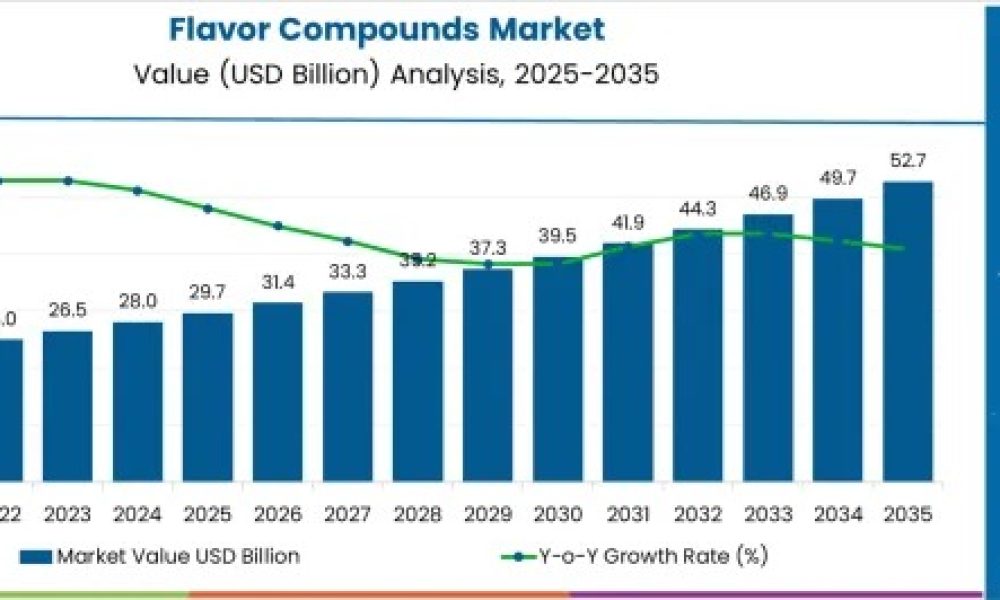
The global flavor compounds market is projected to expand from USD 29.7 billion in 2025 to USD 52.7 billion by 2035, registering a compound annual growth rate (CAGR) of 5.9%. This sustained growth reflects the increasing role of flavor compounds in enhancing taste, consistency, and sensory appeal across processed foods, beverages, snacks, and functional nutrition products. As food manufacturers respond to evolving consumer preferences, flavor compounds are becoming a foundational ingredient within the global food additives ecosystem.
During the early adoption phase between 2020 and 2024, food producers gradually increased the incorporation of flavor compounds to standardize taste profiles and improve product differentiation. By 2025, acceptance across both retail and industrial food segments accelerated, supported by improving supply chains and scalable production capabilities. This transition from selective use to broad integration marks a critical inflection point for long-term market expansion.
Explore trends before investing – request a sample report today!
From 2025 to 2030, the market enters a clear scaling phase as flavor compounds become standard components in processed foods, bakery, dairy, savory snacks, and beverages. Market value grows steadily as production volumes increase and distribution networks mature. By 2030, widespread adoption prepares the industry for consolidation, with leading manufacturers strengthening market positions through operational efficiency and expanded portfolios.
Between 2030 and 2035, growth remains stable as the market reaches maturity. Consolidation during this phase is driven by supply chain optimization, technological differentiation, and the ability of major players to capture higher market shares. By 2035, flavor compounds are expected to represent 19–20% of the total food additives market and over 45% of the flavor and fragrance segment, reinforcing their strategic importance within the broader ingredients landscape.
Market Position Within the Food Additives Industry
In 2025, flavor compounds account for approximately 18% of the global food additives market, benefiting from rising consumption of packaged and convenience foods worldwide. Within the flavor and fragrance segment, flavor compounds hold an estimated 40% share, a figure expected to increase to nearly 44% by 2030 as adoption accelerates across multiple applications.
Why the Flavor Compounds Market Is Growing
The market’s expansion is underpinned by increasing consumer demand for differentiated taste experiences and premium food offerings. Urbanization, exposure to global cuisines, and the proliferation of functional and plant-based foods are driving manufacturers to invest in advanced flavor solutions. Technological innovations in extraction, encapsulation, and stabilization are improving shelf life and performance, enabling consistent flavor delivery even in complex formulations.
Regulatory emphasis on food safety, ingredient transparency, and quality assurance is also shaping product development. Flavor compounds that support reduced-sugar, reduced-salt, and fortified formulations are gaining traction, allowing manufacturers to balance health positioning with sensory appeal.
Segmental Insights: Salty and Protein Bars Lead Adoption
By flavor type, the salty segment leads the market with a 28.5% share in 2025. Its dominance is closely tied to its widespread use in snacks, ready-to-eat meals, and savory processed foods. Innovations in sodium-reduction technologies and flavor masking have further strengthened demand, particularly in health-conscious markets.
By application, protein bars represent the leading segment, accounting for 37.2% of total market share. Flavor compounds play a critical role in masking off-notes from protein ingredients while enabling indulgent and functional flavor profiles. Growth in sports nutrition, on-the-go snacking, and personalized nutrition continues to reinforce this segment’s leadership.
Regional Growth Dynamics
North America, Europe, and Asia-Pacific remain the key growth regions, each shaped by distinct consumption patterns and regulatory environments. Asia-Pacific is the fastest-growing region, supported by urbanization and rising disposable incomes, while North America and Europe benefit from advanced R&D ecosystems and strong demand for clean-label flavors.
Country-level CAGR highlights include:
- China: 8.0%
- India: 7.4%
- Germany: 6.8%
- France: 6.2%
- United Kingdom: 5.6%
- United States: 5.0%
China and India are expanding manufacturing capacity and developing region-specific flavors, while OECD markets emphasize regulatory compliance, sustainability, and premium quality standards.
Dive deeper—click here for the comprehensive report.
Competitive Landscape Remains Innovation-Driven
The flavor compounds market is led by established global suppliers including Givaudan, Firmenich, Symrise, IFF, Sensient Technologies, Kerry Group, Takasago International Corporation, FONA International, Frutarom (IFF), and Tate & Lyle. These players are investing heavily in natural sourcing, digital flavor modeling, and sensory analytics to accelerate innovation and meet diverse regional requirements.
Strategic partnerships, acquisitions, and capacity expansions continue to shape competitive dynamics, ensuring global supply chain resilience and localized market presence.
Why FMI: https://www.futuremarketinsights.com/why-fmi
About Future Market Insights (FMI)
Future Market Insights, Inc. (FMI) is an ESOMAR-certified and ISO 9001:2015 accredited market research and consulting organization, trusted by Fortune 500 companies and global enterprises. With delivery centers in the U.S., UK, India, and Dubai, FMI provides data-driven insights across 30+ industries and over 1,200 global markets, enabling clients to navigate complex business environments with confidence.



