
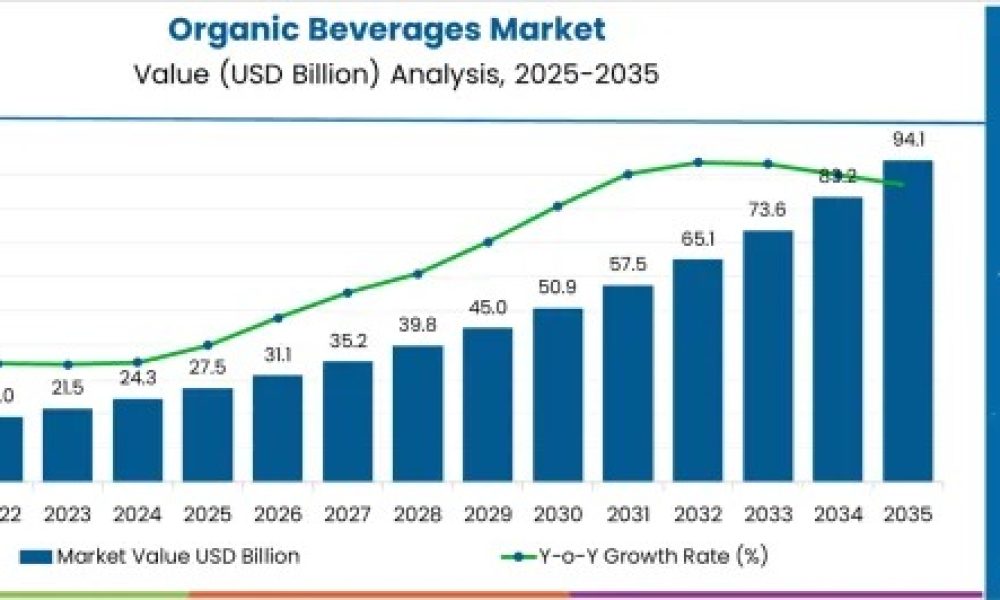
The global organic beverages market is entering a high-growth decade, projected to expand from USD 27.5 billion in 2025 to USD 94.1 billion by 2035, registering a strong CAGR of 13.1%. This growth trajectory represents an absolute dollar opportunity of USD 66.6 billion, underscoring the accelerating shift toward health-conscious, natural, and sustainably produced beverage options worldwide.
Rising consumer awareness of wellness, clean-label nutrition, and chemical-free ingredients is reshaping beverage consumption patterns across regions. Organic juices, teas, coffees, functional drinks, dairy-based beverages, and plant-based alternatives are gaining traction as consumers prioritize transparency, nutrition, and ethical sourcing.
Explore trends before investing – request a sample report today!
Growth is further supported by expanding retail availability, increasing e-commerce penetration, and sustained product innovation. Supermarkets, specialty health stores, and direct-to-consumer platforms are making organic beverages more accessible, while manufacturers continue to introduce fortified and function-focused formulations to meet evolving consumer expectations.
Volume-Led Adoption Transitions Toward Premium Pricing
Revenue expansion in the organic beverages market reflects a dynamic balance between volume growth and pricing power. From 2025 to 2028, market expansion is primarily volume-driven, as adoption accelerates across North America, Europe, and Asia Pacific. Wider distribution networks, higher consumption frequency, and increased consumer education are driving this early-stage momentum.
Between 2029 and 2032, growth becomes increasingly balanced, with both volume and price contributing to revenue gains. Premiumization trends emerge as consumers demonstrate willingness to pay more for organic, sustainably sourced, and fortified beverages.
From 2033 to 2035, price-led growth gains prominence, particularly in mature markets where penetration levels are high. Incremental revenue is expected to come from premium offerings, limited-edition launches, and functional beverages delivering targeted health benefits such as immunity support, digestive health, and energy enhancement.
Functional Drinks and Organic Juices Define Demand Mix
Functional and health beverages account for 35% of total market demand, making them the leading parent segment. Consumers increasingly seek organic drinks enriched with vitamins, antioxidants, probiotics, and adaptogens. Fruit and vegetable juices contribute 25%, driven by nutritional positioning and clean sourcing credentials.
Dairy-based organic beverages represent 20%, including milk, yogurt drinks, and smoothies, while tea and coffee collectively hold 10%, supported by organic and fair-trade certifications. Sports and energy drinks, formulated with natural ingredients, complete the remaining 10%, reflecting growing interest in clean performance nutrition.
Organic Coffee Maintains Segment Leadership
Among product types, organic coffee leads with a 21.6% market share in 2025, reinforcing its strong foothold in the organic beverages landscape. Demand is fueled by rising preference for premium, ethically sourced coffee free from synthetic inputs. Ready-to-drink formats, cold brews, and compostable packaging are expanding appeal, particularly among urban and millennial consumers.
Transparency around origin, fair-trade practices, and sustainability continues to strengthen brand loyalty and long-term growth prospects for this segment.
Retail Stores Anchor Market Accessibility
Retail stores dominate distribution with a 43% share, playing a central role in mainstream adoption. Supermarkets, hypermarkets, and health-focused retail chains are expanding shelf space for organic beverages and supporting trial through in-store promotions and private-label offerings.
While online retailing is growing rapidly, physical retail remains critical for consumer trust, label verification, and impulse purchasing—especially for first-time organic buyers.
Asia Pacific Leads Growth Momentum
Regionally, Asia Pacific accounts for over 40% of global consumption, led by China and India. Country-level growth highlights include:
- China: CAGR of 17.7%, driven by urban demand, e-commerce expansion, and functional beverage adoption
- India: CAGR of 16.4%, supported by rising incomes, herbal beverage demand, and organic farming initiatives
- Germany: CAGR of 15.1%, shaped by sustainability standards and functional innovation
- United States: CAGR of 11.1%, reflecting steady adoption of health-focused and organic-certified beverages
BRICS economies contribute the largest volume growth, while OECD markets emphasize innovation, quality, and premium positioning.
Dive deeper—click here for the comprehensive report.
Competitive Landscape Focuses on Clean Labels and Functionality
Competition in the organic beverages market centers on ingredient purity, functional benefits, and distribution reach. Leading players are advancing cold-pressed juices, probiotic drinks, organic teas, and fermented beverages, while investing in eco-friendly packaging and transparent sourcing to differentiate offerings.
Strategic focus areas include flavor innovation, sustainable sourcing, and expansion across retail and digital channels to capture health-conscious consumers globally.
Key Players in the Organic Beverages Market
BluePrint, LLC | Harmless Harvest | Honest Tea, Inc. | Inko’s LLC | KeVita, Inc. | Kombucha Wonder Drink LLC | Lifeway Foods, Inc. | Nature’s Best, Inc. | New Age Beverages Corporation | Oregon Chai, Inc. | Remedy Drinks | R.W. Knudsen Family, Inc.
Why FMI: https://www.futuremarketinsights.com/why-fmi
About Future Market Insights (FMI)
Future Market Insights, Inc. (FMI) is an ESOMAR-certified, ISO 9001:2015 market research and consulting organization, trusted by Fortune 500 clients and global enterprises. With operations in the U.S., UK, India, and Dubai, FMI delivers data-backed insights and strategic intelligence across 30+ industries and 1,200+ markets worldwide.



