
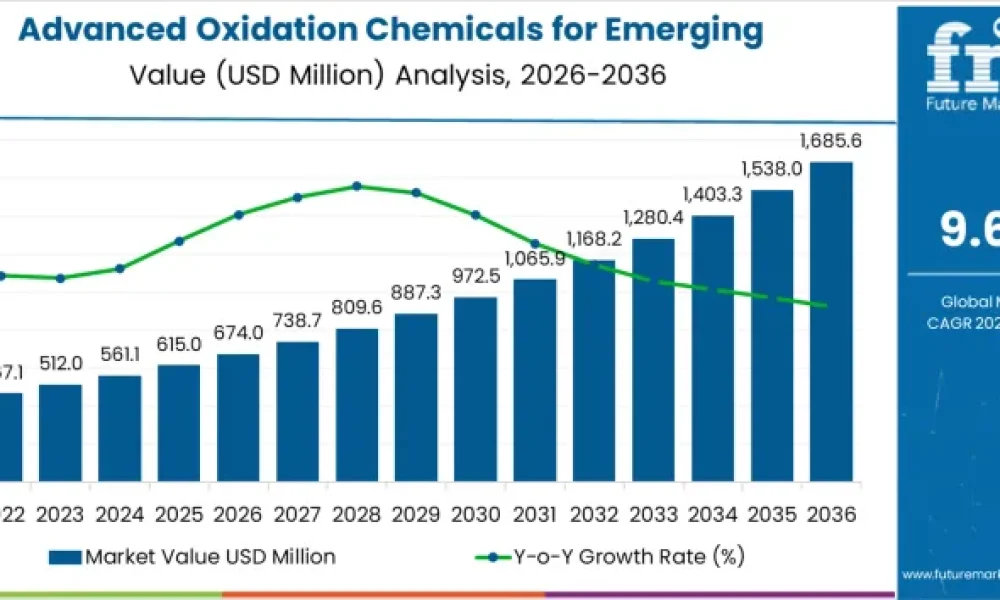
The global Advanced Oxidation Chemicals for Emerging Contaminants Market is poised for remarkable expansion from an estimated USD 674 million in 2026 to approximately USD 1,685.6 million by 2036, demonstrating a robust Compound Annual Growth Rate (CAGR) of 9.6% over the next decade. This significant growth reflects intensifying demand for advanced chemical solutions capable of degrading persistent and hazardous contaminants that evade conventional water treatment methods, including pharmaceuticals, PFAS, endocrine disruptors, and other trace organics. Adoption is being driven by heightened regulatory pressures, accelerating infrastructure investments across municipal and industrial water treatment systems, and an increasing global focus on ensuring water safety and environmental protection.
Key Market Insights at a Glance
In 2026, the market valuation of USD 674 million underscores an inflection point where traditional treatment processes can no longer sufficiently address complex emerging contaminants. Forecasts indicate that by 2036 the market will more than double, underpinned by wide deployment of advanced oxidation chemicals such as ozone and ozonated blends, hydrogen peroxide formulations, UV-activated agents, and Fenton reagents. Regions including North America, Europe, and Asia Pacific are set to dominate value creation, with end-use sectors spanning municipal utilities, industrial wastewater management, pharmaceutical manufacturing, and other critical water treatment operations. Leading the charge are market incumbents that combine chemical expertise with engineered treatment solutions and performance validation.
Segment Overview
The market’s segmentation by chemical type reveals that ozone and ozonated blends account for roughly 30% of total demand due to their exceptional oxidation potential and effectiveness against recalcitrant organics. Hydrogen peroxide and UV-activated chemistries enhance treatment versatility, enabling targeted contaminant breakdown. By contaminant type, PFAS and pharmaceutical residues constitute approximately 28% of the market, as these compounds resist conventional filtration and biological processes and draw regulatory scrutiny for their persistence and health impacts. Municipal water and wastewater applications lead the adoption curve, followed by industrial effluent treatment, groundwater remediation, and advanced pilot system deployments, reflecting broadening use cases and performance optimization across treatment trains.
Regional Overview
Geographically, North America and Europe account for a significant share of early adoption, propelled by stringent regulatory frameworks, comprehensive monitoring programs, and high public awareness of emerging contaminant risks. Growth trajectories in Asia Pacific, particularly in India at a CAGR of 10.4% and China at 10.1%, highlight the rapid scaling of water safety infrastructure and industrial effluent management initiatives. The United States market is also expanding steadily at an 8.5% CAGR, reflecting pervasive integration of advanced oxidation chemicals to meet evolving regulatory and operational requirements. Germany and South Korea register consistent adoption, driven by mature treatment systems and targeted industrial water safety programs. These regional dynamics signify a global shift toward proactive contaminant control and investment in high-performance chemical technologies.
To access the complete data tables and in-depth insights — Request Your Sample Report Now
Competitive Landscape
The competitive landscape is shaped by a blend of specialty chemical manufacturers and engineered water treatment solution providers. Leading players such as Solvay, Evonik, Kemira, SUEZ Water Technologies, and Veolia Water Technologies are defining market direction through innovation in chemical performance, system integration, and contaminant-specific efficacy. Suppliers differentiate by optimizing oxidant reactivity, enhancing compatibility with automated dosing systems, and validating long-term performance across varied water matrices. Strategic investments in pilot testing, real-time monitoring capabilities, and contaminant breakdown efficiency strengthen supplier positions as end-users prioritize reliability and regulatory compliance.
Market Outlook: Powering the Next Decade
Looking ahead, the Advanced Oxidation Chemicals for Emerging Contaminants Market is on track to become a cornerstone of global water treatment strategies. Regulatory environments in developed and emerging economies continue to tighten permissible limits for trace contaminants, necessitating advanced chemical solutions capable of achieving deep oxidation and molecular breakdown. Innovation is expected to focus on hybrid treatment approaches — combining oxidation chemistries with membrane systems, biological processes, and real-time analytics — to enhance overall performance and cost-efficiency. The next decade will see expanded deployment in decentralized water systems, industrial process streams, and reuse applications, enabling utilities and industries to meet resilient water safety goals and environmental targets.
Key Players of Sustainable Label Industry
Within this accelerating market, sustainability and performance go hand-in-hand. Industry leaders are advancing formulations that reduce residual toxicity, improve handling safety, and minimize lifecycle impacts. These sustainable solutions facilitate compliance with emerging contaminant regulations, support circular water reuse frameworks, and underpin global efforts to safeguard public health and aquatic ecosystems.
Recent Strategic Developments
Recent strategic developments in the sector include expanded pilot deployments of ozone-based oxidation systems in municipal plants, collaborative research on next-generation hydrogen peroxide activations for industrial effluents, and enhanced service offerings from engineered solution providers that integrate chemical dosing with digital monitoring platforms. These initiatives reflect a market in transformation — one driven by data-backed performance, regulatory alignment, and a shared commitment to sustainable water stewardship.
Have a specific Requirements and Need Assistant on Report Pricing or Limited Budget please contact us – [email protected]
About Future Market Insights (FMI)
Future Market Insights, Inc. (FMI) is an ESOMAR-certified, ISO 9001:2015 market research and consulting organization, trusted by Fortune 500 clients and global enterprises. With operations in the U.S., UK, India, and Dubai, FMI provides data-backed insights and strategic intelligence across 30+ industries and 1200 markets worldwide.
Why Choose FMI: https://www.futuremarketinsights.com/why-fmi



