
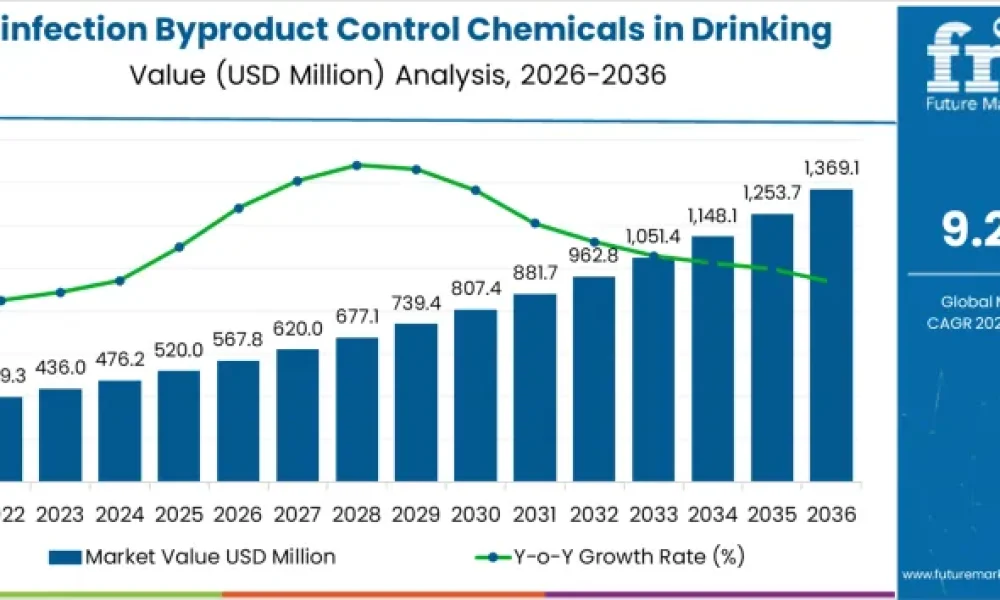
The global Disinfection Byproduct (DBP) Control Chemicals in Drinking Water Market is on a strong growth trajectory, with the market valued at approximately USD 561 million in 2026 and projected to reach around USD 1,369.1 million by 2036, fueled by a compound annual growth rate (CAGR) of 9.2 percent through the forecast period. This significant expansion reflects rising regulatory pressure, growing awareness of water safety, and faster adoption of advanced chemical solutions across municipal, industrial, and residential water treatment systems worldwide. Rapid urbanization, water quality concerns, and stricter compliance requirements are reshaping investment priorities and catalyzing innovation in DBP control.
Key Market Insights at a Glance
The DBP control chemicals market is driven by escalating demand to curb harmful byproducts such as trihalomethanes (THMs) and haloacetic acids (HAAs), which form when disinfectants like chlorine interact with organic matter in source water. Activated carbon and adsorbents currently dominate the chemical type landscape due to their broad applicability, regulatory familiarity, and effectiveness in removing precursor compounds ahead of disinfection. Municipal drinking water plants hold the largest share among application areas, accounting for nearly 38 % of total demand as utilities strive to balance effective disinfection with byproduct minimization.
Segment Overview
The market’s segmentation by chemical type includes activated carbon & adsorbents, chlorine scavengers (such as sulfites and thiosulfate), bio-based agents, pH adjusters & coagulant aids, and specialty chemicals tailored for specific DBP challenges. Among these, activated carbon and adsorbents capture the largest share, offering a reliable solution for precursor removal and ancillary benefits like improved taste and odor. In application areas, municipal systems lead due to stringent regulatory frameworks, while industrial potable water systems, residential treatment solutions, rural networks, and point-of-entry household filtration contribute secondary demand. Segmentation by DBP type controlled captures entities like THMs, HAAs, chloramines, bromate/chlorite, and emerging contaminants, reflecting diversified technical needs across treatment scenarios.
Regional Overview
Regionally, North America, Europe, and Asia Pacific are key growth hubs. North America and Europe benefit from mature regulatory environments and extensive infrastructure investments that promote early adoption of DBP control chemicals. Meanwhile, the Asia Pacific region, particularly India and China, is experiencing rapid expansion due to urbanization, rising water treatment capacity, and strong policy emphasis on drinking water quality. India is projected to register one of the highest regional CAGRs at around 10 %, followed by China at nearly 9.7 %, driven by structural upgrades and compliance with evolving national standards. The United States and Germany continue to exhibit steady growth, reflecting consistent regulatory enforcement and water safety initiatives.
To access the complete data tables and in-depth insights — Request Your Sample Report Now
Competitive Landscape
The competitive landscape features established chemical and water treatment technology providers that emphasize performance, compliance support, and integrated solutions. Industry leaders such as Kemira, Ecolab, Solenis, Veolia Water Technologies, and SUEZ Water Technologies maintain strong market positions by offering broad portfolios designed to control DBPs while enhancing overall treatment efficiency. These players differentiate through application-specific technical support, extensive field validation, and the ability to tailor chemistries to diverse source water characteristics and regulatory environments.
Market Outlook: Powering the Next Decade
Looking ahead, the DBP control chemicals market is expected to enter an accelerated growth phase from 2030 onward as utilities and treatment providers adopt advanced, sustainable chemistries that align with stricter health standards and holistic water quality management models. Innovations in adsorbents, bio-based agents, and coagulant technologies will play a central role in expanding use cases from centralized municipal plants to decentralized and consumer-oriented systems. Emerging automation and process optimization solutions will further improve dosing precision and operational resilience. Growth will be anchored in regulatory compliance imperatives, advances in source water protection, and broader deployment of digital water quality monitoring tools that inform data-driven dosing strategies.
Key Players of Sustainable Label Industry
Market participants are increasingly incorporating sustainability into product development, emphasizing bio-based formulations, reduced environmental footprints, and compatibility with green water treatment approaches. Companies that integrate these principles while delivering robust performance stand to gain competitive advantage as water utilities and stakeholders prioritize long-term safety, ecological responsibility, and cost-effective compliance pathways.
Recent Strategic Developments
Recent industry moves include enhanced portfolio extensions, strategic partnerships to expand geographic footprints, and investments in research and development aimed at next-generation DBP control solutions. Collaborations between chemical suppliers and technology integrators support comprehensive water quality programs that combine chemistry, real-time monitoring, and process engineering, further solidifying the market’s readiness to meet evolving regulatory and operational demands.
The global DBP control chemicals sector is thus positioned for sustained momentum through 2036, underpinned by regulatory compliance, health-driven water quality objectives, and continuous innovation that addresses both existing and emerging disinfection byproduct challenges.
Have a specific Requirements and Need Assistant on Report Pricing or Limited Budget please contact us – [email protected]
About Future Market Insights (FMI)
Future Market Insights, Inc. (FMI) is an ESOMAR-certified, ISO 9001:2015 market research and consulting organization, trusted by Fortune 500 clients and global enterprises. With operations in the U.S., UK, India, and Dubai, FMI provides data-backed insights and strategic intelligence across 30+ industries and 1200 markets worldwide.
Why Choose FMI: https://www.futuremarketinsights.com/why-fmi



