
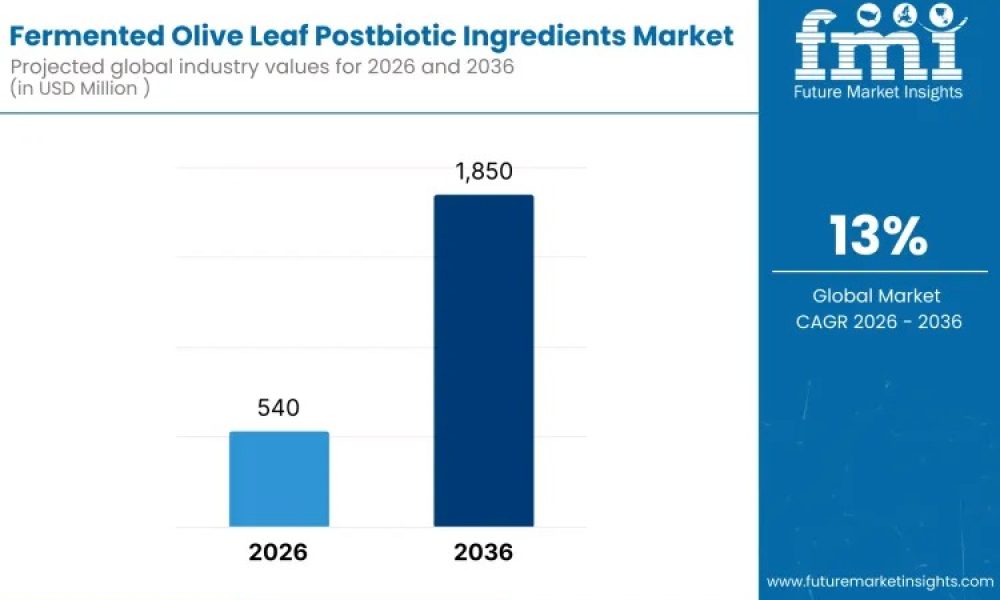
The global fermented olive leaf postbiotic ingredients market is entering a high-growth phase, driven by accelerating demand for functional, plant-based ingredients that support gut health, immune function, and holistic wellness. Valued at USD 540 million in 2026, the market is projected to expand to USD 1,850 million by 2036, registering a robust compound annual growth rate (CAGR) of 13% over the forecast period.
This momentum reflects a broader shift in consumer behavior toward preventive healthcare and scientifically supported nutrition. Postbiotics—bioactive compounds produced during fermentation—are gaining preference over traditional probiotics due to their stability, safety, and consistent functional performance. Fermented olive leaf derivatives, rich in polyphenols and antioxidant metabolites, are emerging as premium ingredients within this evolving landscape.
The market is also benefiting from growing sustainability awareness. Olive leaves, traditionally considered agricultural by-products, are now being upcycled through controlled fermentation processes, aligning well with circular-economy and clean-label trends in the global wellness industry.
Explore trends before investing – request a sample report today!
Dietary Supplements Lead End-Use Demand
Dietary supplements dominate the fermented olive leaf postbiotic ingredients market, accounting for 45% of total end-use application share. Rising consumer focus on digestive health, immune resilience, and inflammation management has significantly increased demand for postbiotic-enriched capsules, tablets, and powders.
Unlike live probiotics, postbiotics offer longer shelf life, formulation flexibility, and predictable efficacy, making them particularly attractive to supplement manufacturers targeting mass and premium wellness segments. Fermented olive leaf postbiotics are increasingly positioned as science-backed, plant-derived alternatives that support microbiome balance without the challenges of live microbial viability.
Powdered Extracts Drive Product Innovation
By product form, powdered postbiotic extracts account for 42% of the global market share, reflecting their versatility and stability. These extracts are easily incorporated into dietary supplements, functional foods, and fortified beverages, offering manufacturers greater formulation control and cost efficiency.
The fermentation process enhances the bioavailability of olive leaf compounds, resulting in concentrated postbiotic metabolites with antioxidant and anti-inflammatory properties. Powdered formats also simplify storage, transportation, and global distribution, making them the preferred choice for multinational ingredient suppliers and nutraceutical brands.
Key Market Statistics at a Glance
- Market Value (2026): USD 540 million
- Forecast Value (2036): USD 1,850 million
- Forecast CAGR (2026–2036): 13%
- Top End-Use Segment: Dietary Supplements (45%)
- Leading Product Form: Powdered Postbiotic Extracts (42%)
Regional Demand Accelerates Across Asia and Western Markets
The fermented olive leaf postbiotic ingredients market is witnessing strong uptake across both emerging and mature economies. India, China, the United States, the United Kingdom, and Japan represent the most dynamic growth regions, supported by rising health awareness and expanding nutraceutical consumption.
- India leads global growth with a CAGR of 16.3%, driven by preventive healthcare adoption, herbal ingredient acceptance, and expanding middle-class spending on wellness products.
- China follows closely at 14.6% CAGR, supported by urban health trends and demand for functional nutrition solutions.
- The USA, growing at 12.8% CAGR, benefits from strong clean-label demand and established dietary supplement markets.
- The UK (11.9%) and Japan (10.7%) show steady growth, underpinned by aging populations and long-standing interest in gut health and longevity.
Market Drivers and Structural Challenges
Key growth drivers include rising consumer interest in plant-based functional ingredients, increasing clinical attention on postbiotic benefits, and the expansion of global nutraceutical and functional food industries. Manufacturers are leveraging fermentation technology to deliver differentiated, high-value bioactives with consistent quality profiles.
However, the market faces challenges related to raw material variability, fermentation standardization, and regulatory complexity across regions. Ensuring consistent bioactive content and meeting evolving food and supplement regulations require advanced processing expertise and quality control systems, which can elevate production costs.
Access the full report for detailed market trends.
Competitive Landscape Remains Innovation-Focused
The global market is moderately consolidated, with competition centered on extract standardization, scientific validation, and scalable production. Leading players include Indena S.p.A, Frutarom (part of IFF), Arjuna Natural Pvt Ltd, Bioflora, and Symrise AG. These companies focus on botanical expertise, fermentation innovation, and technical support for formulation partners across nutraceutical, functional food, and personal care sectors.
Key Players
- Indena S.p.A
- Frutarom (part of IFF)
- Arjuna Natural Pvt Ltd
- Bioflora (postbiotic ingredient developer)
- Symrise AG
About Future Market Insights (FMI)
Future Market Insights, Inc. (FMI) is an ESOMAR-certified, ISO 9001:2015 market research and consulting organization, trusted by Fortune 500 clients and global enterprises. With operations in the U.S., UK, India, and Dubai, FMI provides data-backed insights and strategic intelligence across 30+ industries and 1,200+ markets worldwide.



