
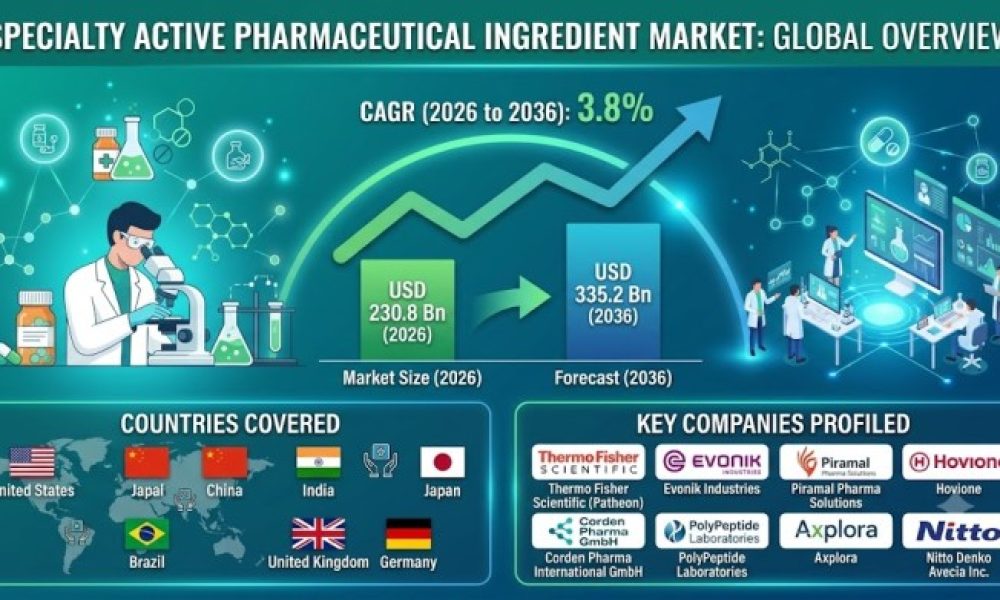
NEWARK, Del. — The global specialty active pharmaceutical ingredient (API) market is projected to grow from USD 230.8 billion in 2026 to USD 335.2 billion by 2036, registering a 3.8% CAGR, according to Future Market Insights. The market was valued at USD 222.4 billion in 2025, with growth linked to oncology drug development, high-potency active ingredients, peptide manufacturing, and increased reliance on contract development and manufacturing organizations (CDMOs).
Procurement decisions increasingly depend on whether suppliers can manufacture complex drug substances under appropriate containment conditions and maintain consistent quality across commercial batches. FMI identifies high-potency APIs (HPAPIs), peptide APIs, and biotechnology-derived ingredients as important areas of demand. Pharmaceutical companies are also outsourcing more complex production to specialist manufacturers with established quality systems and regulatory inspection readiness.
👉 Get Detailed Market Forecasts, Competitive Benchmarking, and Pricing Trends:
https://www.futuremarketinsights.com/reports/sample/rep-gb-1719
Where Growth Is Fastest
- China: The specialty API market is forecast to grow at a 5.9% CAGR from 2026 to 2036, the fastest rate among the countries profiled. Large domestic manufacturing capacity, integrated feedstock access, and CDMO expansion support growth, while tighter environmental compliance can affect supplier qualification.
- India: Demand is projected to increase at a 5.4% CAGR. Capacity additions and import-substitution efforts are creating opportunities for domestic manufacturers, although imported feedstock dependence and price competition remain challenges.
- United Kingdom: The market is expected to grow at a 3.2% CAGR. Stable downstream pharmaceutical demand supports procurement, while import dependence and documentation requirements influence supplier selection and lead times.
- Germany: Sales are forecast to rise at a 3.0% CAGR. An integrated chemical industry and specification-led demand support the market, while energy costs and environmental compliance influence manufacturing economics.
- United States: The market is projected to expand at a 2.0% CAGR. Established pharmaceutical demand and efforts to strengthen domestic specialty production support opportunities, although established supplier relationships can make qualification of new manufacturers time-consuming.
What Leads the Market
- High-potency APIs: This product category is projected to account for 67.0% of market demand in 2026. Oncology and targeted therapies require potent drug substances manufactured with specialized containment, handling, and quality controls.
- Outsourced manufacturing: Outsourced production is expected to represent 57.0% of consumption demand in 2026. Pharmaceutical companies are relying on CDMOs for specialized equipment, technical expertise, and production capacity.
- Oncology APIs: This therapeutic category is forecast to account for 38.2% of demand in 2026, reflecting the importance of cancer drug development and the manufacturing requirements associated with targeted therapies.
- Synthetic APIs: Chemical synthesis is expected to represent 54.6% of manufacturing-type demand in 2026, supported by its role in producing small-molecule specialty APIs and many high-potency ingredients.
- Pharmaceutical companies: This end-user group is projected to account for 51.0% of demand in 2026, as originator and generic drug manufacturers continue to source specialized ingredients for their product portfolios.
The Hurdle
High-potency API manufacturing requires significant investment in containment systems, specialized facilities, process controls, and quality assurance. These requirements can lengthen the time needed to qualify production capacity and bring new manufacturing lines into commercial use.
Regulatory inspection readiness and batch-to-batch consistency also influence procurement. Buyers must assess more than quoted API prices: a supplier’s containment capabilities, documentation, technical support, and ability to maintain reliable delivery can affect the total cost and continuity of supply.
FMI identifies capital-intensive HPAPI facilities and regulatory inspection complexity as key restraints on capacity expansion. Suppliers that cannot meet qualification requirements may find it difficult to secure contracts for complex drug substances.
👉 Access the Complete Report in PDF Format:
https://www.futuremarketinsights.com/reports/brochure/rep-gb-1719
Industry Investment and Recent Developments
- April 2025: Thermo Fisher Scientific announced a USD 2 billion investment in U.S. manufacturing and research and development over four years, including USD 1.5 billion in capital expenditure to expand domestic biopharmaceutical and pharmaceutical services manufacturing capacity.
- January 2025: PolyPeptide Laboratories announced plans to double solid-phase peptide synthesis capacity at its manufacturing site in Malmö, Sweden, responding to growing clinical and commercial demand for peptide APIs.
FMI profiles Thermo Fisher Scientific (Patheon), Evonik Industries, Piramal Pharma Solutions, Hovione, Corden Pharma International GmbH, PolyPeptide Laboratories, Axplora, and Nitto Denko Avecia Inc. The competitive field includes global CDMOs, specialty API manufacturers, peptide producers, and oligonucleotide API suppliers.
Companies compete through manufacturing breadth, specialized containment capability, regulatory compliance, and the ability to support customers from development through commercial-scale production. Focused suppliers can also compete in niches such as spray-dried APIs, peptide synthesis, lipid APIs, and oligonucleotide manufacturing.
Analyst View
Anurag Sharma, Principal Consultant at Future Market Insights, said:
“Buyers are expected to judge hpapi on performance and total cost of ownership rather than headline price. Specialty API adoption is expected to depend on oncology pipeline advancement and CDMO outsourcing expansion. Suppliers that combine HPAPI containment capability with regulatory inspection readiness across multiple geographies are likely to secure multi-year CDMO supply agreements.
Market success is projected to depend on meeting batch consistency and containment requirements for increasingly potent and complex drug substance manufacturing.”
What This Means for API Manufacturers and Pharmaceutical Buyers
- Evaluate suppliers on total cost of ownership. Containment capability, batch consistency, technical support, and delivery reliability can matter as much as the initial quoted price.
- Secure capacity for complex molecules early. HPAPI and peptide manufacturing can require specialized equipment and extended qualification, making early capacity planning important for pharmaceutical companies and CDMOs.
- Build geographic resilience into sourcing. China’s and India’s higher forecast growth rates point to expanding manufacturing opportunities, while supplier qualification and regulatory documentation remain essential across markets.
Access Full report: https://www.futuremarketinsights.com/reports/specialty-active-pharmaceutical-ingredients-market
Report Scope
The Specialty Active Pharmaceutical Ingredient Market report covers HPAPIs, peptide APIs, biotechnology-derived APIs, polymer APIs, carbohydrate APIs, and other specialty ingredients. Consumption is divided into outsourced and in-house production, while therapeutic areas include oncology, cardiovascular, and central nervous system APIs.
The study also examines synthetic, biotechnology-derived, and semi-synthetic manufacturing; pharmaceutical companies, biotechnology companies, and contract research organizations; and markets across North America, Latin America, Europe, East Asia, South Asia and the Pacific, and the Middle East and Africa. The forecast period runs from 2026 to 2036.
About Future Market Insights
Future Market Insights, Inc. (FMI) is an ESOMAR-certified market research and consulting firm headquartered in Delaware, USA, with offices in the United Kingdom, the United Arab Emirates and India. FMI delivers syndicated and custom research across food and beverage, healthcare, chemicals, technology, packaging, consumer goods and industrial sectors.
Media Contact
Future Market Insights, Inc.
Phone: +1-347-918-3531



