
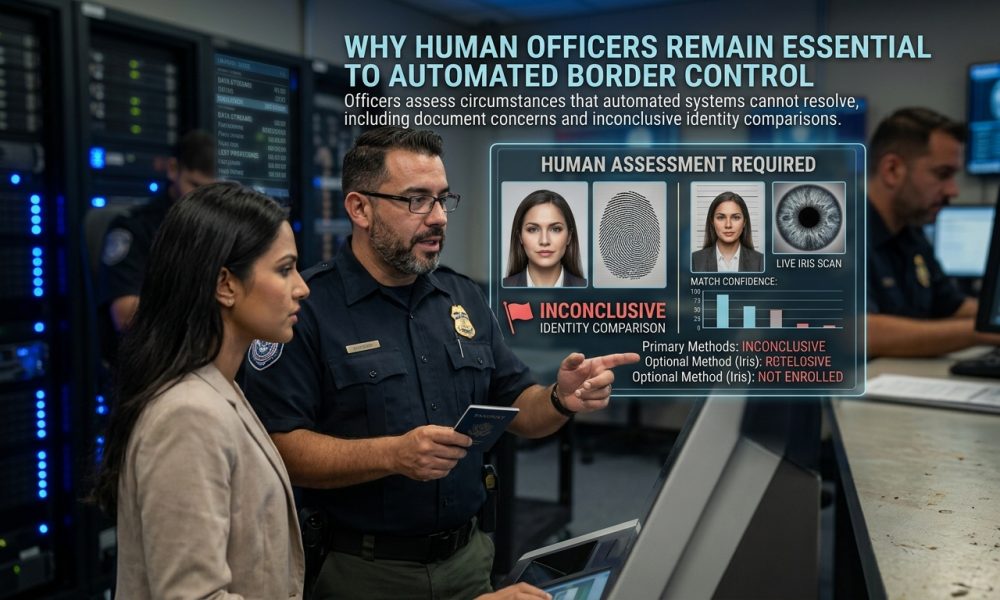
Officers assess circumstances that automated systems cannot resolve, including document concerns and inconclusive identity comparisons.
WASHINGTON, DC, October 12, 2026 – As international airports expand automated passport control systems, facial recognition technology, and electronic identity verification, immigration authorities continue to rely on trained border officers to assess situations that software, biometric comparisons, or electronic document authentication alone cannot conclusively resolve.
Although automated border gates can process eligible travelers within seconds, the technology still depends on accurate reference Information, properly functioning equipment, and predefined decision rules that cannot address every circumstance encountered during international immigration inspections.
Human officers provide essential Judgment when biometric comparisons fail. These documents require additional examination, or immigration officers face circumstances involving legal interpretation, inconsistent Information, or questions about a traveler’s eligibility to enter a country.
The growing importance of automation has not eliminated the need for immigration professionals; instead, it has changed how they deploy their expertise, allowing routine transactions to proceed electronically while directing uncertain or complex cases to appropriately trained personnel.
For governments modernizing international border infrastructure, the central challenge is combining technological efficiency with professional human oversight to ensure legitimate travelers receive fair treatment. At the same time, immigration authorities maintain effective security and document-verification procedures.
Automated Border Control Was Designed to Support Officers
Automated border control systems were developed to improve the efficiency of international passenger processing by performing selected identity verification tasks electronically, reducing the need for officers to conduct every routine passport comparison through conventional inspection counters.
Depending on the airport and jurisdiction, an automated gate may examine the passport’s machine-readable Information, authenticate data from an electronic chip, capture a live facial photograph, and consult authorized immigration systems before determining whether routine processing requirements have been satisfied.
These operations can substantially reduce processing time for eligible travelers, particularly when identity records are consistent, electronic travel documents function correctly, and the individual’s biometric characteristics correspond sufficiently with the reference Image used by the inspection system.
However, automated gates operate within predefined technical and administrative requirements, meaning they can disrupt processing when Information falls outside accepted parameters, even when the underlying problem does not necessarily involve fraud or unlawful activity.
Human officers remain responsible for examining these unresolved circumstances and applying the relevant legal and operational requirements, a division of responsibilities that allows automation to improve efficiency without replacing the broader Judgment required during immigration inspections.
Why Facial Recognition Cannot Resolve Every Identity Question
Facial recognition technology compares mathematical representations of facial characteristics to determine whether two images are sufficiently similar under the operating requirements established for a particular biometric verification system and its intended Application.
At an airport inspection point, the software may compare a newly captured facial Image with a portrait stored in an electronic passport or another authorized identity record and produce a similarity measurement evaluated against a configured acceptance threshold.
While modern recognition algorithms can accommodate many ordinary variations in appearance, differences involving aging, lighting, facial position, Image resolution, or temporary changes in physical appearance may still interfere with otherwise legitimate identity comparisons.
A traveler whose current appearance differs substantially from an older passport photograph may consequently receive an unsuccessful automated result, even when the passport is authentic and the individual remains its lawful holder.
When officers cannot complete a comparison satisfactorily, they can examine the traveler’s appearance, review the document, obtain additional Information, or use another authorized verification procedure to determine whether the discrepancy requires further investigation.
An Unsuccessful Biometric Match Does Not Establish Fraud
One of border personnel’s most important responsibilities is distinguishing between technical difficulties and genuine identity concerns, because an unsuccessful facial recognition comparison does not independently demonstrate that a traveler has presented false Identification.
Biometric recognition systems measure similarity according to mathematical decision rules, and their results can be affected by Image quality, equipment performance, enrollment errors, and the thresholds selected by the authority operating the technology.
A legitimate traveler may therefore be referred for additional inspection simply because the automated system could not obtain sufficient biometric confidence, rather than because the person has violated immigration requirements or used fraudulent documentation.
The International Civil Aviation Organization addresses these considerations in its Guide on Border Control Management, which explains that resolving inconclusive biometric results requires appropriately trained personnel with relevant knowledge and experience in identity verification.
For immigration authorities, this distinction matters because automated referrals must be interpreted within the broader inspection process, ensuring ordinary technological limitations do not automatically become accusations of criminal conduct or documentary fraud.
Passport Authentication Requires More Than Facial Recognition
Electronic passports contain security features designed to help inspection systems determine whether digitally stored Information has been altered and whether recognized cryptographic verification procedures can authenticate the document’s electronic data.
However, successful electronic Authentication does not establish every fact relevant to immigration clearance, because confirming the integrity of passport data is different from determining whether the person presenting the document is its rightful holder.
Similarly, a successful facial comparison does not independently establish that a passport remains valid, that the traveler possesses the necessary immigration authorization, or that the document satisfies every requirement imposed by the destination country.
Human officers can examine physical security features, compare personal Information with available records, and investigate discrepancies between the document, biometric results, and other Information presented during the inspection process.
This layered approach recognizes that international identity verification involves several separate questions, including whether the document is genuine, whether the presenter matches the recorded identity, and whether the individual meets applicable entry requirements.
When Electronic Passport Chips Cannot Be Read
Electronic passport chips can occasionally fail to read because of equipment compatibility, physical damage, communication problems, or other technical limitations that interfere with the inspection system’s ability to retrieve Information reliably.
A failed electronic reading operation does not automatically indicate a counterfeit passport, since authentic documents can still encounter technical difficulties even when their printed Information and physical security features remain intact.
Depending on the jurisdiction and applicable rules, immigration officers may manually examine the passport, use alternative equipment, consult authorized records, or conduct additional checks to determine whether to accept the document.
These procedures matter because electronic Authentication and physical document examination provide different forms of evidence, allowing officers to decide whether an unsuccessful chip transaction reflects a technical problem or a concern that requires investigation.
Nevertheless, human examination should not be described as universally equivalent to successful cryptographic Authentication, because visual inspection alone cannot establish certain electronic security properties, and unresolved concerns may require specialized document examination.
Officers Interpret Information That Automated Systems Cannot Fully Explain.
Automated inspection systems apply predefined rules and compare Information against authorized references, but they cannot independently resolve every administrative or legal question that arises during international travel.
A traveler may have recently changed a legal name, obtained replacement documentation, received updated immigration authorization, or encountered an administrative discrepancy that requires examining records not fully represented in an automated transaction.
Other situations may involve differences in identity Information caused by transliteration conventions, document issuance practices, historical record changes, or administrative errors that require knowledgeable interpretation rather than immediate conclusions about fraudulent conduct.
An experienced immigration officer can review available evidence, request clarification, and determine whether the discrepancy can be resolved under the applicable procedures or whether additional specialist examination is necessary.
Although computerized systems can identify inconsistencies and retrieve relevant Information, their usefulness ultimately depends on the accuracy of underlying records and authorized personnel’s ability to interpret the significance of conflicting evidence.
European Border Rules Preserve Human Oversight
European border legislation shows the importance of keeping human authority in automated inspection arrangements, especially where self-service equipment performs preliminary checks. Still, border guards remain responsible for reviewing results and addressing unresolved cases.
The European Union’s Schengen Borders Code sets out requirements for border checks, automated processing, and officer supervision, including when travelers must be referred for further examination.
The regulatory framework recognizes that automated equipment can perform designated verification activities while border personnel monitor inspection outcomes, consider relevant Information, and exercise responsibilities that cannot be delegated to biometric-matching algorithms.
European rules also address the need for sufficient personnel to assist individuals using automated inspection facilities, reflecting an understanding that operational efficiency must coexist with accessibility, appropriate supervision, and reliable procedures for resolving difficulties.
This approach shows that automation does not necessarily transfer final immigration authority to machines; instead, it gives border officials electronic Information and verification tools, supported by established legal requirements.
Europe’s Entry/Exit System Changes Border Processing
The European Union’s Entry/Exit System marks a major shift in digital border administration, replacing routine passport stamping with electronic records of eligible non-European travelers’ movements and related identity Information.
After its phased introduction in October 2025, the system became fully operational on April 10, 2026, establishing electronic registration procedures that include relevant travel document Information, facial images, fingerprints, and recorded border-crossing events.
The European Commission’s Entry/Exit System guidance explains how electronic registration supports immigration administration, helps identify overstays, and facilitates broader use of automated processing at participating external borders.
Nevertheless, digital registration does not eliminate border guards’ responsibilities, because officers must continue to address document discrepancies, eligibility questions, biometric difficulties, and other circumstances that require examination beyond routine electronic verification.
The distinction matters most for travelers encountering the system for the first time, since initial registration requirements and later verification procedures may involve different interactions with officials and different levels of automated processing.
United States Border Processing Also Relies on Officers
United States Customs and Border Protection has implemented facial recognition across numerous international travel environments, using biometric comparisons to support identity verification while maintaining officer involvement in immigration inspections and additional examinations.
The agency’s Global Entry touchless processing arrangements offer a practical example, letting enrolled travelers complete automated Identification steps while routing certain transactions to officers when the system indicates assistance or additional processing is needed.
According to official CBP guidance, some portal results instruct the traveler to proceed after successful processing. In contrast, other results require document scanning or officer assistance before the inspection process can be completed.
This distinction shows how automated systems can handle routine biometric transactions without independently resolving every issue, preserving immigration personnel’s ability to investigate matters that require additional Information or individualized consideration.
Even when biometric verification succeeds, government officers retain responsibility for immigration admissibility, customs matters, and other statutory requirements that cannot be reduced to a mathematical determination of facial similarity.
Human Judgment Matters During Secondary Inspection
Secondary inspection provides a structured process for examining matters that could not be resolved during initial border processing. However, procedures, available resources, and legal requirements vary considerably by country and port of entry.
A traveler may be referred for an inconclusive biometric comparison, a document irregularity, an immigration record requiring clarification, or another authorized reason that prevents officers from completing the routine inspection process.
During secondary examination, officers may consult additional records, review supporting documentation, ask inspection-related questions, or seek assistance from personnel specializing in document Authentication and identity verification.
A secondary referral should not automatically be interpreted as evidence of wrongdoing, because legitimate travelers may require additional inspection for reasons unrelated to deliberate misrepresentation or prohibited conduct.
For immigration authorities, consistent, professional referral procedures help distinguish routine verification difficulties from genuine security concerns while ensuring unresolved matters receive appropriate attention under the governing legal framework.
Training Helps Officers Recognize Document Security Features
Modern passports incorporate multiple physical and electronic security measures, including specialized printing, optical features, machine-readable Information, and cryptographically protected chip data that together support the Identification of certain forms of document manipulation.
Border officers need training to understand the purposes and limitations of these features, especially because sophisticated travel documents cannot be reliably evaluated based on a single visual characteristic or an isolated electronic verification result.
Specialized document examiners may also employ magnification, appropriate illumination, reference Information, and other authorized techniques to investigate irregularities that routine automated equipment cannot conclusively explain during initial processing.
However, interpret the absence or presence of an individual security feature within the document’s specific design and issuing period, rather than assuming every authentic passport from every country must display identical characteristics.
Professional expertise becomes especially important when physical document evidence and electronic results appear inconsistent, requiring officers to distinguish ordinary variations, technical limitations, and genuine concerns without relying on unsupported assumptions.
Automated Systems Cannot independently determine every immigration requirement.
International entry decisions involve more than matching a traveler to a passport photograph, because governments also apply legal requirements on citizenship, visas, residence status, travel purpose, admissibility, and other relevant circumstances.
Some of these requirements can be checked electronically, particularly where immigration authorities maintain reliable records and systems that can determine whether the necessary authorization appears valid at the time of inspection.
However, unusual circumstances may require interpreting supporting documents, reviewing administrative decisions, or considering legal exceptions that a predetermined automated workflow cannot adequately address.
Immigration officers can evaluate the available Information and determine whether the case requires supervisory review, specialist assistance, or further examination under the procedures established by the responsible government authority.
These responsibilities reinforce the distinction between biometric verification and immigration authorization, since correctly identifying a traveler does not independently establish that every condition governing international admission or departure has been satisfied.
Accessibility and Traveler Assistance Require Human Support
Automated border gates are designed around particular equipment configurations and user interactions. Still, travelers may face accessibility barriers due to mobility limitations, visual impairments, communication needs, or other circumstances that affect their ability to complete the automated process.
Camera positioning, document placement requirements, physical gate dimensions, and on-screen instructions can challenge some individuals, even when their travel documentation is authentic and their identity Information is recorded accurately.
Human personnel can provide guidance, direct travelers toward an appropriate inspection arrangement, and help resolve operational difficulties without treating the inability to use automated equipment as evidence of suspicious conduct.
Families traveling with young children, elderly passengers, and individuals needing additional assistance may also face eligibility restrictions or practical difficulties that make conventional officer-supported inspection more appropriate than automated processing.
Maintaining accessible alternatives is therefore an important part of responsible border modernization, ensuring that improved technological efficiency does not inadvertently prevent eligible individuals from completing required inspections through appropriate, lawful procedures.
Biometric Accuracy Still Requires Professional Interpretation
Facial recognition systems produce similarity measurements based on mathematical models, and their performance depends on Image quality, algorithm design, reference Information, and the acceptance thresholds configured for the particular operational environment.
A system may incorrectly associate photographs of different individuals or fail to associate photographs of the same person, creating error categories that authorities must understand when interpreting automated results and designing referral procedures.
Human officers are not immune to Identification errors either, so training, appropriate reference materials, and carefully structured review procedures are important safeguards, rather than assuming manual examination invariably produces more accurate outcomes.
Where authorized, supplementary fingerprint or iris comparisons may provide additional evidence. However, their usefulness depends on the availability of suitable enrollment records, compatible equipment, and lawful access to relevant biometric Information.
Human oversight therefore aims not simply to override automated decisions, but to evaluate uncertain results through additional evidence and established procedures while recognizing the limitations of both technological and manual methods.
Privacy and Accountability Remain Human Responsibilities
Automated border systems process sensitive Information, including facial photographs, document details, and potentially other biometric characteristics, creating legal and administrative responsibilities that extend beyond the technical performance of recognition software.
Government agencies must establish policies governing collection, authorized use, retention, Information sharing, and access to biometric records, while ensuring that personnel understand the responsibilities associated with processing sensitive traveler Information.
Human oversight remains important when identity records contain errors, when individuals need help understanding applicable procedures, or when a particular inspection raises concerns about the appropriate interpretation of personal Information.
The European Union Agency for Fundamental Rights has emphasized the importance of respectful treatment, data Protection, and appropriate assistance for individuals with particular needs during the implementation of modern electronic entry and exit procedures.
These considerations demonstrate that border modernization must be evaluated through more than processing speed, since public confidence also depends on lawful decision-making, accountability, and meaningful safeguards for individuals affected by government technology.
Automation Changes the Work of Border Officers
As automated systems handle more routine passenger transactions, immigration officers may spend more time examining exceptions, resolving Information discrepancies, and conducting inspections that require specialized attention.
This operational transition can improve personnel allocation when routine verification becomes more efficient. Still, its success depends on sufficient staffing, reliable technology, comprehensive training, and carefully designed procedures for transferring cases between systems and officers.
Poorly configured referral rules or unreliable equipment can create unnecessary workloads, particularly when repeated technical failures direct large numbers of legitimate travelers toward inspection personnel without providing useful Information about the original problem.
Conversely, effective automated processing can let officers focus on cases requiring legal Judgment, more detailed identity assessment, or the examination of security concerns that standardized electronic checks cannot resolve.
The long-term effectiveness of automated border control will therefore depend on treating technology and human expertise as complementary resources rather than competing substitutes within an increasingly complex international immigration environment.
Conclusion: Human Expertise Remains Central to Secure Borders
Automated passport gates, facial recognition systems, and electronic immigration databases have transformed international border processing. Still, these technologies depend on accurate Information, established operational procedures, and human personnel who can resolve circumstances beyond routine electronic verification.
Trained officers provide essential safeguards when biometric comparisons fail, travel documents require closer examination, immigration records contain discrepancies, or individual circumstances demand interpretation that automated decision rules alone cannot reliably provide.
Continued development of digital border infrastructure will likely make routine identity checks faster and more consistent, while also increasing the importance of officers who understand biometric limitations, document security, legal requirements, and appropriate procedures for uncertain cases.
For Amicus International Consulting, these developments reinforce the importance of authentic travel documents, accurate identity records, lawful international mobility, and an informed understanding of how biometric technologies interact with professional immigration inspection procedures.
Ultimately, the most effective border control systems will not eliminate human involvement, but combine secure technology with accountable officers who can distinguish genuine security concerns from ordinary technical difficulties while protecting the integrity of international travel.




