
NEWARK, Del. — The global fertility treatment nutrition market is projected to grow from USD 854.9 million in 2026 to USD 2,138.0 million by 2036, advancing at a 9.6% CAGR during the forecast period, according to Future Market Insights. The market was valued at USD 780 million in 2025.
Demand is being supported by longer preconception planning periods, assisted reproductive technology (ART), and fertility-preservation pathways that create defined windows for consumers to establish nutrition routines. In July 2026, CDC guidance recommended 400 micrograms of folic acid daily before conception. Separately, the American Society for Reproductive Medicine reported in March 2026 that 364 U.S. fertility clinics recorded 449,772 IVF treatment cycles in 2024, based on data from SART-member clinics.
👉 Get Detailed Market Forecasts, Competitive Benchmarking, and Pricing Trends:
https://www.futuremarketinsights.com/reports/sample/rep-gb-35631
Where Growth Is Fastest
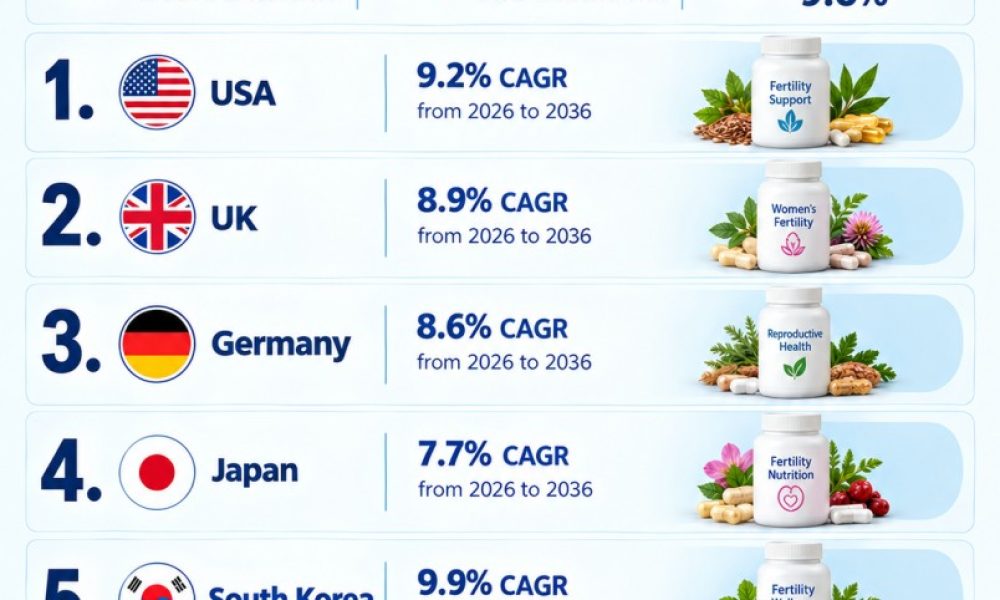
- South Korea: The market is forecast to expand at the fastest rate among profiled countries, reaching a 9.9% CAGR from 2026 to 2036. The Ministry of Health and Welfare said in April 2026 that fertility support would shift toward a package incorporating prevention and mental health after preconception health program applications reached 291,246 in 2025.
- United States: Demand is projected to rise at a 9.2% CAGR. The country’s large IVF treatment base creates recurring preparation windows, while buyers increasingly scrutinize product claims, doses, and evidence.
- United Kingdom: The market is expected to grow at an 8.9% CAGR. HFEA reported more than 77,500 IVF cycles in 2023, while the share funded by the NHS declined to 27% from 35% in 2019.
- Germany: Sales are forecast to increase at an 8.6% CAGR. Statutory health insurance generally covers 50% of approved artificial-insemination costs for eligible patients, leaving fertility nutrition as a separate consumer purchase and increasing the importance of clear product education.
- Japan: The market is projected to expand at a 7.7% CAGR, the lowest among the five profiled countries. A 2026 Japan Society of Obstetrics and Gynecology report recorded 561,664 ART treatment cycles in 2023, with an average patient age of 37.3 years.
What Leads the Market
- Preconception multinutrients: This product type is expected to account for 45.6% of market revenue in 2026, retaining its central position as consumers establish nutrition routines before conception.
- Female users: Female products represent 50.9% of user demand in 2026, although male fertility and couples’ packs are gaining relevance as fertility assessment increasingly addresses both partners.
- Natural conception support: This treatment context holds a 45.1% share in 2026. IUI/IVF adjunct products and egg/sperm freezing preparation remain narrower categories but provide defined opportunities for treatment-stage packs.
- Capsules and softgels: The format accounts for 42.4% of market share in 2026, supported by the ability to combine multiple ingredients into a daily serving. Powders and gummies provide alternative formats where capsule burden becomes a consideration.
- Online/direct-to-consumer: Online/DTC channels are projected to hold 36.1% of sales channel revenue in 2026, helped by product education, bundles, subscriptions, and repeat ordering.
The Hurdle
Clinical evidence remains uneven for some fertility-specific antioxidant and nutraceutical interventions. The 2025 WHO infertility guideline, as cited by FMI, makes no recommendation for or against routine antioxidant use in infertile men. This creates a clear commercial constraint: brands must distinguish nutritional support from medical treatment and avoid claims that extend beyond available evidence.
FMI identifies ingredient rationale, dose transparency, quality signals, and clear treatment-stage instructions as important considerations for buyers and fertility-care decision-makers.
👉 Access the Complete Report in PDF Format:
https://www.futuremarketinsights.com/reports/brochure/rep-gb-35631
Industry Investment and Recent Developments
Product development and distribution are moving toward more targeted fertility routines and broader retail access.
- March 2026: Theralogix launched OvaNAD+, a women’s fertility supplement built around nicotinamide riboside and pterostilbene.
- By spring 2026: Bird&Be expanded from 300 to nearly 1,000 Ulta Beauty stores, carrying Female Fertility Power Prenatal and Male Fertility Power Prenatal with CoQ10.
- September 2026: Bird&Be raised USD 13 million in a Series A financing round led by BDC Thrive and BFG Partners.
FMI profiles Fairhaven Health, Theralogix, Bird&Be, Ovaterra, Zita West, Proceive, Needed, and Ritual as notable companies. The competitive field includes practitioner-oriented reproductive nutrition, couple-centered protocol packs, and consumer-lifestyle fertility and prenatal extensions.
Analyst View
Anurag Sharma, Principal Consultant at Future Market Insights, said:
“Fertility nutrition brands keeping supplement claims apart from treatment outcomes will hold buyers longer. A multinutrient base paired with optional male or treatment-stage modules will bring the most durable repeat purchasing.”
What This Means for Fertility-Nutrition Brands and Retail Buyers
- Build around the preconception base, then add targeted modules. Preconception multinutrients hold the largest product-type share, while male, IVF-support, and preservation-related products can address more specific preparation windows.
- Make evidence and dosage easy to evaluate. Uneven clinical evidence makes transparent ingredient rationale and substantiation increasingly important to clinicians, retailers, and consumers.
- Use treatment-stage timing to improve repeat purchasing. Fertility treatment and preservation pathways create defined periods in which structured three-month routines, couple packs, and subscription models can fit naturally into purchasing behavior.
Report Scope
The Fertility Treatment Nutrition Market report covers product types including preconception multinutrients, CoQ10 and antioxidant blends, IVF-support protocol packs, male fertility nutrition, and others. It analyzes female, male, and couples’ products across natural conception support, IUI/IVF adjunct use, egg/sperm freezing preparation, and other treatment contexts.
The study also covers capsules/softgels, powders, gummies, and other forms across online/DTC, retail pharmacy, supermarkets and hypermarkets, specialty and health stores, and other sales channels. FMI covers seven regions and more than 30 countries, with a forecast period extending from 2026 to 2036.
Access Full report: https://www.futuremarketinsights.com/reports/fertility-treatment-nutrition-market
About Future Market Insights
Future Market Insights, Inc. (FMI) is an ESOMAR-certified market research and consulting firm headquartered in Delaware, USA, with offices in the United Kingdom, the United Arab Emirates and India. FMI delivers syndicated and custom research across food and beverage, healthcare, chemicals, technology, packaging, consumer goods and industrial sectors.
Media Contact
Future Market Insights, Inc.
Phone: +1-347-918-3531



