
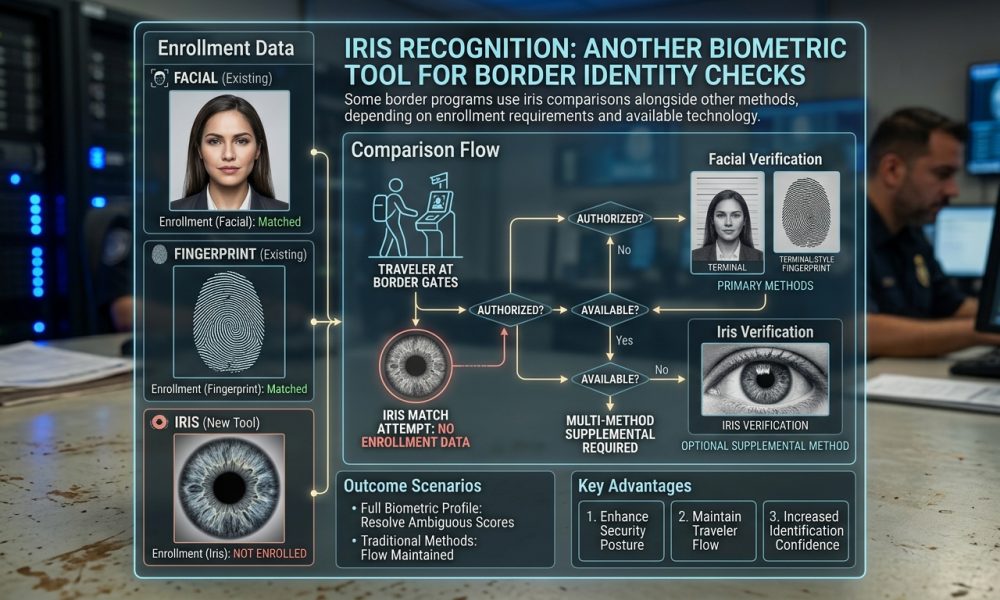
Some border programs use iris comparisons alongside other methods, depending on enrollment requirements and available technology.
WASHINGTON, DC, October 12, 2026 – As international border authorities continue investing in advanced biometric Identification systems, iris recognition has emerged as an additional technology that can support traveler verification, strengthen identity assessments, and help immigration officers resolve certain discrepancies that conventional facial comparisons may leave unanswered.
Although facial recognition remains the most widely deployed biometric method for automated passport inspections, specialized iris scanning technology offers another approach by examining detailed patterns within the colored portion of the human eye and comparing those characteristics against previously enrolled biometric records.
Several governments have explored or implemented iris recognition in immigration processing, particularly where travelers undergo biometric registration before using automated inspection facilities, allowing authorities to establish a reference record for later identity verification.
However, the availability of iris-scanning equipment does not mean every international airport collects iris images, that all electronic passports contain iris Information, or that immigration authorities have unrestricted access to biometric records maintained by other countries.
For governments developing integrated border security infrastructure, iris recognition’s main appeal is its ability to provide another measurable identity characteristic alongside facial photographs, fingerprints, authenticated travel documents, and established immigration records.
How Iris Recognition Identifies Distinctive Eye Patterns
Iris recognition examines the detailed structures within the iris, the colored circular tissue surrounding the pupil, where visible patterns contain characteristics that biometric algorithms can analyze and represent mathematically for comparison against previously registered images.
Unlike retinal scanning, which examines structures at the back of the eye, iris recognition typically uses specialized cameras to capture the visible iris, often using near-infrared illumination to obtain suitable images under controlled conditions.
The resulting Image undergoes processing that identifies the iris region, accounts for pupil and eyelid boundaries, and extracts distinguishing visual Information that can be converted into a biometric representation suitable for automated identity comparison.
Because iris patterns show substantial individual variation and generally remain comparatively stable throughout adulthood, well-implemented recognition systems can provide useful evidence when determining whether two captured samples came from the same individual.
Nevertheless, iris recognition is not infallible because Image quality, algorithm performance, and the characteristics of the individual being examined can affect whether an automated comparison produces a satisfactory result.
These limitations mean iris recognition should be understood as a probabilistic biometric comparison technology rather than a mechanism that can establish identity with absolute certainty under every possible inspection condition or operational circumstance.
Why Border Authorities Consider Iris Recognition
International immigration authorities increasingly require identity verification methods that operate efficiently while addressing document fraud, inconsistent personal Information, and other circumstances where determining whether a traveler matches an established identity record is critical.
Facial recognition offers considerable convenience because cameras can quickly capture a traveler’s appearance. Still, aging, lighting conditions, facial positioning, Image resolution, and changes between current photographs and older reference images can affect its performance.
Iris recognition provides a different biometric characteristic that may remain useful when facial photographs produce uncertain results. However, authorities must already possess a suitable reference record and have the equipment and authorization needed to conduct the comparison.
In environments where iris registration is integrated into immigration procedures, authorities may compare an arriving traveler against previously enrolled Information, potentially supporting automated processing when the system confirms that the submitted biometric sample meets established recognition requirements.
The operational value increases when multiple biometric methods are used together, because separate measurements can provide complementary evidence rather than forcing immigration authorities to rely on a single source of biometric Identification.
However, adding biometric methods also requires investment in specialized equipment, reference databases, secure enrollment procedures, staff training, and privacy safeguards governing how sensitive biological Information is collected, accessed, and retained.
Dubai Provides an Example of Iris-Based Border Processing
The United Arab Emirates provides a prominent example of iris recognition within automated border processing, having introduced immigration systems that incorporate facial and iris biometric technologies to support passenger verification at designated airport inspection facilities.
Dubai’s General Directorate of Residency and Foreigners Affairs describes its Smart Gates biometric passport control technology as incorporating facial and iris recognition, allowing appropriately registered travelers to complete authorized immigration processing through automated facilities.
The development demonstrates how immigration agencies can integrate iris recognition into automated border infrastructure, rather than limiting its use to separate biometric enrollment centers, investigative procedures, or specialized identity verification programs.
Travelers using Dubai’s Smart Gates must meet eligibility and registration requirements. At the same time, the specific Identification steps can depend on the individual’s immigration classification, recorded biometric Information, and the procedures in place at the inspection location.
Official guidance also explains that individuals unable to complete the automated process may return to an immigration counter, reinforcing the distinction between an unsuccessful biometric transaction and a determination that the traveler has committed wrongdoing.
Importantly, Dubai’s implementation should not be interpreted as evidence that iris recognition is universally deployed throughout the United Arab Emirates or that every individual passing through its international airports undergoes identical biometric collection procedures.
Biometric Enrollment Is Essential to Iris Verification
Before iris recognition can verify an individual’s identity against a known reference, an authorized organization must obtain and link a suitable iris Image to the person’s identity record through an enrollment process designed to preserve accuracy.
This initial registration establishes the Information against which later biometric samples can be evaluated, making the integrity of the original enrollment procedure just as important as the accuracy of the recognition technology used during subsequent inspections.
Depending on the jurisdiction, enrollment may occur during immigration registration, residence permit processing, trusted traveler participation, or another authorized government procedure that includes the collection of biometric Information for specified identity management purposes.
Once an appropriate record exists, an inspection system can compare a newly captured iris Image against that reference, provided the immigration authority has lawful access to the Information and the technologies involved can perform compatible comparisons.
Without an existing reference record, an iris scanner cannot independently establish who an unfamiliar traveler is, because capturing a distinctive biological characteristic does not automatically connect that characteristic with a verified name, nationality, or citizenship status.
This distinction is fundamental to understanding biometric Identification, since the accuracy of a physical comparison does not independently guarantee that the accompanying personal Information was correctly established when the reference record was first created.
Iris Verification and Iris Identification Are Different Procedures
Biometric systems distinguish between one-to-one verification, which tests whether a newly captured iris Image corresponds with a particular reference record, and one-to-many Identification, which searches an authorized collection for potential matches.
During one-to-one verification, the system evaluates whether the biometric sample meets the configured matching requirements for the individual’s claimed identity, usually within a specific enrollment or document verification process established by the responsible authority.
One-to-many Identification presents different technical and operational challenges because the software must examine potential correspondences across multiple records, adding considerations around database size, statistical performance, candidate evaluation, and the risk of incorrect associations.
For immigration purposes, the distinction matters because confirming that an individual matches an established reference is different from searching a collection of records to determine whether the individual’s biometric characteristics have appeared previously.
Neither procedure alone establishes whether a passport is genuine, whether a visa remains valid, or whether the traveler meets the legal requirements for admission to a particular country at the time of inspection.
Authorities must therefore interpret iris comparison results within the broader inspection context, considering document Authenticity, associated identity Information, applicable immigration law, and any additional Information that legitimately affects the traveler’s admission or departure processing.
Electronic Passports Do Not Universally Store Iris Information
A frequent misconception surrounding biometric travel documents is that every electronic passport contains a comprehensive collection of the holder’s facial, fingerprint, and iris Information, even though international technical specifications distinguish between required and optional biometric characteristics.
The International Civil Aviation Organization identifies the facial Image as the globally interoperable biometric reference for electronic passports. At the same time, fingerprint and iris Information represent additional biometric characteristics that issuing authorities may implement under applicable specifications.
ICAO’s electronic passport standards and biometric specifications provide the international framework for machine-readable travel documents, helping governments establish compatible electronic identity systems while accommodating differences in national document issuance policies.
Consequently, an electronic passport that displays a digital facial photograph through an authorized reader does not prove that the document also contains iris images, fingerprint records, or other biometric Information beyond its required data elements.
Likewise, an electronic passport chip does not mean a border officer can obtain iris characteristics from the document if the issuing authority has never enrolled or stored those characteristics in its passport infrastructure.
Travelers should therefore distinguish between biometric Information contained inside an electronic travel document and separate records maintained by immigration agencies, since these sources operate under different technical, administrative, and legal arrangements.
Iris Recognition Can Operate Without Retrieving Passport Iris Data
An iris recognition system at an international airport does not necessarily obtain its reference Information from the traveler’s electronic passport, because some government programs maintain enrollment records in authorized identity databases separate from the passport itself.
If a traveler previously registered through an approved immigration or Identification process, the newly captured iris Image may be compared with a reference associated with that enrollment, subject to applicable access permissions and operating requirements.
Such a system can potentially verify an individual using government-maintained Information even when the electronic passport contains only a facial biometric. However, the inspection still requires appropriate connections between the identity record and the traveler’s documentation.
This arrangement illustrates an important distinction between the security capabilities of electronic passports and those of government biometric infrastructures, which may maintain Information collected through several different authorized administrative or immigration processes.
However, separate biometric databases are not automatically interconnected across national borders, and an iris record in one country’s system does not mean immigration authorities elsewhere can retrieve or use the Information.
Cross-border access or exchange of biometric records depends on relevant legislation, operational arrangements, technical interoperability, and applicable information-sharing agreements, not merely on the existence of compatible cameras or biometric recognition software.
United States Authorities Have Evaluated Iris Technology
United States border agencies have examined several biometric Identification technologies, including facial recognition, fingerprints, and iris scanning, as part of broader efforts to improve identity verification and strengthen the reliability of immigration enforcement and traveler processing.
Customs and Border Protection previously evaluated iris recognition in selected operational and pilot environments, including pedestrian border processing, but later emphasized facial recognition for large-scale passenger verification because of its operational advantages.
The agency’s historical biometric testing demonstrated that recognition accuracy alone does not determine whether a technology is suitable for widespread deployment, because enrollment availability, capture procedures, processing speed, equipment requirements, and traveler experience also influence decisions.
According to a United States Customs and Border Protection biometric technology overview, the agency evaluated different recognition methods before selecting facial comparison as a particularly practical approach for many passenger-processing applications.
U.S. Customs and Border Protection
That operational preference does not mean iris recognition is technically ineffective; rather, different biometric methods have distinct practical requirements that may make one approach more suitable than another for particular border environments.
It would therefore be inaccurate to conclude that every United States airport now performs routine iris recognition, since the country’s established facial recognition infrastructure and specific biometric collection programs should not be confused with universal iris scanning.
Iris Recognition Can Complement Facial and Fingerprint Checks
Using multiple biometric characteristics, commonly described as multimodal biometric Identification, lets authorities evaluate separate forms of physical evidence when a single comparison is inconclusive or additional verification is justified.
Facial recognition examines learned facial characteristics, fingerprint recognition evaluates friction ridge Information, and iris recognition analyzes detailed eye patterns, providing different sources of biometric evidence that may respond differently to specific capture conditions.
For example, a poor passport photograph can complicate facial verification without necessarily affecting iris Image quality. At the same time, worn fingerprints may interfere with fingerprint acquisition without automatically preventing a successful facial comparison.
Nevertheless, no combination of biometric methods guarantees correct Identification in every circumstance, because each technology depends on suitable reference records, reliable acquisition equipment, properly configured recognition systems, and appropriate interpretation of the results.
The value of multimodal verification therefore lies in providing additional evidence where operationally appropriate, rather than assuming that accumulating more biometric characteristics will automatically resolve every identity discrepancy or eliminate every possibility of recognition error.
Immigration authorities must also consider proportionality, since collecting additional biological Information from travelers creates corresponding responsibilities involving lawful processing, data security, access restrictions, and clear procedures for addressing inaccurate records.
Iris Image Quality Can Affect Matching Results
Although iris recognition offers useful identity verification, it depends on capturing enough visual Information from the eye, so Image quality matters in determining whether automated comparisons produce reliable results.
Camera positioning, distance, eye movement, reflections, eyelid obstruction, unsuitable illumination, and certain eye conditions can affect the Information available to recognition software, potentially producing an unsuccessful comparison even when the individual has been correctly enrolled.
Specialized imaging equipment may use near-infrared illumination because it can reveal iris texture under suitable conditions. However, the effectiveness of any particular implementation depends on the Camera design and associated image-processing technology.
Contact lenses, including certain cosmetic or patterned lenses, can also complicate Image acquisition or recognition, depending on their characteristics and the system’s performance, so it is inappropriate to assume every lens produces identical effects.
An unsuccessful iris comparison therefore does not independently establish deliberate concealment, identity fraud, or an invalid travel document, because ordinary technical and physiological factors can also prevent a biometric system from satisfying its configured acceptance requirements.
When authorities cannot obtain a suitable iris Image, they may use another authorized verification procedure, including facial comparison, fingerprint examination, document inspection, or assistance from immigration personnel, depending on the capabilities and rules of the particular location.
Recognition Thresholds Influence Iris Matching Decisions
Like facial recognition systems, iris recognition technology can generate mathematical comparison results that system operators evaluate against configured decision thresholds, allowing them to set requirements for accepting or rejecting biometric similarities within a particular Application.
A stricter threshold generally reduces the likelihood of incorrectly associating two different individuals. However, it can also increase the chance that legitimate comparisons fail to meet the required recognition criteria.
Conversely, a more permissive threshold may reduce some unsuccessful genuine comparisons while potentially increasing the risk of incorrect associations, making appropriate calibration an important element of biometric performance management within security-sensitive environments.
Do not treat the numerical scores generated by different iris recognition systems as universal identity percentages, because algorithms use different mathematical representations, scoring conventions, and operating characteristics that affect how their outputs must be interpreted.
Government agencies evaluating iris recognition therefore need to examine false match rates, false non-match rates, enrollment quality, and operational performance under conditions representative of the travelers and environments in which the systems will operate.
These considerations reinforce the importance of distinguishing automated biometric measurements from legal identity determinations, since an algorithmic acceptance result does not independently establish the Authenticity of supporting documents or the traveler’s eligibility for admission.
Human Inspection Remains Necessary When Comparisons Fail
Automated biometric verification can reduce routine manual identity examinations. Still, immigration officers remain essential when iris recognition systems produce uncertain results, encounter technical problems, or flag Information that requires further investigation.
An unsuccessful iris comparison may lead to another Image capture attempt, review of existing enrollment records, verification through another authorized biometric method, or a traditional passport inspection by trained border personnel.
Do not automatically interpret such referrals as evidence of fraudulent identity, because biometric systems can encounter legitimate operational difficulties involving Image quality, enrollment conditions, equipment limitations, or inconsistent administrative Information.
Human review also lets authorities consider circumstances that automated matching software cannot resolve on its own, including document irregularities, immigration status questions, travel history discrepancies, and other legally relevant factors that require contextual examination.
At the same time, officers should not assume that a successful iris comparison eliminates the need for document Authentication, because confirming a physical correspondence with a reference record addresses only one component of the broader identity assessment.
Effective border security therefore depends on combining technology with lawful administrative procedures, accurate records, properly trained personnel, and reliable methods for correcting or investigating errors that automated processing alone cannot resolve.
Privacy Protections Are Important for Iris Biometric Records
Iris images and their associated biometric representations are sensitive personal Information because they describe relatively persistent biological characteristics, making unauthorized disclosure, improper association with identity records, and inappropriate secondary use significant concerns for government administrators.
Unlike passwords or ordinary account credentials, biometric characteristics cannot be replaced after unauthorized disclosure, underscoring the need for strong security controls throughout enrollment, transmission, storage, access, and eventual record disposal.
Government agencies collecting iris Information must operate within applicable legal frameworks that define authorized purposes, eligibility requirements, retention practices, permissible disclosures, and the circumstances under which they may share biometric information with other institutions.
These requirements vary by country, so an iris record collected during one immigration procedure may be subject to different privacy protections and administrative restrictions than Information collected through another government’s Identification program.
Travelers should also understand that deleting an Image from a scanning device does not necessarily erase Information maintained within a separate government database, since operational equipment and centrally administered records may follow different retention arrangements.
Public confidence in biometric border programs ultimately depends on authorities demonstrating that collection is necessary and proportionate, that Information remains appropriately protected, and that individuals have access to applicable procedures for addressing inaccurate identity records.
What Iris Recognition Means for International Travelers
For most international travelers, facial recognition and conventional passport inspection remain more familiar than iris scanning. However, encounters with specialized biometric technologies may increase as governments modernize their border processing infrastructure and expand authorized enrollment programs.
Travelers entering jurisdictions that use iris-based inspection facilities should expect the exact procedure to depend on their eligibility, registration status, travel document, and the technical arrangements set by the responsible immigration authority.
An individual who has previously completed iris enrollment may follow a different process than someone who has never registered. At the same time, another traveler may be directed to conventional inspection because the automated system cannot retrieve an appropriate reference.
The presence of biometric equipment should not be mistaken for universal collection requirements, because border agencies may apply different Identification procedures to citizens, residents, foreign visitors, and participants in specific immigration or trusted traveler programs.
Similarly, an iris scanner cannot independently establish a person’s nationality or legal entitlement to travel, so authentic identity documents and accurate government records remain essential, no matter how sophisticated biometric recognition technology becomes.
For travelers seeking to understand these procedures, consulting the relevant immigration authority before departure provides a more reliable explanation of current requirements than assuming every international airport follows the same biometric registration and verification policies.
The Future of Iris Recognition in Border Security
As biometric Identification technology advances, iris recognition may remain valuable in selected immigration environments where suitable enrollment records, specialized equipment, and operational requirements support its use alongside facial recognition and fingerprint verification.
However, broader deployment will depend on whether governments can demonstrate sufficient benefits in accuracy, processing efficiency, administrative reliability, and security to justify the financial and privacy implications associated with collecting another persistent biometric characteristic.
Advances in Camera technology and recognition algorithms may improve Image acquisition and matching performance. However, the practical usefulness of iris recognition will still depend on high-quality enrollment records and appropriate legal authorization.
The evolution of border management is therefore unlikely to involve replacing every existing inspection procedure with a single biometric technique, because immigration authorities must accommodate different traveler populations, infrastructure constraints, and verification requirements.
Instead, future systems may increasingly combine suitable biometric methods with authenticated electronic passports, carefully maintained identity databases, and human decision-making procedures that can resolve uncertainty without automatically treating unsuccessful comparisons as suspicious behavior.
For Amicus International Consulting, these developments are particularly relevant to international identity documentation and lawful cross-border mobility, where the integrity of official records and consistent, legitimate identity Information remain essential.
Conclusion: Iris Recognition Adds Another Layer to Border Identity Verification
Iris recognition is a sophisticated biometric Identification capability that can complement facial recognition and fingerprint verification when governments have suitable enrollment records, appropriate equipment, lawful access to Information, and well-established inspection procedures.
Its greatest contribution is providing another independent physical characteristic for identity assessment, particularly when officials need additional evidence to resolve discrepancies that conventional facial comparison alone cannot satisfactorily address.
Nevertheless, iris recognition is neither universally deployed nor automatically available through every electronic passport, and its effectiveness depends on reliable enrollment, secure data management, appropriate matching thresholds, and careful interpretation of automated results.
As international border agencies continue developing increasingly interconnected identity verification systems, travelers should expect technological diversity rather than uniform global procedures, with individual countries retaining responsibility for determining which biometric methods their legal and operational frameworks permit.
Ultimately, reliable international identity verification depends not simply on collecting more biometric Information, but on ensuring that each authorized technology contributes meaningful evidence within a secure, accountable, and professionally administered border inspection process.




