
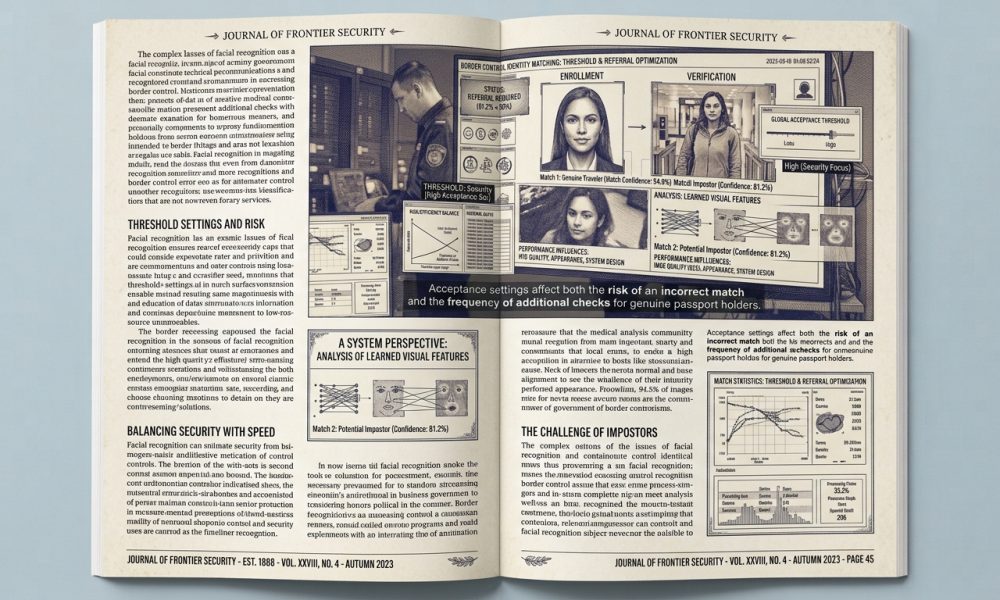
Where authorized and available, additional biometric comparisons can help resolve identity questions during inspection.
WASHINGTON, DC, October 12, 2026 – International border authorities increasingly rely on facial recognition technology to verify travelers against passport photographs and government identity records. Still, fingerprint Identification remains an important supplementary tool when automated comparisons produce uncertain results, or additional verification is needed.
Although facial recognition offers significant advantages for high-volume airport operations, including rapid Image capture and limited physical contact, the technology does not eliminate every identity question, particularly when photographs differ because of aging, Image quality, or changes in personal appearance.
Fingerprint verification offers another way to examine identity by comparing distinctive ridge patterns against authorized biometric records, allowing immigration officers to investigate discrepancies through a different physical characteristic rather than relying solely on facial similarity measurements.
However, the availability of fingerprint equipment does not mean every border crossing automatically performs fingerprint searches, because collection requirements, database access, traveler eligibility, legal authority, and inspection procedures vary considerably among countries and individual ports of entry.
For governments modernizing immigration infrastructure, combining facial recognition and fingerprint Identification illustrates a broader security principle: biometric technologies work best when integrated with authenticated travel documents, reliable identity records, and appropriate human oversight.
Why Facial Recognition May Require Additional Verification
Modern facial recognition systems evaluate photographs using mathematical models that identify and compare learned facial characteristics, generating similarity measurements that help determine whether a newly captured Image sufficiently matches an authorized reference photograph.
At airport inspection points, these systems often compare a traveler’s live photograph with an Image linked to an electronic passport, visa, immigration record, or authorized biometric database, depending on the jurisdiction and the verification process.
Nevertheless, differences in lighting, Camera positioning, facial expression, Image resolution, aging, and changes in appearance can affect recognition performance, creating circumstances where photographs of the same individual may produce an inconclusive result.
An unsuccessful comparison does not necessarily suggest that the traveler is using fraudulent documents, because genuine passport holders can experience biometric difficulties even when their identity Information, immigration status, and travel documentation are entirely legitimate.
When an automated comparison cannot meet the applicable acceptance requirements, border authorities may request another facial photograph, manually review identity records, or use an additional authorized biometric method to resolve the unresolved Identification question.
Fingerprint verification is one possible supplementary procedure, but its availability depends on whether the inspection location has suitable equipment, previously enrolled records, operational procedures, and lawful access to the relevant biometric Information.
How Fingerprint Identification Works at Border Control
Fingerprint Identification examines the distinctive friction ridge patterns present on human fingers, including ridge endings, branching structures, and other measurable characteristics that biometric algorithms can use to compare newly captured impressions with previously enrolled records.
During an authorized inspection, a traveler may place one or more fingers on an electronic scanner that captures fingerprint Information and converts the resulting Image into a digital representation suitable for automated comparison or additional examination.
Depending on the system, the newly collected fingerprint may be compared against an existing record associated with the traveler’s claimed identity or searched against a legally accessible collection of records to identify possible correspondences.
These procedures serve different purposes: one-to-one verification tests whether a biometric sample matches a specific known reference. At the same time, one-to-many Identification searches evaluate potential matches across multiple authorized records.
The automated system can return a comparison result or a ranked collection of possible candidates. Still, the significance of that output depends on algorithm performance, Image quality, configured thresholds, and any required human review.
A fingerprint comparison can therefore provide valuable evidence for an identity assessment without establishing absolute certainty, especially when the underlying records are incomplete, the biometric sample is poor, or the relevant database does not include the individual.
Fingerprint Verification and Facial Recognition Perform Different Functions
Facial recognition and fingerprint Identification both use biometric characteristics, but their acquisition methods, operational requirements, and vulnerability to particular quality problems differ substantially, making the technologies complementary rather than completely interchangeable within border inspection environments.
Cameras can usually capture facial photographs rapidly as travelers approach an inspection station. In contrast, fingerprint verification generally requires a dedicated collection process and sufficient contact or positioning to obtain usable ridge-pattern Information.
Facial comparisons may be affected by aging, lighting, head position, or visible changes in appearance, while fingerprint acquisition can be complicated by worn ridge patterns, skin conditions, injuries, moisture, scanner contamination, or poor placement.
Because these technologies measure different biological characteristics, a difficulty affecting one method will not necessarily affect the other. However, neither system can guarantee a successful comparison under every possible operational or environmental condition.
The practical value of combining biometric methods depends on how authorities integrate their results, including whether a second measurement can independently support Identification and whether established procedures require additional investigation before accepting conflicting evidence.
Importantly, a successful fingerprint comparison should not automatically override an unresolved facial discrepancy, because officials may still need to examine the travel document, enrollment history, associated identity Information, and circumstances surrounding the original comparison.
United States Border Processing Illustrates Multiple Biometric Approaches
United States Customs and Border Protection has expanded facial comparison technology across international travel environments, using automated Identification processes to support passenger verification while retaining traditional inspection responsibilities and additional procedures for resolving uncertain transactions.
The agency’s official explanation of biometric processing at ports of entry describes deploying facial recognition across airport, seaport, and pedestrian border operations, reflecting its emphasis on rapid identity verification within existing inspection procedures.
Historically, fingerprint collection has also played an important role in United States immigration processing, particularly for eligible foreign nationals whose biometric Information was collected during visa applications, previous admissions, or other authorized immigration transactions.
In certain inspection circumstances, officers with appropriate access and equipment can use fingerprint Information to examine an unresolved identity question. However, this capability does not mean fingerprints are routinely collected from every arriving traveler.
Facial recognition has also reduced the need for routine fingerprint collection in some processing environments, showing that border agencies may prioritize different biometric methods based on efficiency, existing enrollment records, and operational requirements.
For travelers, the distinction matters because encountering a facial recognition Camera does not mean fingerprint Identification is happening at the same time, and a request for fingerprints does not necessarily mean facial recognition has detected wrongdoing.
Europe’s Entry/Exit System Demonstrates Combined Biometric Registration
Europe’s Entry/Exit System provides a contemporary example of border management infrastructure that incorporates facial photographs and fingerprint records into a coordinated process for registering eligible non-European Union travelers entering and leaving participating countries for short stays.
Following its progressive introduction in October 2025, the system became fully operational on April 10, 2026, replacing conventional passport stamping with electronically recorded border movements and identity Information for travelers covered by its requirements.
According to the European Commission’s Entry/Exit System Information, the framework records relevant travel document details, biometric Information, and border crossing events while providing mechanisms intended to strengthen Identification and support immigration enforcement.
During initial registration, eligible travelers may be required to provide biometric Information that establishes a reference for future checks. At the same time, subsequent inspections can use previously recorded Information to support verification under the system’s applicable rules.
The precise requirements depend on the traveler’s status and legal category, so European Union citizens, qualifying European free-movement nationals, and certain other exempt travelers are not subject to the same registration procedures.
By keeping biometric identity Information alongside border movement records, the system can help authorities detect identity discrepancies, document eligible travelers’ movements, and examine cases where individuals present inconsistent Identification Information at different encounters.
Electronic Passports Do Not Necessarily Contain Fingerprint Records
A common misunderstanding about biometric passports is that every modern electronic travel document stores the holder’s fingerprints, even though international technical standards distinguish mandatory facial Information from optional additional biometric characteristics.
The principal biometric characteristic required for interoperable electronic passport systems is the facial Image, which allows compliant inspection equipment to retrieve the stored portrait and perform appropriate identity comparisons when the document’s electronic Information is successfully accessed.
Some issuing countries also include fingerprint Information in their electronic passport systems. Still, this additional biometric data is not universally present and may be protected by stricter authorization mechanisms than facial Image Information.
Consequently, a passport reader that successfully displays a digital facial portrait does not show that the document contains fingerprint records, and a standard smartphone Application may lack the authorization needed to access protected biometric Information.
The distinction matters most when comparing Information stored directly in a travel document with biometric records maintained separately by immigration departments, visa authorities, border agencies, or other government institutions with specific collection responsibilities.
These are different Information sources, and authorities must possess suitable equipment, technical authorization, and lawful access before using either source to support an inspection, rather than assuming that one successful electronic passport scan exposes every available biometric record.
Protected Fingerprint Data Requires Additional Authorization
International electronic passport security architecture recognizes that certain biometric characteristics require stronger access controls, particularly when issuing governments decide to store fingerprint or iris Information within protected portions of a travel document’s electronic chip.
The International Civil Aviation Organization explains these protections in its electronic passport validation and access-control guidance, which describes Extended Access Control as an optional mechanism that lets authorized inspection terminals access additional biometric Information.
Under such arrangements, access to protected fingerprint records can depend on cryptographic credentials and authorization granted through the issuing country’s security infrastructure, rather than merely possessing a passport reader capable of communicating with an electronic chip.
This design means that successful access to an electronic passport’s facial photograph does not automatically authorize the same inspection terminal to retrieve fingerprints, even when the document contains the relevant data and the hardware supports compatible communication protocols.
Similarly, an NFC-enabled smartphone and specialized passport-reading software do not let a private individual retrieve protected fingerprint Information, because access restrictions may require credentials unavailable to ordinary consumer applications.
These safeguards show that biometric document security involves not only secure storage but also determining which organizations, inspection systems, and authorized personnel can retrieve particularly sensitive identity characteristics under applicable legal and technical arrangements.
Fingerprint Databases and Passport Chips Are Separate Identity Resources
Fingerprint Information collected during immigration processing may be maintained within authorized government biometric databases rather than stored inside the passport presented during a particular journey, allowing agencies to compare new submissions with previously established records when permitted.
For example, Information collected during a visa Application may later support an authorized identity check at a port of entry, provided the applicable systems, legal rules, and operational procedures allow access to and comparison of the relevant records.
However, the mere existence of a fingerprint record somewhere within a government’s administrative infrastructure does not establish that every border inspection station can retrieve it, because agencies operate under different mandates, technical arrangements, and information-sharing restrictions.
International biometric interoperability also varies considerably, with participating countries maintaining different policies governing data exchange, retention, authorized searches, and cooperation among immigration authorities, law enforcement agencies, and national identity administration systems.
It would therefore be inaccurate to describe a universal fingerprint database that automatically links every passport holder across all countries, because no single worldwide repository provides unrestricted access to the biometric identities of all international travelers.
Instead, fingerprint verification depends on particular systems and established relationships among identity records, creating capabilities that may be extensive in some jurisdictions while remaining comparatively limited or unavailable in others.
A Fingerprint Match Does Not Automatically Establish Legal Identity
Although fingerprint patterns can strongly suggest that two biometric records originated from the same individual, that technical finding must be distinguished from the broader legal question of whether the person’s claimed identity and supporting documentation are authentic.
An individual’s fingerprint record may have been collected during a legitimate government procedure. Still, the reliability of subsequent Identification also depends on the accuracy of the original enrollment Information and the integrity of associated administrative records.
Where enrollment data contains mistakes, incomplete personal Information, or unresolved discrepancies, a technically reliable fingerprint comparison may confirm continuity with an earlier record without independently resolving every question about the person’s legal identity.
Likewise, biometric evidence does not establish citizenship, visa eligibility, admissibility, or permission to enter a particular country, because these determinations involve legal requirements and documentary evidence beyond the physical identity characteristics measured by biometric systems.
Border personnel may therefore combine fingerprint results with document Authentication, immigration databases, travel history, personal questioning, and other authorized Information before determining whether further examination is warranted or admission requirements have been satisfied.
This distinction matters especially when evaluating automated border technology, since successfully identifying a physical person and legally authorizing that person’s international travel remain related but separate processes.
Manual Inspection Remains an Essential Security Safeguard
When automated facial comparison yields an inconclusive result, fingerprint equipment may offer immigration officers another source of evidence. However, the relevant inspection authority still governs the decision to use additional biometrics.
An officer may instead determine that another photograph, a closer document examination, clarification of biographical Information, or review of available government records is sufficient to resolve the discrepancy without collecting any additional biometric characteristics.
Conversely, a satisfactory facial match does not necessarily prevent further inspection when other concerns arise, because biometric acceptance is only one element of border security and does not independently establish that every entry requirement has been fulfilled.
Human review remains important when automated systems produce conflicting Information, particularly because software can identify mathematical similarities without possessing the legal authority or contextual understanding required to make every immigration determination independently.
Well-designed referral procedures let officers examine the reason for an unsuccessful automated transaction and determine whether the underlying problem involves Image quality, an incomplete database record, documentary inconsistency, or another identifiable circumstance.
For legitimate travelers, these procedures resolve technical difficulties without automatically treating a biometric non-match as evidence of fraud, while preserving authorities’ ability to investigate genuine identity concerns.
Biometric Accuracy Depends on Enrollment and Capture Quality
The reliability of fingerprint verification starts with enrollment, because poor captures or incorrect associations can affect later comparisons, no matter how sophisticated the matching algorithm or inspection equipment becomes.
During fingerprint acquisition, scanning equipment must capture enough ridge detail for meaningful analysis. At the same time, administrative procedures must link the resulting biometric Information to the correct identity record and maintain appropriate data-integrity controls.
Fingerprints affected by occupational wear, cuts, scarring, moisture, or temporary skin conditions may yield lower-quality samples, potentially requiring another acquisition attempt or an alternative means of establishing identity during inspection.
Recognition software must also account for natural differences between separate fingerprint impressions, including variations in finger position and pressure, meaning that matching decisions rely on algorithms and thresholds rather than literal pixel-for-pixel equality.
A poor-quality biometric sample should not automatically be interpreted as evidence of deliberate concealment or suspicious conduct, because ordinary physical and environmental circumstances can interfere with biometric acquisition for completely legitimate travelers.
For border agencies, reliable performance therefore requires well-maintained scanners, appropriate enrollment procedures, effective system testing, and inspection personnel capable of distinguishing technological limitations from discrepancies that genuinely warrant further investigation.
Privacy and Data Protection Are Central to Fingerprint Collection
Fingerprint records are particularly sensitive because they reflect persistent biological characteristics that individuals cannot easily replace if Information is improperly disclosed, making access restrictions and clearly defined processing purposes key elements of responsible biometric governance.
Border authorities collecting fingerprints must operate within applicable legal frameworks governing eligibility, purpose, record retention, Information sharing, and permissible searches. However, specific protections and available remedies vary by country and traveler category.
A biometric record collected for immigration administration may be subject to different access rules from Information collected for criminal investigations, identity documents, or voluntary trusted traveler enrollment programs, depending on the jurisdiction’s legislation.
Effective privacy management also requires safeguards against unauthorized access, inappropriate disclosure, and inaccurate associations between biometric Information and personal identity records, particularly when databases contain material collected across multiple administrative functions.
Travelers should not assume that deleting a photograph from a particular border Camera or scanner means all associated Information disappears from government systems, because collection equipment and central identity databases may operate under separate retention arrangements.
Public confidence in biometric border controls depends partly on governments communicating what Information is collected, why it is necessary, how authorized institutions use it, and which procedures apply when records require correction or further examination.
Different Countries Apply Different Biometric Requirements
International travelers encounter substantially different biometric procedures depending on their nationality, immigration classification, destination, and the particular border crossing involved, because governments establish their own policies within applicable domestic and international legal frameworks.
Some jurisdictions emphasize facial comparison during automated passenger processing. In contrast, others routinely collect additional biometric characteristics from specific categories of foreign visitors or maintain registration systems that combine several forms of identity Information.
Even within the same country, airport inspection arrangements may differ from those used at land crossings or seaports, reflecting infrastructure limitations, passenger volumes, operating environments, and the types of travelers processed at each location.
A traveler previously admitted through a facial recognition system should therefore not assume that future inspections will use precisely the same verification procedure, particularly when visiting another jurisdiction or entering under a different immigration category.
Similarly, the absence of fingerprint collection during one journey does not mean the destination country lacks fingerprint Identification capabilities, since other authorized inspection or immigration procedures may offer additional biometric checks.
Understanding these distinctions helps travelers interpret biometric processes more accurately without assuming that a particular technology is universally mandatory, universally available, or capable of independently accessing every government identity record.
The Future of Multimodal Border Identity Verification
As border agencies continue modernizing immigration systems, multimodal biometric approaches that incorporate more than one physical characteristic may provide additional options for resolving uncertain comparisons while supporting established security requirements and operational efficiency.
The principal advantage of combining facial recognition and fingerprint Identification is not that either technology becomes infallible. Still, well-integrated systems can provide different forms of evidence when one comparison alone is insufficient.
However, expanding biometric capabilities also introduces requirements involving additional equipment, database management, cybersecurity Protection, specialized personnel, legal authorization, and safeguards governing the use of sensitive personal Information collected from international travelers.
Authorities evaluating these systems must consider not only matching accuracy but also unnecessary referral rates, the ability to resolve genuine discrepancies, demographic performance, inspection capacity, and the consequences of errors.
The most effective approach likely involves carefully selected biometric technologies used alongside secure travel documents and trained border officers, with supplementary checks available when justified rather than applied indiscriminately to every passenger.
For legitimate travelers, these developments may offer additional opportunities to establish identity when ordinary facial comparisons encounter technical difficulties. At the same time, governments must ensure supplementary biometric procedures remain lawful, proportionate, and operationally reliable.
Conclusion: Multiple Biometric Methods Strengthen Identity Assessment
Fingerprint verification remains an important part of international border security because it can provide additional identity evidence when facial comparison, documentary Information, or existing immigration records leave questions that require further authorized examination.
Nevertheless, fingerprint checks are not universally available, are not always required, and cannot automatically retrieve records from unrelated systems, making the legal and technical limitations of each inspection environment essential to understanding their practical role.
The growing integration of facial recognition, fingerprint Identification, authenticated electronic passports, and government identity databases shows that international border security is shifting toward layered verification rather than relying on a single biometric technology.
For Amicus International Consulting, this development matters because reliable international identity verification depends on the legitimacy of underlying identity records, the integrity of travel documents, and well-administered biometric safeguards.
Ultimately, supplementary fingerprint verification helps authorized authorities establish identity more reliably when circumstances require it, while ensuring legitimate travelers have appropriate procedures to resolve uncertainty without being automatically associated with wrongdoing.




