
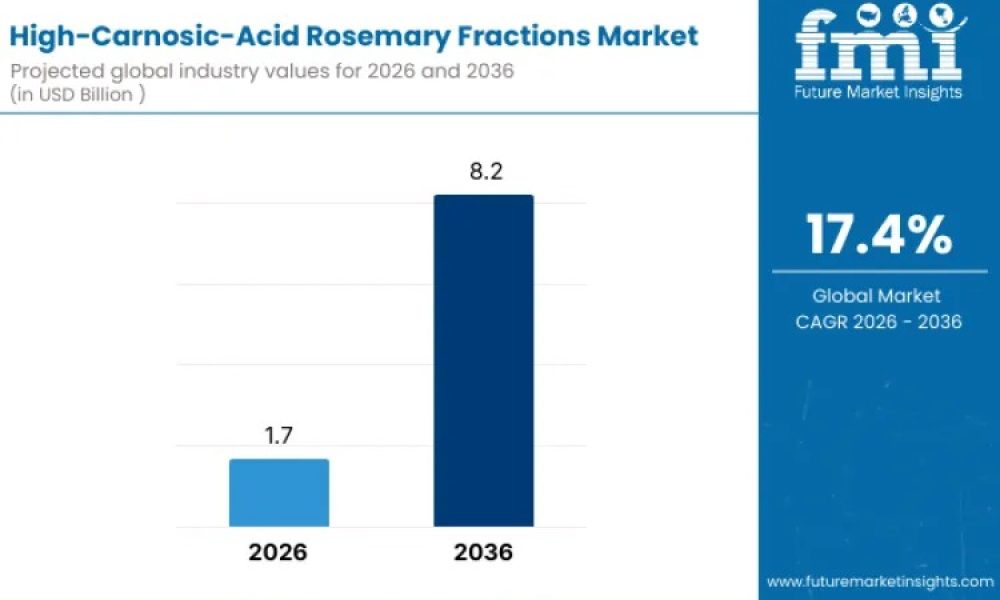
The global high-carnosic-acid rosemary fractions market is entering a phase of accelerated expansion, fueled by the rising replacement of synthetic antioxidants across food, nutraceutical, and cosmetic industries. Valued at USD 1.7 billion in 2026, the market is projected to reach USD 8.2 billion by 2036, advancing at a robust CAGR of 17.4% over the forecast period. This growth trajectory reflects the increasing preference for natural, plant-derived stabilizers that deliver high oxidative protection while supporting clean-label product positioning.
High-carnosic-acid rosemary fractions, derived from Rosmarinus officinalis, are gaining traction for their strong free-radical scavenging activity, thermal stability, and compatibility with lipid-rich formulations. Manufacturers are increasingly turning to these fractions to improve shelf life, flavor integrity, and color stability in processed foods, dietary supplements, and personal-care products.
Explore trends before investing – request a sample report today!
Clean-Label Preservation Drives Market Momentum
The transition away from synthetic antioxidants such as BHA and BHT is a defining factor shaping demand. High-carnosic-acid fractions deliver comparable or superior antioxidant performance at lower inclusion rates, making them economically and functionally attractive. Their ability to stabilize frying oils, snack coatings, meat systems, and omega-rich formulations under high-heat conditions has positioned them as a preferred natural alternative.
Growing consumer awareness around ingredient transparency continues to reinforce adoption. Food and wellness brands increasingly emphasize botanical sourcing, solvent-free extraction, and standardized potency—criteria well-aligned with high-carnosic-acid rosemary fractions.
High-Potency Concentrates Lead Fraction-Type Demand
Among fraction types, high-carnosic-acid concentrates exceeding 20% active content account for 47.1% of global demand, making them the dominant segment. Elevated active levels allow formulators to achieve strong oxidation control with minimal impact on taste, aroma, or color.
Key functional advantages include:
- Strong lipid-oxidation suppression in meat, poultry, and seafood
- High thermal stability for frying and baked applications
- Improved efficiency due to lower dosage requirements
Medium-strength extracts and synergistic carnosic acid–carnosol fractions support broader formulation flexibility, while stabilized antioxidant complexes enhance resistance to degradation during processing.
Supercritical CO₂ Extraction Sets the Industry Benchmark
By extraction method, supercritical CO₂ technology holds a 45.6% share, reflecting industry preference for solvent-free, high-purity processing. This method preserves thermally sensitive diterpenes and ensures consistent carnosic-acid retention, meeting both regulatory and clean-label requirements.
Advances in molecular distillation and resin-based adsorption systems further refine fraction purity, enabling suppliers to deliver standardized antioxidant profiles across food, supplement, and cosmetic applications. Extraction-method trends highlight the importance of yield optimization, batch consistency, and organoleptic neutrality.
Meat, Poultry, and Seafood Remain the Leading Applications
Natural antioxidant use in meat, poultry, and seafood accounts for 46.4% of global application demand, driven by the need to control lipid oxidation, preserve color, and extend refrigerated shelf life. Nutraceuticals represent a fast-growing segment, leveraging high-carnosic-acid fractions for antioxidant, cognitive, and metabolic health positioning.
Cosmetics and personal-care manufacturers increasingly incorporate these fractions to stabilize botanical oils and emulsions, while functional food producers rely on rosemary antioxidants to protect fortified and high-fat products.
Asia-Pacific and North America Anchor Regional Growth
China, India, the USA, and Japan represent the most influential growth markets, supported by expanding natural-ingredient processing capacity and strong clean-label demand.
- China leads with an 18.3% CAGR, driven by nutraceutical expansion and advanced CO₂ extraction investments.
- India follows at 17.7% CAGR, supported by herbal wellness growth and improved fractionation technologies.
- USA posts a 16.6% CAGR, reflecting regulatory-driven replacement of synthetic preservatives.
- Japan records 15.7% CAGR, underpinned by precision purification and high-purity botanical standards.
Competitive Landscape Emphasizes Standardization and Traceability
The global market is shaped by players focused on phytochemical standardization, regulatory compliance, and application-specific antioxidant platforms. Naturex (Givaudan) holds an estimated 29.0% market share, strengthened by controlled sourcing and reproducible carnosic-acid profiles. Kalsec, Frutarom (IFF), FLAVEX Naturextrakte, and Nexira continue to expand through CO₂-extracted fractions, stabilized antioxidant systems, and traceable Mediterranean supply networks.
Key Players in the High-Carnosic-Acid Rosemary Fractions Market
- Naturex (Givaudan)
- Kalsec
- Frutarom (IFF)
- FLAVEX Naturextrakte
- Nexira
Access the full report for detailed market trends.
Outlook: Natural Antioxidants Gain Strategic Importance
As food, nutraceutical, and cosmetic manufacturers prioritize oxidative stability alongside clean-label credentials, high-carnosic-acid rosemary fractions are set to play a strategic role in formulation innovation. Ongoing advances in extraction efficiency, agricultural sourcing, and regulatory alignment are expected to support sustained double-digit growth through 2036.
About Future Market Insights (FMI)
Future Market Insights, Inc. (FMI) is an ESOMAR-certified, ISO 9001:2015 market research and consulting organization, trusted by Fortune 500 clients and global enterprises. With operations in the U.S., UK, India, and Dubai, FMI provides data-backed insights and strategic intelligence across 30+ industries and 1,200 markets worldwide.



