
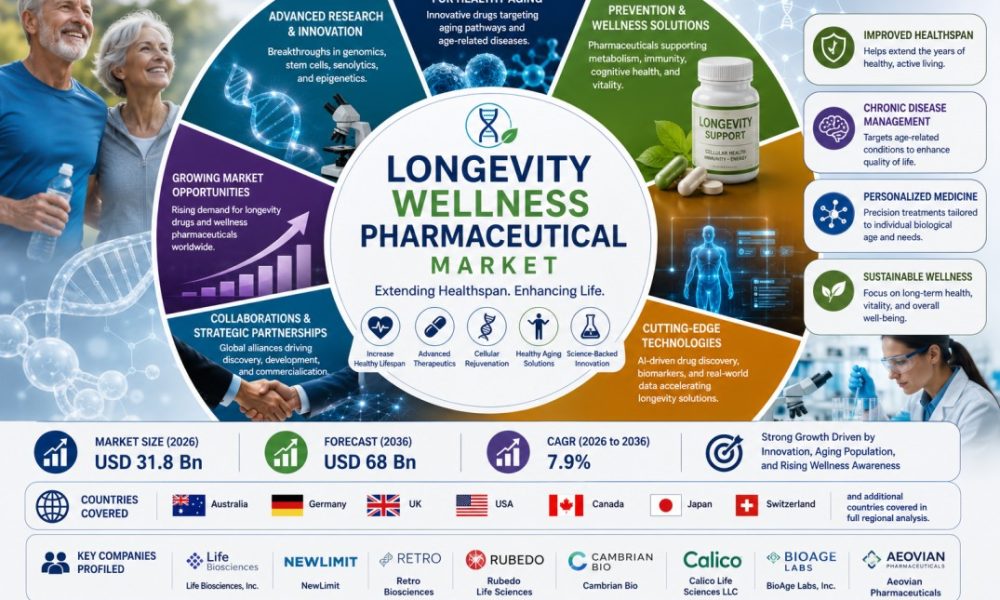
NEWARK, Del. — The global longevity wellness pharmaceutical market is projected to grow from USD 31.8 billion in 2026 to USD 68 billion by 2036, registering a 7.9% CAGR, according to Future Market Insights. Demand is being shaped by research into cellular senescence, age-related disorders, and therapies designed to preserve function through measurable biological and clinical outcomes.
The commercial focus is moving toward treatments supported by defined disease indications rather than broad anti-aging claims. The World Health Organization projected in October 2025 that one in six people worldwide would be aged 60 or older by 2030. This demographic shift is increasing attention to therapies targeting age-related illnesses, but commercial success still depends on clinical evidence, acceptable safety profiles, and regulatory review.
👉 Get Detailed Market Forecasts, Competitive Benchmarking, and Pricing Trends:
https://www.futuremarketinsights.com/reports/sample/rep-gb-34386
Where Growth Is Fastest
- Australia: The market is forecast to grow at a 9% CAGR from 2026 to 2036, the fastest rate among the countries profiled by FMI. Specialist research networks and growing attention to healthy-life extension create opportunities for disease-specific clinical programs.
- Germany: Demand is projected to expand at a 3% CAGR. A research-intensive pharmaceutical sector and structured clinical assessment support the development of therapies targeting age-related disease.
- United Kingdom: The market is expected to register an 5% CAGR. Established clinical research institutions and formal medicine-assessment pathways make measurable endpoints and safety evidence important to market entry.
- United States: Sales are forecast to grow at an 1% CAGR. Biotechnology investment, clinical trial capacity, and specialist research programs support development, although reimbursement and regulatory requirements remain important commercial considerations.
- Canada: The market is projected to expand at a 5% CAGR. University research and coordinated specialist care support opportunities for therapies with clear clinical indications and practical monitoring requirements.
What Leads the Market
- Senolytic drugs: This product category is expected to account for 0% of market revenue in 2026. These therapies target senescent cells associated with tissue dysfunction and chronic inflammation. Commercial adoption depends on demonstrating target engagement, safety, and meaningful functional outcomes.
- Healthy aging: This application is projected to hold 0% of market share in 2026. Its commercial relevance depends on translating broad interest in healthy aging into defined therapeutic indications and measurable patient benefits.
- Hospitals: Hospitals are expected to account for 0% of end-user demand in 2026. Specialist oversight, medication management, and multidisciplinary care make hospitals important settings for complex therapies requiring monitoring.
- Hospital pharmacies: This distribution channel is forecast to represent 0% of revenue in 2026. Formulary controls, coordination with specialist teams, and documented medication-handling procedures support its leading position.
- Pharmaceutical therapies: This therapy category is projected to hold 0% of market share in 2026, supported by established small-molecule and biologic development pathways that allow sponsors to align indications with benefit-risk assessment.
The Hurdle
Uncertain biomarkers and long clinical timelines remain major constraints. A biological change does not necessarily establish that a treatment improves a patient’s health or preserves function over time. Sponsors must demonstrate that the selected endpoints are relevant to the intended indication and supported by suitable evidence.
The US Food and Drug Administration’s December 2025 discussion of osteoporosis drug development illustrates the time involved: conventional trials using fracture outcomes can take two to five years. Similar challenges can increase capital requirements and delay commercial decisions in longevity-related programs.
👉 Access the Complete Report in PDF Format:
https://www.futuremarketinsights.com/reports/brochure/rep-gb-34386
Industry Investment and Recent Developments
- November 2025: Calico Life Sciences received US FDA Orphan Drug Designation for investigational treatment ABBV-CLS-628, which is being developed for autosomal dominant polycystic kidney disease.
- January 2026: Life Biosciences announced FDA clearance of the investigational new drug application for ER-100, advancing its partial epigenetic reprogramming program into clinical development for optic neuropathies.
- February 2026: The Advanced Research Projects Agency for Health listed an award of up to USD 30.8 million for Cambrian BioPharma’s selective mTORC1 program, supporting translational research into intrinsic capacity in older adults.
- May 2026: Retro Biosciences announced a new financing round to support its aging-therapy pipeline and clinical development.
FMI identifies Life Biosciences, NewLimit, Retro Biosciences, Rubedo Life Sciences, Cambrian Bio, Calico Life Sciences, BioAge Labs, and Aeovian Pharmaceuticals among notable companies. Their approaches include epigenetic reprogramming, senolytic drug development, and interventions targeting metabolic and cellular pathways.
Competition depends on the ability to move from laboratory findings to clinically meaningful results. Companies must establish target specificity, suitable patient selection, reproducible manufacturing, and safety over the exposure period required by each therapy.
Analyst View
Anurag Sharma, Principal Analyst for Healthcare at Future Market Insights, said:
“Longevity pharmaceutical value begins with a measurable endpoint and a regulated development plan. Sponsors gain confidence depending on functional outcomes and safety evidence across extended exposure. Commercial scale follows clinical proof instead of generalized interest in aging.”
What This Means for Pharmaceutical Companies and Investors
- Prioritize measurable outcomes. Biomarkers are useful only when their relationship to disease progression or functional benefit is sufficiently established for the intended development program.
- Plan for longer investment horizons. Extended follow-up and safety requirements can delay commercial validation, making milestone-based financing and realistic clinical timelines important.
- Focus on defined indications. Disease-specific programs provide a clearer path to clinical evaluation and regulatory review than generalized anti-aging positioning.
Access Full report: https://www.futuremarketinsights.com/reports/longevity-wellness-pharmaceutical-market
Report Scope
The Longevity Wellness Pharmaceutical Market report covers senolytic drugs, NAD+ boosters, mTOR inhibitors, cellular reprogramming therapies, and peptide therapeutics. Applications include healthy aging, cardiovascular health, neurodegenerative disorders, metabolic disorders, and immune health.
The study analyzes hospitals, specialty clinics, pharmaceutical companies, research institutes, and home healthcare providers. Distribution channels include hospital pharmacies, retail pharmacies, online pharmacies, specialty pharmacies, and direct sales. Therapy categories include pharmaceutical therapies, regenerative medicine, gene therapy, nutraceutical-based therapy, and combination therapy. Geographic coverage includes North America, Europe, East Asia, South Asia and the Pacific, Latin America, and the Middle East and Africa. The forecast period runs from 2026 to 2036.
About Future Market Insights
Future Market Insights, Inc. (FMI) is an ESOMAR-certified market research and consulting firm headquartered in Delaware, USA, with offices in the United Kingdom, the United Arab Emirates and India. FMI delivers syndicated and custom research across food and beverage, healthcare, chemicals, technology, packaging, consumer goods and industrial sectors.
Media Contact
Future Market Insights, Inc.
Phone: +1-347-918-3531



