
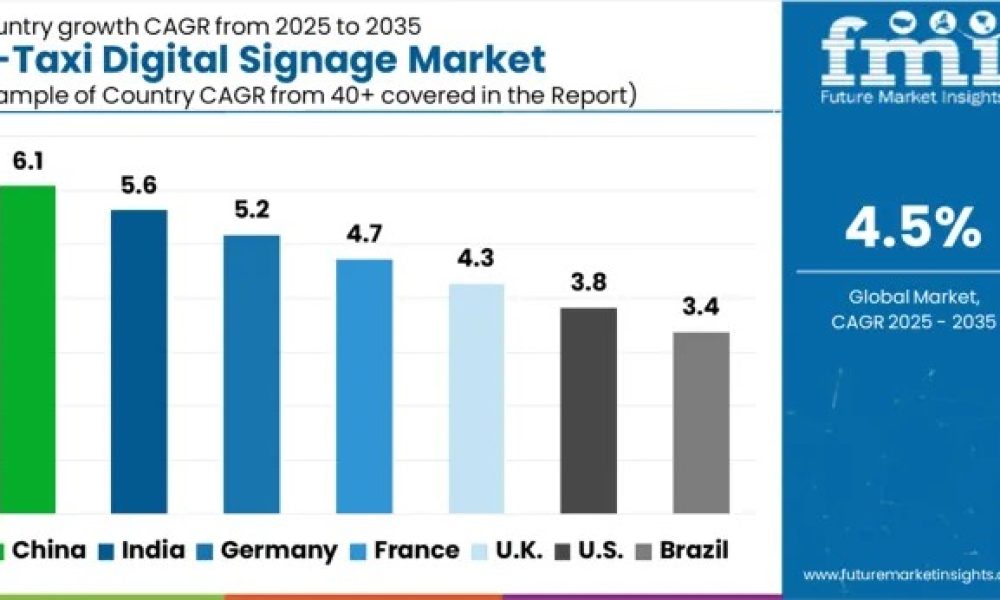
The global in-taxi digital signage market is projected to grow from USD 684.7 million in 2025 to USD 1,063.3 million by 2035, registering a compound annual growth rate (CAGR) of 4.5% and creating an absolute dollar opportunity of USD 378.6 million over the forecast period. Market expansion is being shaped by rising urban mobility, increasing demand for in-vehicle advertising, and continuous advances in display hardware, connectivity, and cloud-based content management platforms.
In-taxi digital signage systems—comprising screens, software, and services installed inside taxis and ride-hailing vehicles—are increasingly used to deliver targeted advertising, passenger information, and infotainment. Their adoption reflects the convergence of smart transportation initiatives, fleet digitization, and advertisers’ interest in reaching captive, high-dwell-time audiences in urban environments.
Market Growth Pattern Reflects Predictable Adoption Curve
Analysis of the market growth curve highlights a three-phase trajectory. Between 2025 and 2028, growth follows a gradual upward slope as early adoption continues in mature markets such as North America and Europe, where taxi fleets are retrofitted with digital signage systems and advertising contracts generate incremental revenue.
From 2029 to 2032, the curve steepens as Asia Pacific and Latin America deploy large-scale in-taxi digital signage networks. This acceleration is supported by rising ride-hailing penetration, rapid urbanization, and growing demand for interactive passenger experiences. In the final phase, 2033 to 2035, growth moderates as markets approach higher penetration levels, replacement cycles become more prominent, and innovation shifts toward content sophistication and interactivity rather than new hardware installations. Overall, the market demonstrates early uptake, mid-period acceleration, and late-stage stabilization.
Get access to comprehensive data tables and detailed market insights — request your sample report today!
Urban Transportation and Advertising Drive Core Demand
Urban transportation applications account for approximately 42% of total market share, as taxi and ride-hailing fleets integrate digital displays to enhance passenger engagement and unlock advertising revenue. The advertising and media segment contributes around 28%, leveraging in-taxi screens for targeted brand campaigns in high-traffic areas. Public transportation networks represent close to 15%, using digital signage for route updates and passenger communication, while hospitality and tourism account for about 10% through promotional and travel information content. The remaining 5% is generated by logistics and corporate shuttle services.
Market evolution is closely tied to improvements in cloud-based content management, GPS integration, and analytics. These technologies allow fleet operators and advertisers to update content remotely, schedule campaigns dynamically, and deliver location-based messaging in real time. Energy-efficient, high-resolution displays further reduce operating costs while improving visibility in varied lighting conditions.
Hardware Remains the Largest Component Segment
By component, hardware dominates the market with a 49.6% revenue share in 2025. Demand is driven by the need for durable, vibration-resistant, and temperature-tolerant displays capable of long operating hours in commercial vehicles. Modular hardware designs allow operators to upgrade individual elements without replacing entire systems, lowering total cost of ownership and supporting long-term adoption.
In terms of vehicle type, economy and budget taxis account for 54.1% of market revenue, reflecting their widespread presence in urban transport networks and high passenger turnover. Standardized interiors and cost-effective installations make these fleets particularly attractive for digital signage deployment. Luxury and premium taxis adopt signage primarily to enhance passenger experience and brand differentiation.
Drive Your Business Growth Strategy: Checkout the Report for Key Insights
LED Displays and Advertising Applications Lead Adoption
LED displays hold 52.8% of the market, favored for their brightness, energy efficiency, and durability. Advances in high-resolution panels and adaptive brightness control ensure content clarity across day and night operations. Advertising remains the dominant application, representing around 60% of installations, followed by infotainment at 25% and navigation assistance at 15%.
Interactive touchscreens, IoT-enabled signage, and integration with ride-hailing apps are emerging as key trends. Approximately 30% of new taxis in Asia Pacific and North America now feature interactive screens, while programmatic, data-driven advertising accounts for nearly 35% of deployments in Europe.
Asia Pacific Leads, While OECD Markets Focus on Efficiency
Regionally, Asia Pacific accounts for 36% of global adoption, driven by China, Japan, and India. Europe follows with 30%, supported by Germany, France, and the UK, while North America contributes 28%, largely from the United States. Country-level growth rates highlight China at 6.1% CAGR, India at 5.6%, and Germany at 5.2%, reflecting strong alignment between urban mobility expansion and digital advertising strategies.
Competitive Landscape Centers on Integration and Scalability
The competitive environment is defined by display quality, content management sophistication, and seamless integration with vehicle infotainment and payment systems. Samsung Electronics Co. Ltd., 42 Gears Mobility Systems, Adflow Digital, Apple Inc., Curb Mobility LLC, LYFT, Navori SA, Swipe Technologies, TOPAZ, and VeriFone Holdings Inc. are among the key participants shaping the market through hardware innovation, cloud-based platforms, and scalable deployment models.
Outlook
As cities continue to invest in smart mobility and fleet operators seek diversified revenue streams, the in-taxi digital signage market is expected to maintain steady, predictable growth through 2035. Detailed segmentation, regional analysis, and competitive benchmarking provide deeper insight into how technology adoption, advertising demand, and urban transportation trends will shape market opportunities over the coming decade.
Why Choose FMI: Empowering Decisions that Drive Real-World Outcomes: https://www.futuremarketinsights.com/why-fmi
About Future Market Insights (FMI)
Future Market Insights, Inc. (FMI) is an ESOMAR-certified, ISO 9001:2015 market research and consulting organization, trusted by Fortune 500 clients and global enterprises. With operations in the U.S., UK, India, and Dubai, FMI provides data-backed insights and strategic intelligence across 30+ industries and 1200 markets worldwide.



