
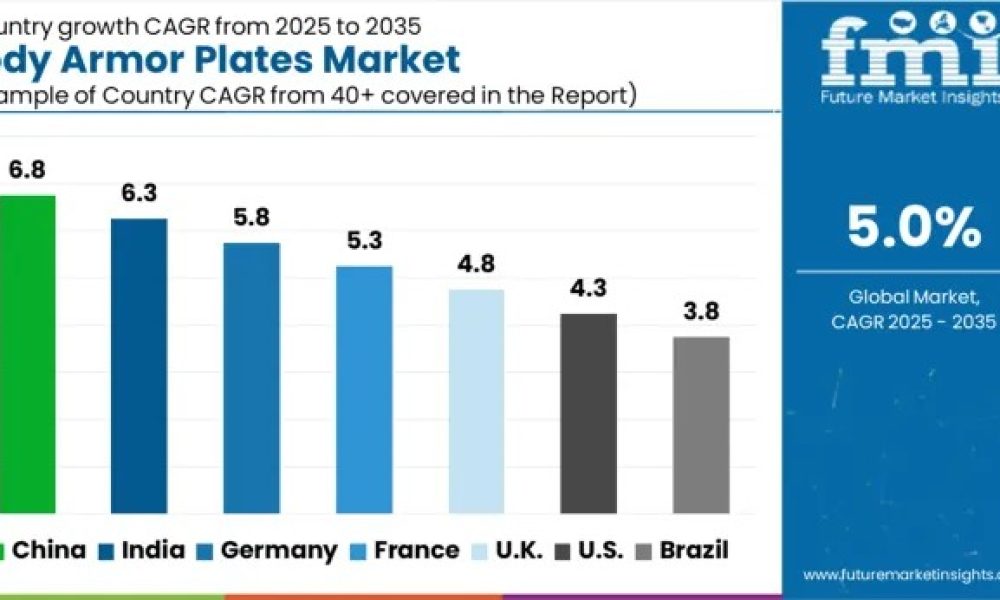
The global body armor plates market is projected to expand from USD 2.1 billion in 2025 to USD 3.4 billion by 2035, registering a compound annual growth rate (CAGR) of 5.0% over the forecast period. Market growth reflects the transition of body armor plates from specialized protective gear into standardized, mission-critical equipment across military, law enforcement, and private security applications worldwide.
During the early adoption phase (2020–2024), the market grew from USD 1.6 billion to USD 2.1 billion, as defense and security agencies conducted pilot deployments to assess ballistic resistance, weight optimization, and operational comfort. These evaluations laid the foundation for broader procurement programs now shaping the market’s next growth phase.
Market Progression from Adoption to Consolidation
By 2025, the body armor plates market is expected to enter a phase of steady institutional adoption, supported by validated performance standards, procurement planning cycles, and operational readiness exercises. From 2025 to 2030, scaling is anticipated as armed forces, paramilitary units, and law enforcement agencies increase deployment volumes to meet evolving threat environments.
By 2030, the market is forecast to reach approximately USD 2.5 billion, before transitioning into a consolidation phase (2030–2035). During this period, growth is expected to moderate as leading manufacturers strengthen competitive positions, supply chains mature, and smaller or non-compliant suppliers are gradually phased out. By 2035, body armor plates are expected to be firmly established as standard personal protection solutions across defense and security sectors globally.
Get access to comprehensive data tables and detailed market insights — request your sample report today!
Defense and Public Safety Investments Anchor Market Demand
The market is supported by multiple upstream and adjacent sectors. The defense and military segment contributes nearly 35% of overall demand, driven by troop modernization programs and heightened emphasis on personnel survivability. Law enforcement and public safety agencies account for approximately 20%, adopting armor plates for patrol, riot control, and special operations.
Private security services contribute around 10%, while tactical gear and personal protective equipment manufacturing adds 8%, reflecting the integration of armor plates with helmets, vests, and modular carriers. Additional contributions stem from aerospace and defense equipment (7%), research and development services (6%), maintenance and retrofitting (5%), and government and regulatory bodies (9%), which shape certification, standards, and compliance frameworks.
Lightweight Materials and Ballistic Performance Drive Growth
Market expansion is being driven by rising demand for lightweight, high-strength armor solutions that enhance mobility without compromising ballistic protection. Advances in material science have enabled the development of plates capable of withstanding higher-caliber threats while reducing wearer fatigue in prolonged operations.
Defense agencies and law enforcement organizations are increasingly prioritizing equipment standardization, durability, and ergonomic design, enabling predictable performance across diverse operational environments. These trends are creating sustained demand for next-generation armor plates optimized for comfort, protection, and long-term deployment.
UHMWPE Emerges as the Leading Material Segment
The Ultra-High Molecular Weight Polyethylene (UHMWPE) segment is projected to hold 46.8% of total market revenue in 2025, making it the dominant material category. Its leadership is attributed to an exceptional strength-to-weight ratio, corrosion resistance, and compatibility with modular armor designs.
UHMWPE plates are widely adopted due to their ability to provide multi-hit resistance while maintaining mobility, making them particularly attractive for defense and law enforcement agencies seeking long-duration operational efficiency. The ability to upgrade designs without full system replacement further enhances cost efficiency, supporting sustained adoption across global markets.
Level IV Protection Dominates High-Threat Applications
By protection level, Level IV body armor plates are anticipated to capture 52.1% of total revenue in 2025. This segment’s dominance is driven by increasing demand for armor capable of stopping armor-piercing and high-caliber rounds, particularly in combat and high-risk tactical environments.
Level IV systems are favored for their scalability and compatibility with modular carriers, enabling flexible deployment across mission profiles. Continuous investment in advanced ceramics and composite manufacturing is expected to sustain the segment’s leadership through the forecast period.
Defense Sector Remains the Primary End User
The defense application segment is projected to account for 64.5% of total market revenue in 2025, reflecting ongoing global military modernization initiatives and heightened geopolitical tensions. Armed forces are increasingly procuring armor plates that balance maximum ballistic protection with reduced weight, improving soldier endurance and tactical agility.
Standardized procurement, compliance with international ballistic standards, and the ability to upgrade armor systems over time are reinforcing long-term demand within the defense sector, positioning it as the core revenue driver of the market.
Drive Your Business Growth Strategy: Checkout the Report for Key Insights
Asia-Pacific and BRICS Economies Drive Volume Growth
Regionally, Asia-Pacific is emerging as a high-growth market, supported by defense modernization, border security needs, and expanding domestic manufacturing capabilities. China (6.8% CAGR) and India (6.3% CAGR) are leading growth among BRICS nations, driven by large-scale procurement and increasing adoption across military and law enforcement agencies.
In contrast, OECD markets such as Germany (5.8%), the United Kingdom (4.8%), and the United States (4.3%) represent mature but stable markets, characterized by advanced materials adoption, strict regulatory compliance, and emphasis on high-performance armor systems.
Competitive Landscape Focused on Innovation and Compliance
The body armor plates market is moderately consolidated, with leading players including BAE Systems plc, AEGIS Engineering Systems, Armored Republic, LLC, Ballistic Body Armour Pty., Bluewater Defense Inc., Ceradyne Inc. (3M), and Craig International Ballistics Pty. Ltd. These companies are investing heavily in research and development, focusing on lightweight composites, multi-layered protection systems, and enhanced ergonomics.
Competitive differentiation is increasingly defined by material innovation, ballistic performance, regulatory certification, and global distribution capabilities. As threats evolve, manufacturers are expected to prioritize cost-efficient production, compliance with international standards, and scalable designs to meet rising global demand.
Outlook
With sustained defense spending, heightened security awareness, and rapid advancements in protective materials, the body armor plates market is positioned for stable, long-term growth through 2035. The sector’s evolution toward lighter, stronger, and more adaptable armor solutions underscores its critical role in future defense and security strategies worldwide.
Why Choose FMI: Empowering Decisions that Drive Real-World Outcomes: https://www.futuremarketinsights.com/why-fmi
About Future Market Insights (FMI)
Future Market Insights, Inc. (FMI) is an ESOMAR-certified, ISO 9001:2015 market research and consulting organization, trusted by Fortune 500 clients and global enterprises. With operations in the U.S., UK, India, and Dubai, FMI provides data-backed insights and strategic intelligence across 30+ industries and 1200 markets worldwide.



