
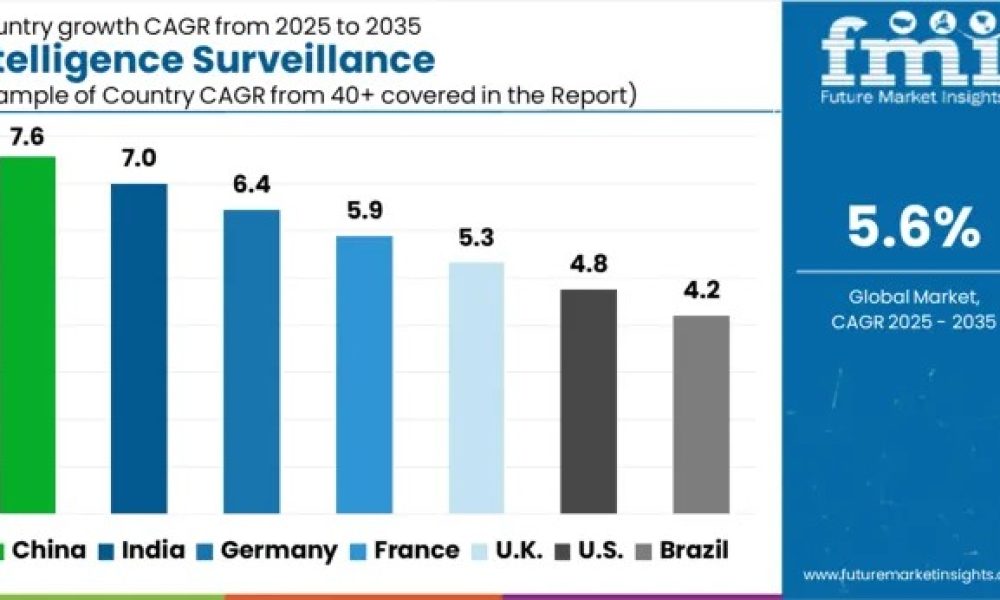
The global intelligence, surveillance, and reconnaissance (ISR) market is projected to expand from USD 44.4 billion in 2025 to USD 76.5 billion by 2035, registering a compound annual growth rate (CAGR) of 5.6% and generating an absolute dollar opportunity of USD 32.1 billion over the forecast period. Market growth is being driven by rising defense budgets, increasing geopolitical tensions, and accelerating adoption of unmanned systems, satellite-based surveillance, and advanced sensor technologies across military and security operations worldwide.
ISR solutions play a central role in modern defense and security frameworks by enabling real-time battlefield awareness, threat detection, border monitoring, and intelligence gathering. Governments and defense agencies across North America, Europe, and Asia Pacific are prioritizing ISR investments as part of long-term modernization programs, focusing on integrated platforms that combine high-performance hardware with advanced software, analytics, and secure communication networks.
Market Growth Reflects Strategic Defense Priorities and Regional Investment Cycles
Market expansion between 2025 and 2035 reflects steady demand tempered by periods of growth-rate volatility. From 2025 to 2028, expansion remains moderate, supported by incremental upgrades and modernization initiatives in North America and Europe, where established defense infrastructure continues to absorb ISR investments. Between 2029 and 2032, growth volatility increases as Asia Pacific and the Middle East accelerate defense spending in response to regional security concerns, leading to large-scale procurement of ISR platforms and systems.
From 2033 to 2035, growth stabilizes as early-adopting regions reach higher penetration levels and demand shifts toward system upgrades, integration, and replacement cycles. This pattern underscores the ISR market’s sensitivity to geopolitical developments, defense allocation cycles, and technology deployment timelines.
Get access to comprehensive data tables and detailed market insights — request your sample report today!
Defense and Military Applications Anchor Market Demand
The defense and military sector accounts for approximately 50% of total ISR market demand, relying on ISR systems for mission planning, situational awareness, and real-time intelligence in multi-domain operations. Homeland security and law enforcement contribute around 20%, using ISR technologies for border control, counter-terrorism, and public safety. Aerospace and aviation represent close to 15%, integrating ISR capabilities into unmanned aerial vehicles (UAVs) and manned aircraft, while maritime applications account for roughly 10% through coastal monitoring, anti-piracy operations, and naval intelligence. The remaining demand comes from disaster management and environmental monitoring applications.
Hardware Solutions Maintain Leading Position
By solution type, hardware remains the leading segment, accounting for 38.7% of total ISR market revenue in 2025. Demand is driven by the need for high-performance imaging sensors, radars, and data collection modules capable of operating in harsh environments. Defense agencies continue to prioritize long-term investments in robust and scalable hardware platforms that can be integrated with software-defined analytics and command systems.
Technological improvements in sensor resolution, miniaturization, and low-power operation are reinforcing the role of hardware as the foundation of ISR networks, particularly for unmanned and multi-platform deployments.
Military Operations Dominate Application Segment
Military operations represent the largest application area, capturing an estimated 42.5% of ISR market revenue in 2025. Armed forces increasingly depend on ISR systems for threat detection, operational coordination, and intelligence superiority across land, sea, air, and space domains. Integration of artificial intelligence, real-time analytics, and data fusion technologies is enhancing the speed and accuracy of decision-making in combat and strategic planning environments.
Drive Your Business Growth Strategy: Checkout the Report for Key Insights
Land Platforms Lead Deployment Share
By platform, land-based ISR systems account for the largest share at 44.8% in 2025. Growth is driven by deployment across ground vehicles, mobile command centers, and fixed border surveillance installations. Land platforms support larger sensor payloads, stable communications, and persistent monitoring capabilities, making them essential for sustained intelligence collection and situational awareness.
Regional Outlook Highlights Asia Pacific Momentum
North America leads the ISR market with approximately 38% share, supported by ongoing investments in the United States and Canada. Europe follows with 27%, driven by Germany, France, and the United Kingdom. Asia Pacific holds 25% and represents the fastest-growing region, led by China and India, where defense modernization, border security, and adoption of unmanned systems are accelerating ISR deployments. The Middle East & Africa and Latin America contribute smaller but strategically significant shares.
China is projected to grow at a CAGR of 7.6%, supported by large-scale defense electronics and surveillance programs. India follows at 7.0%, reflecting border monitoring and defense upgrades. Germany records 6.4%, while the United States grows at a steadier 4.8%, reflecting maturity and high existing penetration.
Competitive Landscape Defined by Integration and Performance
The ISR market is characterized by competition centered on sensor precision, platform interoperability, real-time data integration, and operational reliability. Key participants include Lockheed Martin, BAE Systems, Boeing, Elbit Systems, General Atomics, General Dynamics, Israel Aerospace Industries, Kratos Defense, L3Harris, Northrop Grumman, Raytheon Technologies, Rheinmetall, Saab, Textron, and Thales. Market strategies emphasize multi-sensor fusion, AI-enabled analytics, autonomous operation, and secure communication architectures.
As defense forces worldwide continue to prioritize intelligence superiority and situational awareness, ISR systems are expected to remain a strategic investment area. Comprehensive analysis of regional demand, technology evolution, and procurement trends will be critical for stakeholders evaluating opportunities in this USD 76.5 billion global market.
Why Choose FMI: Empowering Decisions that Drive Real-World Outcomes: https://www.futuremarketinsights.com/why-fmi
About Future Market Insights (FMI)
Future Market Insights, Inc. (FMI) is an ESOMAR-certified, ISO 9001:2015 market research and consulting organization, trusted by Fortune 500 clients and global enterprises. With operations in the U.S., UK, India, and Dubai, FMI provides data-backed insights and strategic intelligence across 30+ industries and 1200 markets worldwide.



