
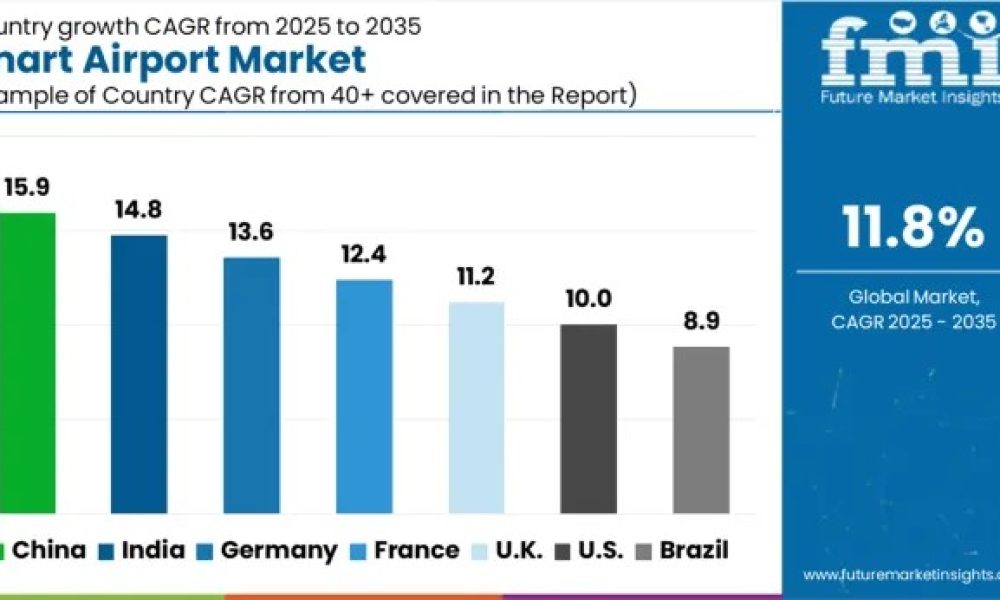
The global smart airport market is projected to expand from USD 7.0 billion in 2025 to USD 21.5 billion by 2035, registering a compound annual growth rate (CAGR) of 11.8% over the forecast period. The market is expected to generate an absolute dollar opportunity of USD 14.5 billion, reflecting sustained long-term investment in digital airport infrastructure to manage rising passenger traffic, operational complexity, and security requirements.
Smart airport adoption is being driven by the need for real-time operational visibility, enhanced passenger experience, and optimized resource utilization. Airports are increasingly deploying IoT-enabled systems, AI-based analytics, automated baggage handling, and biometric passenger processing to improve throughput without proportional expansion of physical infrastructure.
Market Growth Pattern Reflects Phased Global Adoption
Market value accumulation follows a multi-stage trajectory aligned with regional infrastructure readiness and passenger growth trends.
Value accumulation timeline highlights:
- 2025–2028: Steady growth driven by early-stage adoption in North America and Europe, supported by digitalization pilots, regulatory compliance programs, and modernization initiatives
- 2029–2032: Accelerated growth as Asia Pacific, the Middle East, and Latin America scale smart airport deployments to manage rising passenger volumes and infrastructure expansion
- 2033–2035: Continued upward momentum with moderate deceleration as early adopters reach higher penetration and demand shifts toward upgrades, replacements, and technology enhancements
This phased adoption underpins the USD 14.5 billion opportunity generated across the forecast period.
Get access to comprehensive data tables and detailed market insights — request your sample report today!
Smart Airport Market Snapshot
- Market value (2025): USD 7.0 billion
- Forecast value (2035): USD 21.5 billion
- Forecast CAGR (2025–2035): 11.8%
- Leading airport size segment (2025): Large airports (47.8%)
- Key growth regions: North America, Asia-Pacific, Europe
Functional Drivers Shaping Market Demand
Smart airport systems are increasingly embedded into daily airport operations as traffic density and service expectations rise.
Primary growth drivers include:
- Increasing global passenger traffic and flight frequency
- Demand for operational efficiency and cost optimization
- Strengthened security and surveillance requirements
- Adoption of automation, biometrics, and predictive analytics
- Focus on seamless, contactless passenger journeys
Smart airports enable real-time data analysis across terminal, landside, and airside operations, supporting faster decision-making and improved system coordination.
Market Structure by Operation and Application
Airport operations and management represent the largest share of demand, accounting for approximately 44% of the market, as airports adopt digital platforms to improve efficiency, safety, and passenger flow.
Market share by functional area:
- Airport operations and management: ~44%
- Airline and ground services: ~25%
- Retail and commercial services: ~15%
- Security and surveillance: ~10%
- Air traffic management and facility maintenance: ~6%
Passenger processing systems remain the single largest application at 30%, followed by baggage handling automation at 25%, security and surveillance at 20%, air traffic management at 15%, and analytics platforms at 10%.
Segment Insights: Large Airports Lead Adoption
Large airports are projected to account for 47.8% of smart airport revenue in 2025, reflecting their higher passenger volumes and operational complexity.
Key adoption factors for large airports:
- Need for integrated check-in, boarding, and baggage systems
- Use of predictive analytics for passenger flow management
- Centralized monitoring for energy optimization and security
- Ability to scale modular digital systems without disrupting operations
As global air travel continues to expand, large airports remain the primary drivers of smart airport investments.
Software and Airport 4.0 Models Drive Value Capture
Software and solutions represent the leading system category, accounting for 42.6% of market revenue in 2025. Growth is supported by the flexibility of software-driven platforms that integrate baggage management, passenger processing, security, and flight operations into centralized control systems.
Airport 4.0 is the dominant airport model, holding 51.3% of market share in 2025. This model integrates IoT, AI, robotics, and cloud computing to enable predictive maintenance, automated workflows, and seamless passenger experiences. Its modular architecture allows continuous upgrades without large-scale infrastructure disruption.
Regional Growth Signals Strong Infrastructure Alignment
Asia Pacific leads global adoption with 36% market share, driven by China (18%), India (10%), and Japan (8%). Europe follows with 32%, led by Germany, France, and the UK, while North America accounts for 28%, primarily driven by the United States.
Projected CAGR by key countries:
- China: 15.9%
- India: 14.8%
- Germany: 13.6%
- France: 12.4%
- UK: 11.2%
- USA: 10.0%
Growth reflects a combination of infrastructure expansion in emerging markets and operational optimization in mature aviation hubs.
Constraints Influencing Adoption Pace
Despite strong momentum, adoption remains influenced by several structural challenges.
Drive Your Business Growth Strategy: Checkout the Report for Key Insights
Key market constraints:
- Smart airport installations cost 20–25% more than traditional systems
- Integration complexity with legacy infrastructure
- Regulatory variation related to data privacy and aviation security
- Cybersecurity requirements across IoT and AI-enabled platforms
- Budget limitations at small and regional airports
These factors moderate adoption speed, particularly in developing regions.
Competitive Landscape
The smart airport market is shaped by global technology providers including Amadeus, Cisco Systems, Huawei Technologies, IBM, Siemens, SITA, Thales, Raytheon Technologies, Sabre, and Wipro, among others. Competition centers on system interoperability, real-time data integration, cybersecurity, and passenger-centric automation rather than standalone hardware deployment.
Market Outlook
The smart airport market is positioned for sustained expansion through 2035 as airports globally prioritize digital infrastructure to manage traffic growth, improve efficiency, and enhance passenger experience. Market growth is being driven by long-term operational transformation rather than short-term capacity expansion, reinforcing smart airport solutions as foundational components of modern aviation infrastructure.
Why Choose FMI: Empowering Decisions that Drive Real-World Outcomes: https://www.futuremarketinsights.com/why-fmi
About Future Market Insights (FMI)
Future Market Insights, Inc. (FMI) is an ESOMAR-certified, ISO 9001:2015 market research and consulting organization, trusted by Fortune 500 clients and global enterprises. With operations in the U.S., UK, India, and Dubai, FMI provides data-backed insights and strategic intelligence across 30+ industries and 1200 markets worldwide.



