
Global PCR-Based Industrial Nonwoven Textile Market Set for Robust Growth by 2036
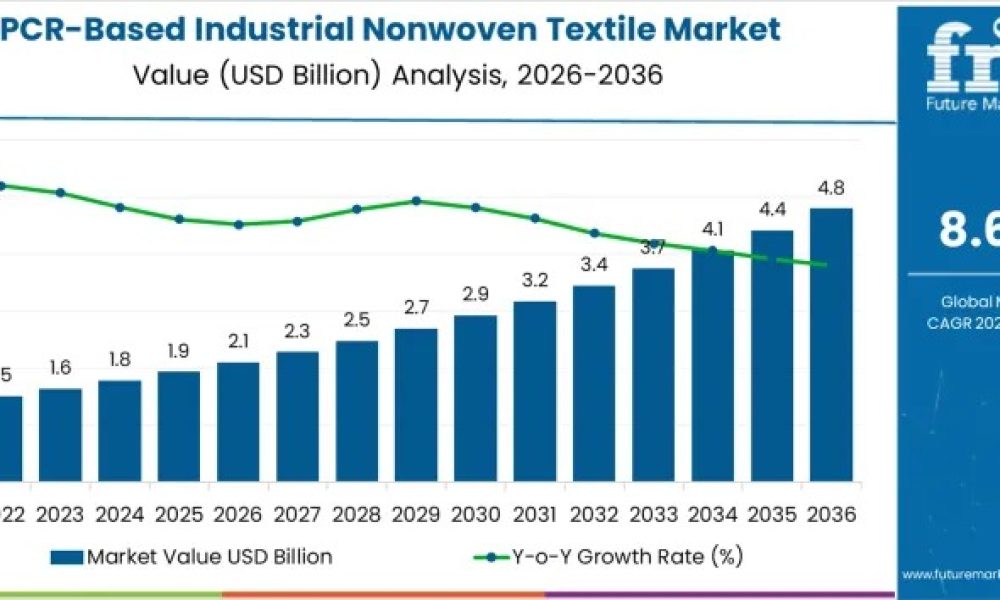
The PCR-Based Industrial Nonwoven Textile Market is poised for significant expansion, valued at USD 2.1 billion in 2026 and projected to reach USD 4.8 billion by 2036, reflecting a CAGR of 8.6%. Market growth is shaped by performance specifications, fiber consistency, and industrial processing requirements. Manufacturers with stable access to post-consumer recycled (PCR) feedstock gain a competitive edge through cost efficiency and predictable output quality, enabling them to meet industrial durability and tensile strength targets.
Subscribe for Year-Round Insights → Stay ahead with quarterly and annual data updates:
Drivers of Market Growth
The PCR-based industrial nonwoven textile market is witnessing growth due to regulatory mandates, sustainability initiatives, and technological advancements in recycled fiber processing. Key drivers include:
- Regulatory Pressure: Governments globally are increasing recycled-content targets, compelling industrial manufacturers to adopt PCR fibers in automotive, filtration, and hygiene applications.
- Industrial Performance Needs: Nonwoven textiles used in filtration media, geotextiles, automotive interiors, and industrial wipes demand mechanical strength and dimensional stability, supporting broader PCR adoption.
- Process Innovations: Advances such as spunbond-meltblown hybrids and engineered fiber blends improve mechanical performance, allowing higher PCR content without compromising durability.
Regional Market Dynamics
United States: Growing at 7.8% CAGR, adoption focuses on sustainable manufacturing and operational efficiency. Industrial textile hubs and automotive suppliers integrate PCR fibers to reduce virgin polymer use while maintaining high-performance standards.
Germany: At a CAGR of 7.2%, EU regulatory mandates drive adoption. German industrial clusters and automotive zones emphasize compliance, using EU-certified PCR fibers to maintain quality and environmental alignment.
China: With 11% CAGR, rapid industrialization and urban manufacturing clusters drive market expansion. PCR-based nonwovens are increasingly integrated in automotive, filtration, and hygiene sectors to support circular economy goals.
India: The market grows at a robust 12.4% CAGR, propelled by emerging industrial parks and expanding hygiene and filtration product sectors. Government incentives further accelerate PCR fiber integration.
Brazil: Growing at 8.2% CAGR, established industrial hubs and hygiene manufacturers are adopting PCR fibers to meet corporate sustainability goals while maintaining reliable production cycles.
Market Segmentation and End-Use Insights
- Filtration & Industrial Wipes: Account for 42% of demand due to high-volume consumption and tolerance for controlled material variability. Steady replacement demand is driven by industrial maintenance and clean-up operations.
- Automotive & Construction: Secondary adoption where performance thresholds are tighter. Automotive interiors and construction fabrics emphasize tensile strength, durability, and regulatory compliance.
- Nonwoven Types: Spunbond and meltblown dominate (~45% of demand) due to controlled fiber formation, scale efficiency, and predictable performance. Needle-punched and spunlace serve niche applications with specialized mechanical and aesthetic requirements.
Strategic Market Approaches
Leading players such as Berry Global, Freudenberg, Fitesa, and Toray are leveraging controlled PCR integration to maintain product performance while meeting sustainability targets. Strategies include:
- Aligning production processes with industrial qualification standards.
- Integrating PCR feedstock management for consistent fiber morphology and bonding behavior.
- Customizing solutions for regional waste streams and industrial applications.
This focus on process reliability, performance repeatability, and supply continuity ensures that industrial buyers can meet stringent durability and compliance standards without sacrificing sustainability goals.
Outlook and Market Opportunities
The PCR-based industrial nonwoven textile market is entering a growth phase characterized by broader substitution of virgin fibers across automotive, construction, and industrial applications. Key opportunities include:
- Expanding use in high-volume industrial wipes and filtration media.
- Leveraging engineered fiber blends to improve PCR compatibility and mechanical performance.
- Aligning production with regulatory recycled-content targets to capture long-term industrial contracts.
As industrial buyers increasingly value consistent performance and supply reliability, firms integrating sourcing, processing, and application testing will capture the most sustainable growth and margin outcomes.
Get data that aligns with your strategic priorities — ask for report customization today:
Have a specific Requirements and Need Assistant on Report Pricing or Limited Budget please contact us – [email protected]
About Future Market Insights (FMI)
Future Market Insights, Inc. (FMI) is an ESOMAR-certified, ISO 9001:2015 market research and consulting organization, trusted by Fortune 500 clients and global enterprises. With operations in the U.S., UK, India, and Dubai, FMI provides data-backed insights and strategic intelligence across 30+ industries and 1200 markets worldwide.
Contact Us:
Future Market Insights Inc.
Christiana Corporate, 200 Continental Drive,
Suite 401, Newark, Delaware – 19713, USA
T: +1-347-918-3531



