
Global Vehicle Cabin Air Quality & Filtration Test Systems Market Forecast and Outlook 2026–2036
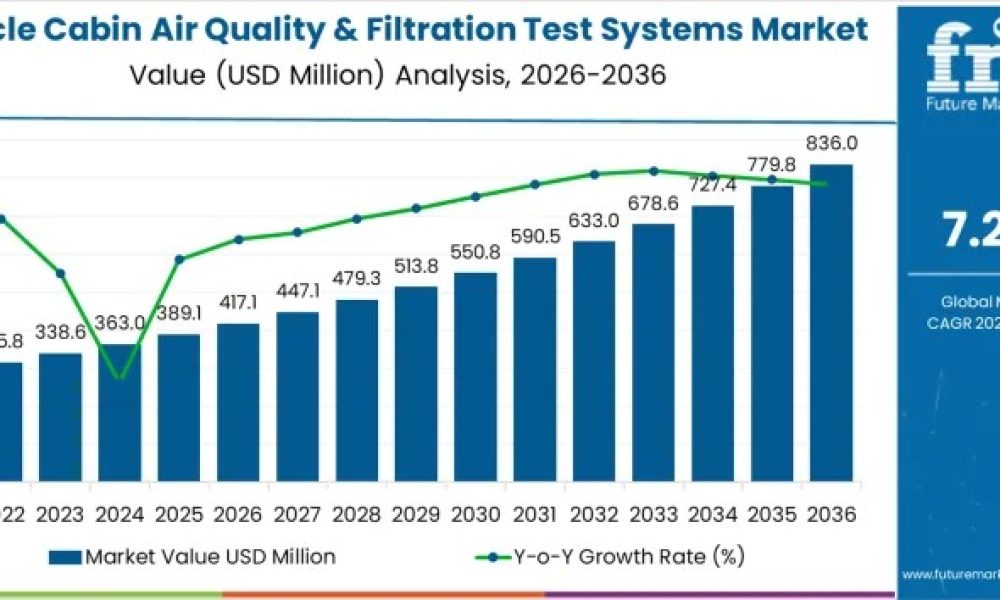
The Vehicle Cabin Air Quality & Filtration Test Systems Market is projected to expand from USD 417.1 million in 2026 to USD 836 million by 2036, reflecting a steady CAGR of 7.20%. This surge is driven by growing consumer awareness about in-vehicle air quality, increasing adoption of electric vehicles (EVs), and stringent regulations governing cabin air pollution. With urban pollution and allergens impacting health, automotive manufacturers are prioritizing cleaner cabin environments, driving demand for advanced filtration and testing systems.
Subscribe for Year-Round Insights → Stay ahead with quarterly and annual data updates:
As the automotive sector accelerates electrification, the importance of high-quality cabin air is becoming central. EVs, unlike traditional vehicles, lack exhaust emissions but still expose passengers to external pollutants. Advanced testing platforms, including particle counters and gas analyzers, are enabling automakers to validate cabin air quality under real-world conditions. This focus not only addresses health concerns but also enhances passenger comfort, particularly in polluted urban centers.
Market Drivers and Growth Dynamics
Several factors are propelling growth in this market:
- Rising Health Awareness: Consumers increasingly prefer vehicles with cleaner air to reduce exposure to PM2.5, allergens, and volatile organic compounds (VOCs).
- Stringent Regulatory Standards: Governments across Asia-Pacific, North America, and Europe are imposing regulations on cabin air quality, forcing OEMs to invest in high-performance filtration and testing solutions.
- Electric Vehicle Penetration: As EV adoption rises, automakers are emphasizing HVAC and filtration performance to ensure cleaner cabin environments in emission-free vehicles.
- Technological Advancements: Real-time monitoring systems, AI-powered analytics, and modular testing platforms allow precise evaluation of filtration efficiency, enhancing product reliability and passenger safety.
Segment Analysis: Vehicle Types and Measurement Technologies
- Vehicle Segment: Passenger cars dominate the market with 46% share, reflecting widespread adoption of advanced cabin air quality systems. Luxury and commercial vehicles follow as automakers implement premium filtration solutions.
- Measurement Technology: Particle counters or photometers lead with a 56% share, crucial for detecting fine particulate matter. Gas analyzers, aerosol generators, and multi-sensor suites support comprehensive air quality evaluation across various vehicle types.
The market’s growth is further supported by modular and scalable solutions, enabling customized testing for different vehicles, from compact cars to premium EVs. This flexibility allows OEMs and filter suppliers to meet evolving regulatory requirements efficiently.
Regional Growth Outlook
- China: Leading with an 8.4% CAGR, driven by rapid EV adoption and government emphasis on green mobility and cabin air quality standards.
- Brazil: Growing at 7.9%, fueled by rising consumer awareness of health and air pollution in urban centers.
- USA: Projected 7% CAGR, supported by innovations in connected vehicles and stricter regulatory frameworks.
- South Korea & Germany: Both expanding at 6.8%, backed by strong automotive industries focusing on smart mobility and passenger comfort.
Key Trends Shaping the Market
- Smart and Connected Systems: Integration of telematics with HVAC systems for real-time monitoring.
- AI & Advanced Analytics: Predictive models for filter performance and pollutant behavior over time.
- Modular Test Platforms: Flexible configurations for different vehicle types, allowing faster product iterations.
Competitive Landscape
The market is highly competitive, with leading players emphasizing measurement precision, real-time data analytics, and integration with HVAC systems:
- TSI Incorporated: High-precision aerosol and particle measurement solutions.
- HORIBA: Gas and particle analyzers with robust data logging.
- AVL: Integrated test rigs simulating real driving conditions.
- Testo & Palas: Portable instruments for laboratory and field testing.
- Honeywell & Parker Hannifin: Filtration system validation with flow and contaminant assessment.
- UL Solutions & Intertek: Independent testing and compliance verification.
- Siemens: Software-enhanced platforms for synchronized data capture and HVAC analysis.
These companies focus on improving accuracy, repeatability, and actionable insights, helping manufacturers enhance cabin comfort and occupant health.
Conclusion & Call-to-Action
The global vehicle cabin air quality & filtration test systems market is set for sustained growth, driven by stricter regulations, rising EV adoption, and heightened consumer focus on health and comfort. Market participants are innovating continuously to provide smarter, modular, and real-time testing solutions, ensuring superior in-vehicle air quality.
Get data that aligns with your strategic priorities — ask for report customization today:
Have a specific Requirements and Need Assistant on Report Pricing or Limited Budget please contact us – [email protected]
About Future Market Insights (FMI)
Future Market Insights, Inc. (FMI) is an ESOMAR-certified, ISO 9001:2015 market research and consulting organization, trusted by Fortune 500 clients and global enterprises. With operations in the U.S., UK, India, and Dubai, FMI provides data-backed insights and strategic intelligence across 30+ industries and 1200 markets worldwide.
Contact Us:
Future Market Insights Inc.
Christiana Corporate, 200 Continental Drive,
Suite 401, Newark, Delaware – 19713, USA
T: +1-347-918-3531



