
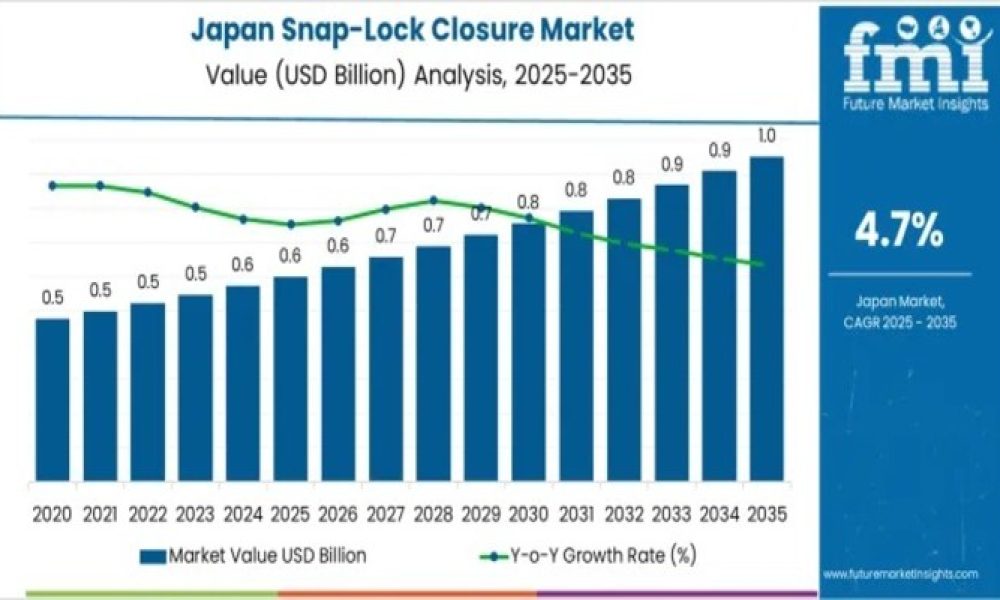
The demand for snap-lock closures in Japan is entering a phase of steady, functionality-led growth between 2025 and 2035. As Japanese consumers increasingly favor convenient, hygienic, and resealable packaging formats, snap-lock closures are becoming a critical component across food, beverage, household-care, and personal-care packaging.
In 2025, the Japan snap-lock closure market is valued at USD 0.6 billion, and it is projected to reach USD 1.0 billion by 2035, advancing at a CAGR of 4.7%. This growth reflects Japan’s emphasis on product safety, efficient packaging design, and alignment with evolving recycling standards.
Meaning and Market Definition
Snap-lock closures are packaging components designed to securely seal containers through a press-fit or snap mechanism, allowing repeated opening and reclosing without compromising product integrity. In Japan, these closures are widely used on PET and HDPE containers due to their lightweight structure, ease of use, and compatibility with automated bottling and filling systems.
Discover Market Opportunities – Get Your Sample of Our Industry Overview Today!
Market Overview
Japan’s snap-lock closure market is mature yet resilient, supported by consistent demand from high-volume consumer goods industries. Packaged beverages, sauces, condiments, detergents, shampoos, and healthcare liquids form the backbone of closure consumption. Plastic snap-lock closures dominate due to established manufacturing capabilities and cost efficiency, while metal variants serve niche industrial and construction-related applications.
Quick Market Snapshot (Japan):
- Market Value (2025): USD 0.6 billion
- Forecast Value (2035): USD 1.0 billion
- Forecast CAGR (2025–2035): 4.7%
- Leading Material: Plastic
- Key Growth Regions: Kyushu & Okinawa, Kanto
Growth Outlook Through 2035
Growth in Japan’s snap-lock closure market follows a balanced pattern of acceleration and moderation. Early growth is supported by packaging upgrades focused on safety, child resistance, and convenience, particularly in food and household-care categories. Brands periodically refresh closure designs to improve grip, sealing strength, and usability, creating short-term demand surges.
However, deceleration appears in mature categories where packaging redesign cycles are infrequent and refill-based systems reduce the number of new closures introduced. Japan’s strong recycling culture and emphasis on lightweight packaging also moderate volume growth. Overall, the market exhibits stable, innovation-timed expansion rather than rapid structural disruption.
Demand Drivers
Several structural and lifestyle factors continue to support rising demand for snap-lock closures in Japan:
- Growth of convenience foods, chilled items, and ready-to-use beverages
- Rising number of single-person households requiring portion-controlled packaging
- Increased use of e-commerce and home delivery requiring leak-resistant packaging
- Expansion of personal-care and household liquid products in portable formats
- Strong preference for hygienic, easy-to-open, and resealable containers
Retailers and logistics operators favor snap-lock systems because they maintain seal integrity during transport without secondary packaging, reducing damage and returns.
Material and Application Analysis
By Material Type
Plastic snap-lock closures account for 68.0% of demand, driven by molding flexibility, corrosion resistance, and compatibility with PET and HDPE bottles. Metal closures represent 32.0%, primarily used in construction, industrial fastening, and high-strength applications.
Key Material Insights:
- Plastic closures support lightweighting and recycling goals
- Metal closures provide durability for structural and industrial use
- Material choice is influenced by automation compatibility and end-use conditions
By Application
Bags lead application demand with a 45.0% share, particularly in food packaging and household storage. Roofing applications follow at 38.0%, while other uses such as hardware and transport packaging account for 17.0%.
Application Highlights:
- Bags dominate due to freshness retention and spill prevention
- Roofing requires resistance to wind, moisture, and temperature variation
- Specialty industrial uses demand precise locking strength
Key Market Trends
The snap-lock closure market in Japan is shaped by sustainability, automation, and user-centric design:
- Adoption of tethered closures to improve recycling collection efficiency
- Reduced resin usage through lightweight and thinner-wall designs
- Custom closure geometry optimized for vending-machine compatibility
- Rising demand for closures suited to refill pouches and multi-use containers
- Focus on tactile feedback and controlled opening force
These trends align closely with Japan’s circular economy objectives and high consumer expectations for packaging performance.
Regional Demand Analysis
Regional demand reflects manufacturing concentration, logistics infrastructure, and consumer distribution density.
Regional CAGR Highlights (2025–2035):
- Kyushu & Okinawa: 5.9%
- Kanto: 5.4%
- Kinki: 4.8%
- Chubu: 4.2%
- Tohoku: 3.7%
- Rest of Japan: 3.5%
Kyushu & Okinawa lead due to beverage consumption, tourism-driven retail, and humid climate conditions requiring secure sealing. Kanto benefits from dense urban retail networks, high-speed filling lines, and strong recycling infrastructure.
Competitive Landscape
Japan’s snap-lock closure market is characterized by technically advanced domestic manufacturers with strong relationships across food, beverage, and personal-care sectors. Competition centers on precision molding, hinge durability, sealing consistency, and recyclability alignment.
Leading Players Include:
- Yoshino Kogyosho Co., Ltd.
- Takemoto Yohki Co., Ltd.
- Nihon Tokan Package Co., Ltd.
- Nissei Plastic Industrial Co., Ltd.
- Albéa Japan
These companies focus on delivering closures that maintain performance across repeated use while meeting Japan’s strict quality and sustainability expectations.
Why FMI: https://www.futuremarketinsights.com/why-fmi
About Future Market Insights (FMI)
Future Market Insights, Inc. (FMI) is an ESOMAR-certified, ISO 9001:2015 market research and consulting organization, trusted by Fortune 500 clients and global enterprises. With operations in the U.S., UK, India, and Dubai, FMI provides data-backed insights and strategic intelligence across 30+ industries and 1200 markets worldwide.



