
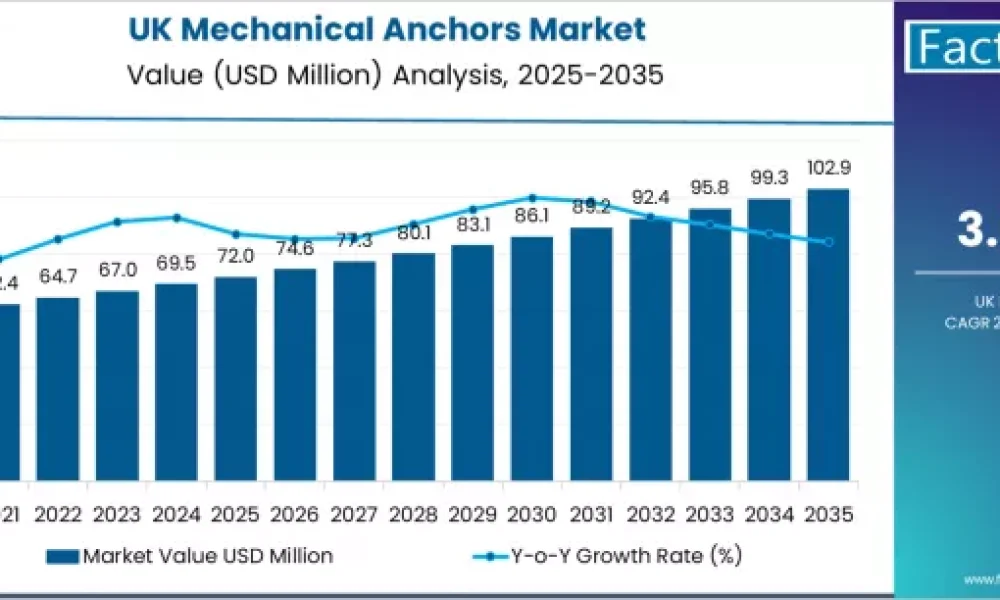
Demand for Mechanical Anchors in UK is expected to increase at a compound annual growth rate (CAGR) of 3.6% between 2025 and 2035, from USD 72.0 million in 2025 to roughly USD 102.9 million.
The demand for mechanical anchors in the United Kingdom is experiencing steady growth, supported by rising construction activity, infrastructure modernization, and ongoing investments in commercial, residential, and industrial projects. Mechanical anchors are critical fastening solutions used to secure structural and non-structural elements into concrete, masonry, and stone substrates. Their reliability, ease of installation, and immediate load-bearing capacity make them indispensable across a wide range of UK construction applications.
As the UK construction industry adapts to stricter safety regulations, sustainability goals, and performance standards, demand for high-quality, certified mechanical anchoring systems continues to increase.
Quick Market Overview (2025–2035)
- UK Mechanical Anchors Sales Value (2025): USD 72.0 million
- UK Mechanical Anchors Forecast Value (2035): USD 102.9 million
- UK Mechanical Anchors Forecast CAGR: 3.6%
- Leading Material Type in UK Mechanical Anchors Industry: Stainless Steel (49.2%)
- Key Growth Regions in UK Mechanical Anchors Industry: England, Scotland, Wales, and Northern Ireland
- Regional Leadership: England holds the leading position in demand
- Key Players in UK Mechanical Anchors Industry: Hilti Group, Stanley Black & Decker Inc., Simpson Strong-Tie Company Inc., Illinois Tool Works Inc., Koelner Rawlplug IP, Mungo Befestigungstechnik AG, MKT Fastening LLC, UCAN Fastening Products, Regional mechanical anchor specialists
To access the complete data tables and in-depth insights, request a Discount On The Report here: https://www.factmr.com/connectus/sample?flag=S&rep_id=12619
Market Overview
Mechanical anchors are fastening devices that rely on expansion, friction, or mechanical interlock to secure components into base materials. In the UK, these anchors are widely used in applications such as steel-to-concrete connections, façade installations, safety barriers, railings, HVAC systems, and heavy machinery mounting.
The growing emphasis on structural safety, durability, and compliance with building regulations has reinforced the importance of certified mechanical anchoring solutions. As older buildings and infrastructure are renovated or retrofitted, mechanical anchors remain a preferred solution due to their proven performance and ease of inspection.
Key Market Drivers
1. Infrastructure Development and Rehabilitation
The UK continues to invest in infrastructure upgrades.
Bridge repair and reinforcement projects
Transportation infrastructure and rail upgrades
Utilities, tunnels, and public facilities refurbishment
Mechanical anchors are extensively used in retrofitting and reinforcement applications where immediate load-bearing performance is required.
2. Growth in Commercial and Residential Construction
Urban development and housing demand support anchor consumption.
Expansion of commercial office spaces and mixed-use developments
Residential housing projects and apartment construction
Installation of façades, balconies, staircases, and safety systems
These projects rely heavily on mechanical anchoring systems for structural and non-structural installations.
3. Preference for Immediate Load-Bearing Solutions
Mechanical anchors offer practical advantages on job sites.
No curing time compared to chemical anchoring systems
Faster installation and reduced downtime
Suitable for time-sensitive construction schedules
This makes mechanical anchors particularly attractive for fast-track projects.
4. Strict Safety and Regulatory Standards
UK construction standards emphasize structural integrity.
Compliance with building codes and safety regulations
Demand for certified and tested anchoring products
Increased focus on long-term durability and reliability
As regulatory scrutiny increases, demand shifts toward high-performance mechanical anchors.
Market Segmentation Analysis
By Anchor Type
Wedge Anchors:
Widely used for heavy-duty applications in concrete structures.Sleeve Anchors:
Versatile anchors suitable for masonry and concrete substrates.Drop-In Anchors:
Preferred for overhead installations and flush-mount applications.Bolt and Expansion Anchors:
Used for structural steel connections and industrial installations.
By Application
Infrastructure and civil engineering projects
Commercial buildings and offices
Residential construction and renovations
Industrial facilities and warehouses
Infrastructure and commercial construction represent the largest demand segments in the UK.
By End User
Construction contractors
Engineering and infrastructure firms
Maintenance and retrofit service providers
Industrial facility operators
Contractors and civil engineering firms account for the majority of anchor consumption.
Regional Demand Trends within the UK
England:
Largest market due to high construction activity in major cities and infrastructure corridors.Scotland:
Steady demand driven by public infrastructure and energy-related projects.Wales:
Growth supported by regeneration initiatives and public-sector construction.Northern Ireland:
Moderate demand with emphasis on commercial and residential developments.
Challenges and Market Restraints
1. Competition from Chemical Anchoring Systems
Chemical anchors offer higher load capacity in some applications
Preference in high-performance structural connections
2. Price Sensitivity in Construction Projects
Cost pressures on contractors
Demand for competitively priced fastening solutions
3. Installation Errors and Performance Risks
Improper installation can reduce load capacity
Need for skilled labor and adherence to guidelines
Emerging Trends and Opportunities1. Growth in Retrofitting and Renovation Projects
Aging infrastructure increases demand for anchoring solutions.
2. Demand for Corrosion-Resistant Anchors
Stainless steel and coated anchors gaining popularity
Suitable for coastal and harsh environments
3. Focus on Lightweight and Efficient Designs
Manufacturers are developing anchors with optimized material usage and performance.
4. Increased Adoption in Renewable Energy Projects
Wind, solar, and energy infrastructure require reliable anchoring systems.
Competitive Landscape Highlights
Market participants are focusing on:
Product certification and compliance with UK standards
Development of high-load and corrosion-resistant anchors
Technical support and on-site installation guidance
Long-term supply partnerships with contractors
Future Outlook
The UK mechanical anchors market is expected to maintain stable growth through 2035, supported by infrastructure modernization, urban development, and ongoing maintenance of existing structures. As construction projects become more performance-driven and safety-focused, demand for certified, durable, and easy-to-install mechanical anchors will remain strong.
Manufacturers that deliver reliable performance, regulatory compliance, and cost efficiency will be well positioned to capitalize on long-term demand. Mechanical anchors will continue to play a critical role in ensuring structural safety and efficiency across the UK construction landscape.
Have specific requirements or need assistance on report pricing or have a limited budget? Please contact [email protected]
About Fact.MR:
Fact.MR is a global market research and consulting firm, trusted by Fortune 500 companies and emerging businesses for reliable insights and strategic intelligence. With a presence across the U.S., UK, India, and Dubai, we deliver data-driven research and tailored consulting solutions across 30+ industries and 1,000+ markets. Backed by deep expertise and advanced analytics, Fact.MR helps organizations uncover opportunities, reduce risks, and make informed decisions for sustainable growth.



