
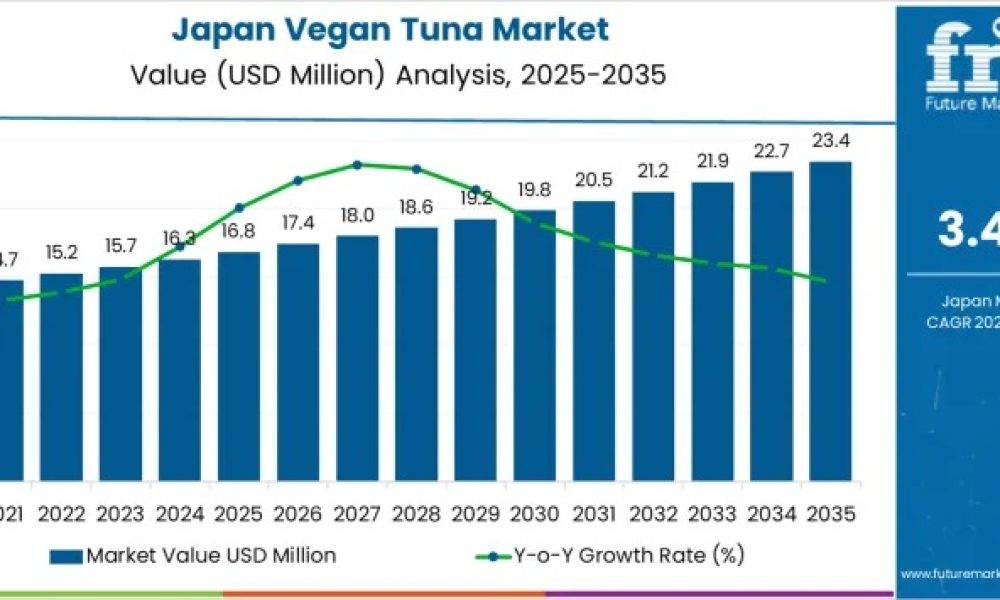
The demand for vegan tuna in Japan is valued at USD 16.8 million in 2025 and is projected to reach USD 23.4 million by 2035, expanding at a compound annual growth rate (CAGR) of 3.4%. Growth remains structurally concentrated in urban, flexitarian-led consumption rather than mainstream household diets. Unlike plant-based meat analogs, vegan tuna in Japan is embedded primarily within prepared meals, foodservice, and premium retail formats where controlled portioning and culinary compatibility matter more than ideological positioning.
Consumption is closely tied to ready-to-eat toppings for rice bowls, onigiri fillings, sushi-style rolls, and salad proteins. Chilled and frozen formats dominate distribution due to their suitability for convenience stores, bento manufacturers, airline catering, and institutional kitchens. Demand density is highest in Kanto and Kansai, where restaurant concentration, premium grocery penetration, and convenience retail infrastructure support repeat-use formats rather than one-off trials.
Explore trends before investing – request a sample report today! https://www.futuremarketinsights.com/reports/sample/rep-gb-29634
In 2025, Japan’s vegan tuna industry reflects a measured evolution rather than rapid disruption. From USD 14.2 million in 2020 to USD 16.8 million in 2025, growth has been driven by gradual menu extensions, limited SKU expansion, and controlled experimentation by foodservice operators. Vegan tuna is most often introduced as a functional substitute in prepared foods rather than positioned as a direct replacement for traditional seafood consumption.
Market Trajectory Through 2035
By 2030, demand is expected to reach USD 19.2 million, representing an incremental gain of USD 2.4 million during the first half of the forecast period. This phase is characterized by adoption across convenience meals, specialty plant-based outlets, and urban foodservice channels. Price sensitivity continues to limit pantry stocking, keeping household adoption secondary to institutional and premium retail use.
From 2030 to 2035, demand rises more sharply, adding USD 4.2 million to reach USD 23.4 million. This acceleration reflects broader inclusion in frozen foods, corporate cafeterias, school lunch programs, airline meals, and tourism-driven foodservice. Rising seafood price volatility and supply constraints further encourage plant-based substitution in processed meals, where texture fidelity and umami replication outweigh sustainability messaging.
Key Market Snapshot
- Industry Value (2025): USD 16.8 million
- Forecast Value (2035): USD 23.4 million
- CAGR (2025–2035): 3.4%
- Leading Source (2025): Wheat (24%)
- Key Growth Regions: Kyushu & Okinawa, Kanto, Kinki, Chubu
What Is Driving Demand in Japan?
Vegan tuna demand in Japan has emerged from a combination of seafood supply pressure, price instability, and evolving definitions of protein quality. Tuna holds deep cultural relevance in sushi, rice bowls, and convenience foods, making its availability and cost highly sensitive. Vegan tuna is increasingly positioned as a buffering ingredient that stabilizes margins in prepared foods rather than as a lifestyle-driven alternative.
Early adoption was led by specialty restaurants, health-focused retailers, and urban flexitarian consumers. Over time, foodservice operators recognized its operational advantages, including standardized portioning, cold storage efficiency, and allergen-controlled handling. Acceptance hinges less on sustainability narratives and more on flavor fidelity, oil retention, and compatibility with soy sauce, vinegar, and mayonnaise-based profiles.
Source and Application Dynamics
By source, wheat-based formulations account for 24% of demand, reflecting strong alignment with Japan’s processed food infrastructure. Wheat gluten offers cost stability, predictable texture, and reliable performance across extrusion, steaming, and retort cooking. Domestic availability and limited import dependence further support its dominance, particularly in private-label and convenience retail production.
By application, “other applications” represent 39% of demand, covering ready meals, rice toppings, fillings, and institutional catering. High-volume bento production, airline catering, and corporate foodservice drive recurring demand through centralized procurement and frozen logistics. These applications favor standardized flake size, moisture retention, and seasoning absorption over branding differentiation.
Regional Demand Patterns
Regional growth varies across Japan, shaped by foodservice density, tourism exposure, and retail infrastructure:
- Kyushu & Okinawa (4.2% CAGR): Tourism-driven foodservice and resort dining fuel experimentation.
- Kanto (3.9% CAGR): Dense convenience retail and private-label ready meals anchor demand.
- Kinki (3.4% CAGR): Institutional catering and regional brands support steady uptake.
- Chubu (3.0% CAGR): Factory catering and frozen meal kits drive balanced growth.
- Tohoku & Rest of Japan (2.5–2.6% CAGR): Household cooking and institutional meals sustain gradual adoption.
Competitive Landscape and Access Channels
The competitive field includes domestic food innovators, plant protein specialists, and selected global alternative seafood brands operating through private-label and co-manufactured offerings. Brands such as Good Catch Plant-Based Tuna, Sophie’s Kitchen Plant-Based Toona, Loma Linda TUNO, Vegan ZeaStar Tuna, and Worthington Meatless Tuna participate through specialty retail, distributor-led foodservice, and limited sushi-style trials.
Supplier selection is guided by texture similarity to skipjack tuna, neutral flavor profiles, frozen stability, and compliance with Japan’s strict labeling and food safety standards. Success increasingly depends on culinary performance within rice-based dishes rather than consumer-facing storytelling.
Subscribe for Year-Round Insights → Stay ahead with quarterly and annual data updates! https://www.futuremarketinsights.com/reports/brochure/rep-gb-29634
Outlook
By 2035, vegan tuna in Japan remains niche relative to conventional seafood but becomes structurally embedded within processed food manufacturing and institutional catering. Long-term growth will depend on continued improvements in texture engineering, cost parity, and broader acceptance of plant-based seafood as a functional ingredient within everyday Japanese meals, rather than a symbolic alternative.
About Future Market Insights (FMI)
Future Market Insights, Inc. (FMI) is an ESOMAR-certified, ISO 9001:2015 market research and consulting organization, trusted by Fortune 500 clients and global enterprises. With operations in the U.S., UK, India, and Dubai, FMI provides data-backed insights and strategic intelligence across 30+ industries and 1200 markets worldwide.



