
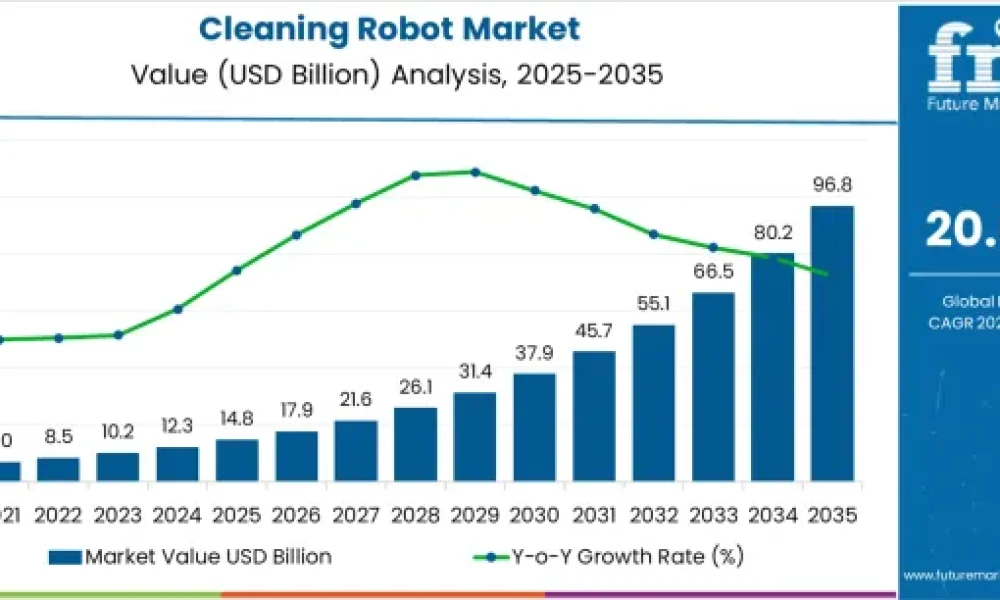
The global cleaning robot market is set for remarkable growth, projected to soar from an estimated USD 14.8 billion in 2025 to an impressive USD 96.8 billion by 2035. This growth represents a robust compound annual growth rate (CAGR) of 20.6%, driven by rapid advancements in technology and shifting consumer preferences towards automation.
Subscribe for Year-Round Insights → Stay ahead with quarterly and annual data updates: https://www.futuremarketinsights.com/reports/sample/rep-gb-18953
Market Overview
The cleaning robot market is rapidly evolving, fueled by increasing automation across residential, commercial, and industrial sectors. Rising labor costs and growing consumer demand for efficient, time-saving cleaning solutions are key catalysts. Moreover, innovations in artificial intelligence (AI), sensor-based navigation, and voice-assisted controls have revolutionized cleaning robots’ functionality, making them smarter, more user-friendly, and highly effective.
Urbanization and shrinking living spaces are further accelerating demand, as robotic cleaners offer practical solutions for maintaining hygiene with minimal effort. Affordability has also improved, making these technologies accessible to a broader audience.
Key Market Drivers
- Technological Advancements: AI-powered robots with enhanced navigation and obstacle detection improve cleaning efficiency and user experience.
- Rising Labor Costs: Businesses and households seek automation to reduce reliance on manual labor, driving adoption.
- Pandemic-induced Hygiene Awareness: Increased focus on cleanliness post-COVID-19 has propelled demand for smart sanitizing and cleaning robots.
- Smart Home Integration: Compatibility with IoT devices and voice assistants enhances usability and convenience, attracting tech-savvy consumers.
Segment Insights
By Type: Professional vs. Personal Cleaning Robots
The professional cleaning robot segment leads with a commanding 57.3% market share. These robots are widely deployed in airports, hospitals, offices, and retail outlets where high hygiene standards and cost efficiency are critical. Advanced mapping and self-docking capabilities enable large-area autonomous cleaning, reducing operational downtime and maintenance costs.
In contrast, the personal cleaning robot segment is gaining ground, predicted to grow at a CAGR of 21.5% through 2035. With improved affordability and user-friendly features, personal robots are becoming popular in urban households for routine domestic cleaning.
By Product: Floor-Cleaning Robots Dominate
Floor-cleaning robots hold the largest product share at approximately 61.5%. They are widely accepted for their effectiveness on various surfaces such as hardwood, tile, and carpets. Innovations like wet-and-dry hybrid functionality and self-emptying dustbins are making these devices increasingly attractive.
Other product categories include lawn-cleaning, pool-cleaning, and window-cleaning robots, which are expanding their footprint in niche markets.
By Application: Residential Segment Leads
Residential applications account for about 62% of the market, driven by rising disposable incomes and greater awareness of smart home technologies. Homeowners are embracing cleaning robots for their convenience, especially those integrated with mobile apps and voice assistants.
Commercial and industrial applications are also growing rapidly, particularly in healthcare and hospitality sectors, where hygiene and efficiency are paramount.
Regional Outlook
- North America: Expected to maintain significant market share due to high disposable incomes and early adoption of advanced cleaning technologies. The U.S. market alone is forecasted to grow at a CAGR of 21.9%, driven by demand for premium products with AI features.
- Asia-Pacific: Rapid urbanization and expanding middle-class populations in China, Japan, and South Korea are fueling growth. Countries like South Korea, with strong tech conglomerates like Samsung and LG, are spearheading innovations.
- Europe: Growth in the UK and Western Europe is supported by dense urban living and strong e-commerce penetration, making cleaning robots widely accessible.
Competitive Landscape
The cleaning robot market is highly competitive, with key players including:
- iRobot Corporation
- Ecovacs Robotics
- SharkNinja
- Xiaomi Corporation
- Samsung Electronics
- Neato Robotics
- ILIFE Robotics
- Roborock
- Dyson Ltd.
These companies continue to innovate, focusing on multi-surface cleaning capabilities, battery life enhancements, and connectivity features.
Recent Industry Developments
- In January 2025, Samsung Electronics introduced the Bespoke Jet Bot Combo™, combining vacuuming and mopping with advanced AI and steam cleaning.
- Avidbots launched the Neo 2W in April 2025, designed specifically for warehouse and factory environments to boost productivity.
- TAILOS unveiled the TAILOS Swarm in February 2025, enabling multiple robots to work together for efficient large-area cleaning.
Emerging Trends and Opportunities
- Sustainability: Eco-friendly cleaning products and biodegradable materials are gaining importance among environmentally conscious consumers.
- Energy Efficiency: R&D into longer-lasting batteries and potential solar-powered charging could reduce environmental impact.
- Swarm Robotics: Collaborative cleaning robots working in tandem for large spaces present a promising innovation.
- Healthcare Applications: Robots specialized in disinfection and sanitization are in increasing demand in hospitals and care facilities.
- Accessibility: Development of robots catering to the elderly and people with disabilities opens new market segments.
Challenges to Market Growth
- High Initial Costs: Price remains a barrier for mass adoption, particularly in developing regions.
- Cybersecurity Risks: Increased connectivity raises concerns over data privacy and device security.
- Regulatory Compliance: Manufacturers must navigate evolving standards related to safety, privacy, and environmental impact.
Conclusion
The cleaning robot market is on a strong growth trajectory, propelled by technological advancements, shifting consumer lifestyles, and expanding use cases. From smart homes to large commercial facilities, cleaning robots are revolutionizing hygiene and operational efficiency. With ongoing innovation and increasing affordability, this market is poised to reach nearly USD 97 billion by 2035, transforming the cleaning landscape globally.
Have a specific Requirements and Need Assistant on Report Pricing or Limited Budget please contact us – [email protected]
About Future Market Insights (FMI)
Future Market Insights, Inc. (FMI) is an ESOMAR-certified, ISO 9001:2015 market research and consulting organization, trusted by Fortune 500 clients and global enterprises. With operations in the U.S., UK, India, and Dubai, FMI provides data-backed insights and strategic intelligence across 30+ industries and 1200 markets worldwide.



