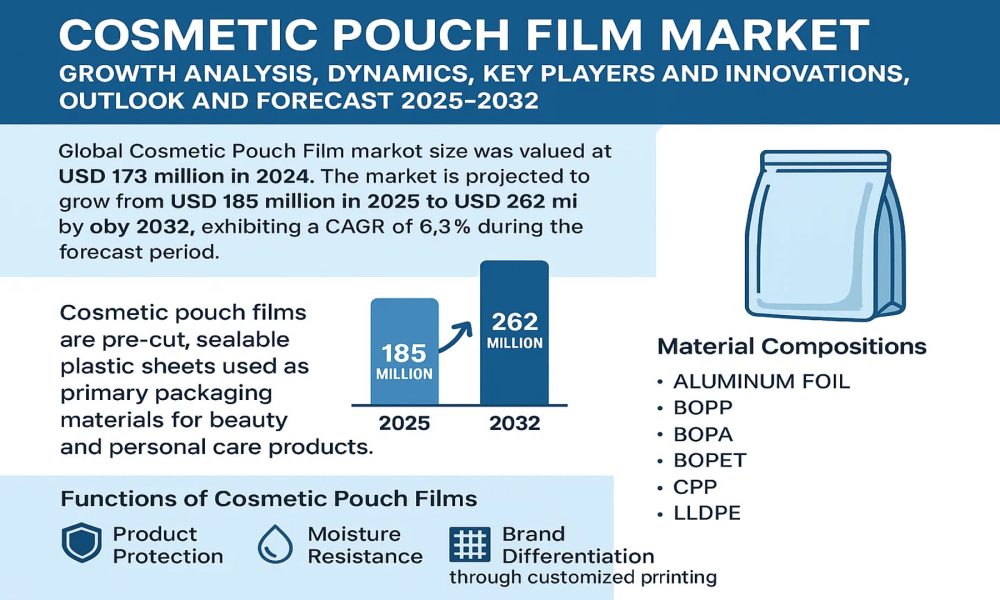
Global Cosmetic Pouch Film market size was valued at USD 173 million in 2024. The market is projected to grow from USD 185 million in 2025 to USD 262 million by 2032, exhibiting a CAGR of 6.3% during the forecast period.
Cosmetic pouch films are pre-cut, sealable plastic sheets used as primary packaging materials for beauty and personal care products. These films come in various material compositions such as aluminum foil, BOPP, BOPA, BOPET, CPP, and LLDPE films, selected based on product compatibility and barrier requirements. The films serve critical functions like product protection, moisture resistance, and brand differentiation through customized printing.
The market growth is primarily driven by the expanding global beauty industry, which reached USD 427 billion in 2022, with skincare products accounting for USD 190 billion. While North America and Europe dominate production due to concentrated cosmetic brand headquarters, Asia-Pacific shows strong growth potential due to rising disposable incomes. Recent innovations in sustainable film materials and digital printing technologies are creating new opportunities, though regulatory pressures on plastic use present challenges for traditional material suppliers.
Unlock Your Free Sample Report Here- https://www.intelmarketresearch.com/download-free-sample/8099/cosmetic-pouch-film-market
MARKET DYNAMICS
MARKET DRIVERS
Growing Cosmetic Industry Demand to Propel Cosmetic Pouch Film Market
The global cosmetics industry, valued at approximately $427 billion in 2022, continues to expand at a steady pace, directly driving demand for innovative packaging solutions like cosmetic pouch films. With skincare products alone accounting for $190 billion in sales, brands are increasingly adopting flexible packaging formats to enhance product appeal and functionality. Cosmetic pouch films offer superior barrier properties, lightweight convenience, and customization options that align perfectly with the premiumization trend in beauty packaging. The market for these films is further bolstered by the rising popularity of travel-sized toiletries and luxury cosmetics in emerging markets, where easy-to-carry pouches are preferred over traditional rigid containers.
Sustainability Push Accelerates Adoption of Eco-Friendly Films
Increasing environmental awareness has transformed packaging preferences across the cosmetics sector, creating significant opportunities for sustainable pouch film solutions. Over 65% of global consumers now consider sustainability an important factor when purchasing beauty products, pushing brands to adopt recyclable and biodegradable films. The development of advanced materials like compostable BOPA films and recycled LLDPE films has enabled manufacturers to meet both performance requirements and environmental standards. Recent innovations in mono-material pouch films allow for easier recycling while maintaining the high-barrier properties needed for sensitive cosmetic formulations.
➤ Leading beauty brands have committed to achieving 100% recyclable or reusable packaging by 2025, accelerating R&D investments in sustainable pouch film technologies.
Furthermore, regulatory pressures such as extended producer responsibility (EPR) schemes and plastic taxation policies in Europe and North America are compelling cosmetic companies to transition toward eco-friendly packaging solutions. This regulatory momentum, combined with consumer demand for green alternatives, positions sustainable pouch films as a key growth segment within the cosmetics packaging market.
MARKET OPPORTUNITIES
Smart and Interactive Packaging Creates New Value Propositions
The integration of smart technologies into cosmetic pouch films presents significant growth opportunities. Innovations such as NFC-enabled films for product authentication, augmented reality triggers, and freshness indicators are gaining traction among premium beauty brands. These advanced functionalities enhance consumer engagement while addressing growing concerns about product authenticity in the cosmetics market, where counterfeit products account for an estimated 10-15% of global sales.
Furthermore, the development of active packaging films with antimicrobial properties or oxygen scavengers offers solutions for preserving sensitive formulations without traditional preservatives. This aligns perfectly with the clean beauty movement and increasing consumer demand for preservative-free products, creating new avenues for premium-pouch film applications.
The Asia-Pacific region, with its booming e-commerce sector and rapidly expanding middle class, presents particularly strong opportunities for value-added pouch films. Local manufacturers are investing heavily in high-speed filling technologies and e-commerce-optimized pouch designs to capture this growing market segment.
Segment Analysis:
By Type
- Aluminum Foil
- BOPP Film
- BOPA Film
- BOPET Film
- CPP Film
- LLDPE Film
- Others
BOPP Film holds a dominant position due to its superior moisture resistance, durability, and cost-effectiveness in cosmetic packaging applications.
By Application
- Skincare
- Shampoos and Shower Gels
- Color Cosmetics
- Hair Care
- Others
Skincare applications lead the market, fueled by increasing demand for premium and sustainable packaging solutions in the beauty industry.
By End User
- Cosmetics Brands
- Contract Packaging Manufacturers
- Private Label Manufacturers
Cosmetics Brands represent the primary users, driving innovation in pouch film designs to enhance product differentiation and shelf appeal.
By Film Structure
- Single-layer Films
- Multi-layer Films
- Co-extruded Films
Multi-layer Films are gaining traction as they provide enhanced barrier properties and extended product shelf life for cosmetic formulations.
List of Key Cosmetic Pouch Film Companies Profiled
- Toray Industries, Inc. (Japan)
- Polibak (Turkey)
- Vacmet India Ltd. (India)
- WINPAK Ltd. (Canada)
- DuPont Teijin Films (U.S./Japan)
- Mitsubishi Chemical Corporation (Japan)
- Uflex Limited (India)
- Jindal Poly Films Ltd. (India)
- Sunrise Packaging Material Co., Ltd. (China)
- Vibac Group (Italy)
- Cosmo Films Ltd. (India)
- Vitopel (Brazil)
- Innovia Films (U.K.)
- Toppan Printing Co., Ltd. (Japan)
- Tredegar Corporation (U.S.)
COSMETIC POUCH FILM MARKET TRENDS
Sustainable Material Innovation Driving Market Expansion
The cosmetic pouch film market is experiencing a transformative shift toward eco-friendly materials as brands respond to increasing consumer demand for sustainable packaging. With the global beauty industry generating over 120 billion units of packaging annually, manufacturers are prioritizing biodegradable and recyclable pouch films such as mono-material BOPP and BOPET structures. Recent data indicates that approximately 42% of beauty consumers now consider sustainability a key purchasing factor, accelerating adoption of films with reduced carbon footprints. Furthermore, advancements in bio-based polymers derived from sugarcane and cellulose are gaining traction, enabling high-barrier protection while addressing environmental concerns.
Other Trends
Premiumization through Functional Films
The rise of luxury skincare segments, projected to grow at 8.2% CAGR through 2030, is fueling demand for high-performance pouch films with enhanced functionalities. Multi-layer laminates incorporating aluminum foil (35% market share in premium pouches) provide superior oxygen and moisture barriers for active-ingredient preservation. Meanwhile, the integration of smart films with temperature-sensitive inks for product authenticity verification is emerging as a brand differentiator in high-value cosmetics. These innovations cater to a consumer base increasingly willing to pay 15-20% premiums for packaging that ensures product integrity and shelf appeal.
Asia-Pacific Growth Reshaping Supply Chains
With Asia-Pacific accounting for 38% of global cosmetic sales, regional pouch film manufacturers are expanding production capacities to meet surging demand. The Chinese market alone is expected to contribute 45% of total volume growth through 2032, driven by booming e-commerce requiring durable, lightweight packaging. Local players are innovating cost-effective BOPA films (nylon-based) that offer puncture resistance for international shipping, while Japanese firms lead in ultra-thin 12-micron BOPET films for compact luxury pouches. This geographical shift is prompting global brands to establish strategic partnerships with regional suppliers to optimize logistics and tariff advantages.
Recent Developments in the Cosmetic Pouch Film Market
- Shift Toward Sustainable Packaging Materials
- Many cosmetic brands are adopting eco-friendly pouch films made from biodegradable, recyclable, or compostable polymers.
- Major players like Amcor, Sealed Air, and Mondi are investing in mono-material pouch films that enhance recyclability without compromising on barrier properties.
- Growth of Premiumization in Packaging
- With rising consumer demand for luxury skincare and beauty products, companies are introducing high-gloss, metallic finish, and soft-touch pouch films to improve product aesthetics.
- Digital printing technology is being increasingly integrated for customization and limited-edition packaging.
- Technological Advancements in Barrier Properties
- New multi-layer pouch films are being developed with enhanced UV resistance, oxygen barrier, and moisture barrier capabilities.
- These films help maintain product stability, especially for organic and natural cosmetics sensitive to light and air.
- Expansion in Emerging Markets
- Asia-Pacific, particularly China, India, and South Korea, is witnessing rapid adoption of cosmetic pouch films due to the growing skincare and personal care industry.
- Local manufacturers are collaborating with global packaging giants to cater to the booming e-commerce-driven beauty market.
- Smart Packaging and Digital Integration
- QR codes and NFC-enabled pouch films are being introduced to provide traceability, authentication, and consumer engagement.
- Brands are using interactive pouch films to share tutorials, authenticity checks, and sustainability information.
- Focus on Lightweight and Cost-Efficient Solutions
- Manufacturers are reducing material thickness to create lightweight films, lowering transportation costs and carbon emissions.
- Flexible pouch films are replacing rigid containers in certain product categories, such as travel-size skincare sachets and refill packs.
- Strategic Collaborations and Acquisitions
- Packaging companies are partnering with cosmetic brands and film technology developers to co-create innovative pouch film solutions.
- Recent acquisitions in the flexible packaging sector are strengthening the supply chain and expanding product portfolios in cosmetic films.
Unlock Your Free Sample Report Here- https://www.intelmarketresearch.com/download-free-sample/8099/cosmetic-pouch-film-market
About Intel Market Research
Intel Market Research delivers actionable insights in technology and infrastructure markets. Our data-driven analysis leverages:
- Real-time infrastructure monitoring
- Techno-economic feasibility studies
Competitive intelligence across 100+ countries
Trusted by Fortune 500 firms, we empower strategic decisions with precision.
International: +1(332) 2424 294 | Asia: +91 9169164321
Website: https://www.intelmarketresearch.com
Follow us on LinkedIn: https://www.linkedin.com/company/intel-market-research




