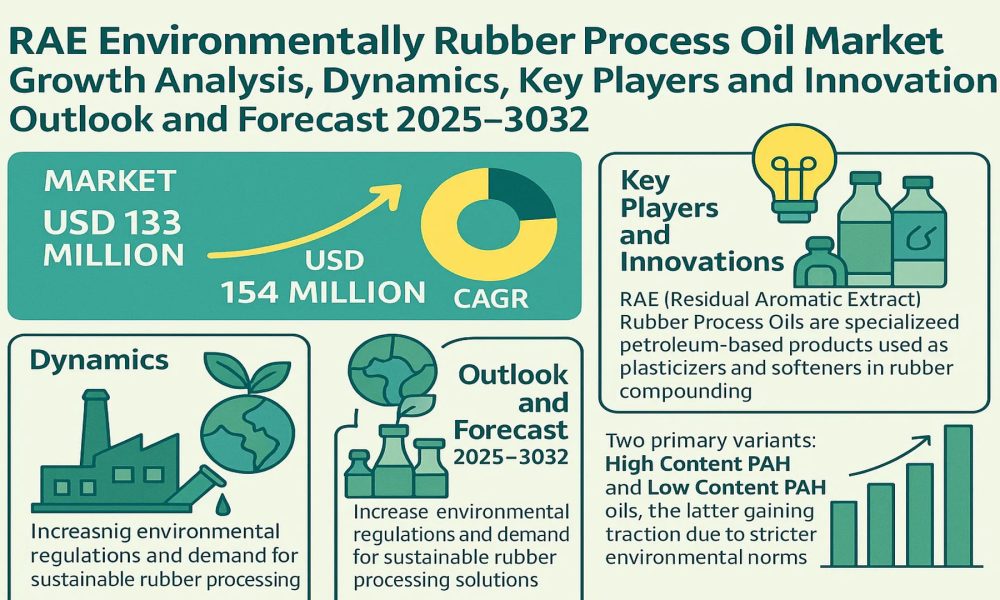
RAE Environmentally Rubber Process Oil Market was valued at USD 133 million in 2024 and is projected to reach USD 154 million by 2032, exhibiting a CAGR of 2.1% during the forecast period. While growth appears moderate, increasing environmental regulations and demand for sustainable rubber processing solutions are driving steady expansion.
RAE (Residual Aromatic Extract) Rubber Process Oils are specialized petroleum-based products used as plasticizers and softeners in rubber compounding. These oils improve processing efficiency, elasticity, and performance characteristics in both tire and non-tire rubber products. The market offers two primary variants: High Content Polycyclic Aromatic Hydrocarbon (PAH) and Low Content PAH oils, with the latter gaining traction due to stricter environmental norms.
The market’s growth is primarily fueled by the expanding automotive sector, particularly in Asia-Pacific, where tire production continues to rise. However, challenges persist regarding regulatory compliance and the shift toward bio-based alternatives. Key industry players like Shell, Total, and Repsol are investing in sustainable formulations to maintain competitiveness while addressing environmental concerns.
Download Your Free Copy of the Sample Report- https://www.intelmarketresearch.com/download-free-sample/8078/rae-environmentally-rubber-process-oil-market
MARKET DYNAMICS
MARKET DRIVERS
Rising Demand for Eco-Friendly Rubber Products Accelerates Market Growth
The global shift toward sustainable manufacturing practices is significantly driving the RAE environmentally rubber process oil market. With increasing environmental regulations banning conventional aromatic oils containing high PAH content, manufacturers are rapidly adopting RAE oils as compliant alternatives. The European Union’s REACH regulations and similar frameworks in North America have created a regulatory push towards these safer formulations. The tyre industry alone accounts for over 60% of total rubber process oil consumption, and major tyre manufacturers are transitioning to RAE oils to meet both regulatory and consumer demands for greener products. This fundamental industry shift provides sustained momentum for market expansion.
Automotive Industry Expansion Fuels Consumption Growth
The global automotive industry’s recovery and growth present a key driver for RAE rubber process oils. As vehicle production rebounds post-pandemic, particularly in emerging Asian markets, demand for both OEM and replacement tyres continues to climb. Southeast Asia has emerged as a particularly strong growth region, with automotive production volumes growing at approximately 5% annually. This directly translates to increased consumption of rubber process oils in tyre manufacturing. Beyond tyres, the growing complexity of automotive rubber components – from hoses to vibration dampeners – is creating additional demand vectors for high-performance process oils that meet stringent environmental standards.
Technological Advancements in Oil Refining Enhance Product Portfolio
Recent advancements in hydrotreatment and solvent extraction technologies have enabled the production of superior quality RAE rubber process oils. These innovations allow manufacturers to precisely control PAH content while maintaining optimal elastomer compatibility and performance characteristics. Several leading producers have introduced new product grades specifically designed for high-performance applications such as silica-filled tyre formulations. The ability to customize viscosity, flash point, and other critical parameters has expanded the potential applications of RAE oils across various rubber product segments, creating new growth avenues in both tyre and non-tyre applications.
MARKET OPPORTUNITIES
Expansion in Emerging Markets Presents Significant Growth Potential
The gradual tightening of environmental regulations in developing economies creates substantial opportunities for RAE rubber process oil adoption. As countries like India, Brazil, and ASEAN nations implement stricter controls on PAH content, local rubber manufacturers will need to transition to compliant formulations. This regulatory evolution coincides with rapid industrialization in these regions, where rubber product manufacturing is expanding to serve growing domestic demand. Early movers establishing local production or distribution networks stand to capture significant market share as these transitions accelerate.
Development of High-Performance Blends Opens New Application Areas
Innovative formulation technologies present opportunities to expand RAE oil applications beyond traditional rubber products. Recent developments in customized oil blends have shown promise in specialty elastomers used in medical devices, food contact materials, and other high-value applications. The ability to precisely engineer chemical compositions while maintaining environmental compliance allows penetration into markets previously dominated by synthetic oils. These high-value segments typically command premium pricing, improving overall market profitability in addition to volume growth.
Circular Economy Initiatives Create Demand for Sustainable Solutions
The growing emphasis on circular economy principles in the rubber industry is driving interest in sustainable processing aids. RAE oil producers have the opportunity to develop closed-loop systems incorporating recycled content or bio-based components without compromising performance. Several leading tyre manufacturers have already announced ambitious sustainability targets that include transitioning to 100% sustainable materials by 2040. Proactive engagement in these initiatives through product innovation and lifecycle analysis can position RAE oil suppliers as essential partners in the industry’s green transformation.
Segment Analysis:
By Type
- High Content Polycyclic Aromatic Hydrocarbon (PAH)
- Low Content Polycyclic Aromatic Hydrocarbon (PAH)
Low Content PAH is gaining prominence due to stricter environmental regulations and sustainability initiatives in rubber manufacturing.
By Application
- Tyre Products
- Non-Tyre Products
Tyre Products remain the dominant application segment due to the high demand for durable, high-performance rubber compounds in automotive applications.
By End User
- Rubber Manufacturers
- Automotive Industry
- Industrial Goods Producers
Rubber Manufacturers constitute the primary end users, driven by the need for high-quality process oils in tire and industrial rubber production.
By Regulatory Standard
- REACH Compliant
- Non-REACH Compliant
REACH Compliant oils are experiencing faster adoption rates, particularly in European markets, due to stringent environmental legislation.
List of Key RAE Environmentally Rubber Process Oil Manufacturers
- Shell plc (Netherlands/UK)
- H&R Group (Germany)
- Eni S.p.A. (Italy)
- Repsol S.A. (Spain)
- Orgkhim Biochemical Holdings (Russia)
- TotalEnergies SE (France)
- HollyFrontier Specialty Products (U.S.)
- IRPC Public Company Limited (Thailand)
Second-tier competitors are pursuing niche strategies to differentiate themselves. HollyFrontier Specialty Products has carved out a strong position in the North American market through its focus on customized oil formulations for synthetic rubber applications. Similarly, Thailand’s IRPC has become a key supplier to Southeast Asian tire manufacturers by offering competitive pricing and short lead times.
The competitive dynamics are evolving as environmental concerns reshape industry requirements. All major players are now investing in technologies to reduce PAH content below 3% while maintaining performance characteristics – a challenging technical feat that could determine future market leadership. Recent industry consolidation suggests we may see further M&A activity as companies seek to combine technical capabilities and distribution networks.
RAE ENVIRONMENTALLY RUBBER PROCESS OIL MARKET TRENDS
Sustainability Regulations Driving Demand for Low-PAH Rubber Process Oils
Increasing environmental regulations are reshaping the rubber process oil industry, with low-PAH (Polycyclic Aromatic Hydrocarbon) variants gaining significant traction. The European Union’s REACH regulations and similar frameworks in North America and Asia are mandating stricter limits on PAH content in rubber products, particularly in tires and industrial rubber goods. Manufacturers are responding by shifting toward RAE (Residual Aromatic Extract) environmentally friendly rubber process oils, which typically contain less than 3% PAH content compared to traditional oils that may exceed 25%. This transition is expected to accelerate, given that over 60% of global rubber production now falls under some form of PAH restriction.
Other Trends
Automotive Industry’s Green Shift
The automotive sector’s push toward sustainability is creating robust demand for eco-friendly rubber process oils, particularly in tire manufacturing. With electric vehicle production projected to grow at over 20% annually through 2030, tire manufacturers require specialized rubber compounds that align with lower carbon footprint initiatives. RAE environmentally rubber process oils help achieve this while maintaining critical performance characteristics like flexibility and durability. Major tire producers are actively reformulating compounds, with some investing up to 15% more in R&D for sustainable material integration.
Asia-Pacific Emerging as Growth Hotspot
While Europe currently leads in regulatory-driven adoption, Asia-Pacific is witnessing the fastest growth in RAE environmentally rubber process oil consumption. Countries like India and China are implementing stricter environmental policies while simultaneously expanding their rubber product manufacturing capacities. China alone accounts for nearly 40% of global rubber consumption, and its domestic producers are rapidly transitioning to compliant formulations to maintain export market access. Regional production capacity for low-PAH process oils has grown by approximately 8% annually since 2020 to meet this demand.
Download Your Free Copy of the Sample Report- https://www.intelmarketresearch.com/download-free-sample/8078/rae-environmentally-rubber-process-oil-market
Recent Developments in the RAE Environmentally Rubber Process Oil Market
- Shift Toward Sustainable Alternatives
Leading oil manufacturers are focusing on producing environmentally friendly rubber process oils with very low polycyclic aromatic hydrocarbon (PAH) content to comply with REACH (Registration, Evaluation, Authorisation and Restriction of Chemicals) regulations in Europe and other global standards. RAE-based process oils are gaining wider acceptance due to their balance of environmental compliance and processing efficiency. - Product Innovations in Rubber Compounding
Companies are introducing RAE-based process oils with enhanced compatibility for tire and non-tire rubber applications. These new grades are designed to improve flexibility, durability, and rolling resistance in tires, while also supporting eco-label certifications demanded by automotive OEMs. - Strategic Expansion by Global Players
Major oil producers such as Nynas, TotalEnergies, and Repsol have expanded their portfolio of RAE-based process oils, aiming to meet the rising demand from Asia-Pacific markets, especially in China and India, where tire manufacturing is rapidly growing. - Growing Use in Green Tires
With rising demand for fuel-efficient and low-emission vehicles, tire manufacturers are increasingly adopting RAE-based rubber process oils in green tire formulations. This is supported by regulatory mandates on tire labeling and fuel efficiency in the EU, Japan, and the U.S. - R&D and Collaboration
Companies are investing in research partnerships with tire and rubber manufacturers to optimize RAE oils for different rubber formulations. This includes enhancing low-temperature performance, heat resistance, and eco-safety properties. - Expansion in Non-Tire Applications
Apart from tires, RAE oils are finding growing usage in belts, hoses, seals, gaskets, and footwear manufacturing, as industries increasingly replace traditional aromatic oils with environmentally compliant alternatives. - Supply Chain Diversification
To ensure stability against fluctuating crude oil prices and geopolitical risks, manufacturers are diversifying their feedstock sources and investing in regional production hubs for process oils.
About Intel Market Research
Intel Market Research delivers actionable insights in technology and infrastructure markets. Our data-driven analysis leverages:
- Real-time infrastructure monitoring
- Techno-economic feasibility studies
Competitive intelligence across 100+ countries
Trusted by Fortune 500 firms, we empower strategic decisions with precision.
International: +1(332) 2424 294 | Asia: +91 9169164321
Website: https://www.intelmarketresearch.com
Follow us on LinkedIn: https://www.linkedin.com/company/intel-market-research




