
Definition
Electronic grade trimethylphosphite (TMP) is a highly purified organophosphorus compound used primarily in semiconductor manufacturing. TMP serves as a critical phosphorus precursor in the deposition of phosphosilicate glass (PSG) and borophosphosilicate glass (BPSG) dielectric layers on silicon wafers. These layers are essential for MEMS devices, integrated circuits, and other advanced semiconductor applications.
TMP’s electronic grade is distinguished by its ultra-high purity requirements. Standard grades include 7N (≥99.99999% purity), 8.5N (≥99.9999995% purity), and 9N (≥99.9999999% purity). Maintaining such purity ensures that trace contaminants do not interfere with wafer processing, which is especially critical in sub-10nm semiconductor nodes.
The product’s applications extend beyond traditional CMOS wafer fabrication. It is increasingly used in MEMS device manufacturing, photonic integrated circuits, and 3D advanced packaging processes. TMP is supplied to semiconductor foundries, IDMs (Integrated Device Manufacturers), MEMS producers, and research institutions worldwide.
The market for electronic grade TMP is highly specialized, dominated by a few global manufacturers due to the technical complexity of producing ultra-high-purity chemicals, strict environmental regulations, and the need for robust supply chain management.
Recent Developments in the Electronic Grade Trimethylphosphite (TMP) Market
The electronic grade trimethylphosphite (TMP) market is experiencing a significant shift toward higher purity and greater application diversity, fueled by the rapid expansion of the semiconductor and electronics industries. Recent developments are focused on achieving increasingly high purity levels (e.g., 7N, 8N, and 9N), which are crucial for the flawless performance of advanced microelectronic devices. There is also growing interest in using TMP as a phosphorus source in new applications beyond its traditional role in phosphosilicate and borophosphosilicate glass (PSG/BPSG) layers for semiconductor fabrication. This includes its use as an electrolyte additive in high-voltage lithium-ion batteries, where it enhances battery stability, safety, and performance. This trend is driving research into new synthesis and purification techniques to meet the stringent quality demands of these cutting-edge applications.
Major Distribution Channels
The distribution of electronic grade trimethylphosphite (TMP) is a highly specialized and controlled process, dominated by direct sales and a limited network of authorized distributors. Given the high-purity and hazardous nature of the chemical, direct sales from manufacturers to semiconductor fabricators and other large-scale electronic manufacturers are the primary channel. These are typically long-term, high-volume contracts that ensure a stable supply for complex manufacturing processes. A second important channel is through specialized chemical distributors who are equipped to handle and deliver ultra-pure and hazardous materials to smaller manufacturers, research institutions, and companies developing new electronic applications. The global market is largely centered in Asia-Pacific, particularly in countries with major semiconductor manufacturing hubs, and distribution networks are strategically aligned to serve these critical industrial clusters.
Market Size
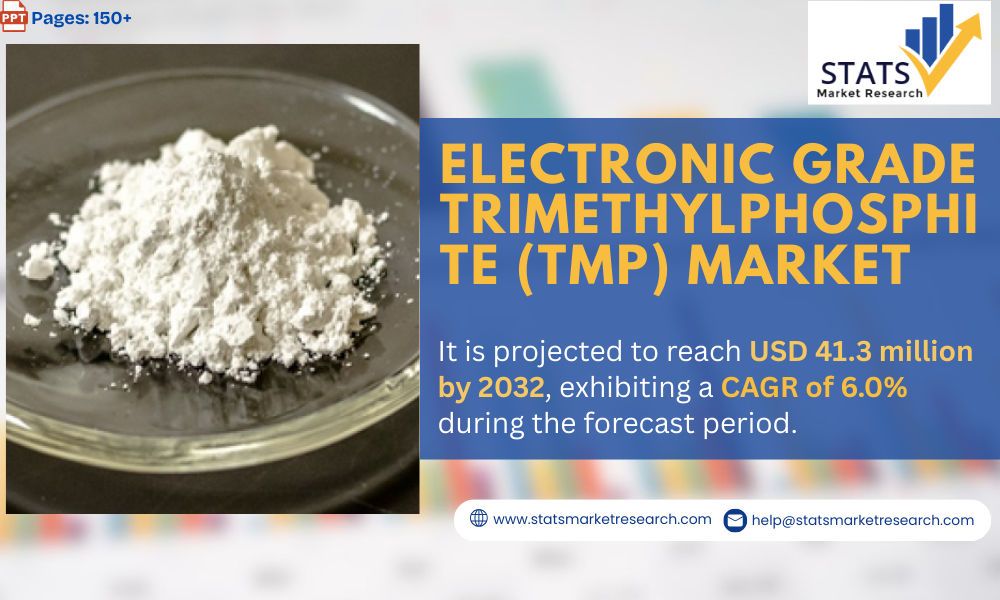
Global electronic grade TMP market was valued at USD 26.5 million in 2024 and is projected to reach USD 41.3 million by 2032, growing at a CAGR of 6.0%.
Download FREE Sample of this Report @ https://www.statsmarketresearch.com/download-free-sample/8060221/global-electronic-grade-trimethylphosphite-forecast-market
Historically, demand for TMP has mirrored the growth of the global semiconductor industry. With semiconductor revenues projected to exceed USD 650 billion by 2030, TMP demand rises in parallel due to its role in depositing critical phosphorus-doped dielectric layers. In particular, the Asia-Pacific region dominates consumption, with China accounting for over 60% of global fab capacity expansion.
The market’s growth is influenced by technological trends such as MEMS proliferation, miniaturization of semiconductor nodes, advanced packaging, and photonic integration. However, supply chain constraints, high production costs for 9N grade TMP, and geopolitical trade restrictions pose limitations on rapid expansion.
Investments by key suppliers like Entegris and Merck (Versum Materials) in purification technologies are expected to stabilize supply and support market growth, especially for next-generation semiconductor nodes below 3nm. The increasing complexity of wafer fabrication and MEMS device production drives the need for higher purity grades, with 9N TMP gradually becoming a critical requirement for cutting-edge applications.
Market Dynamics (Drivers, Restraints, Opportunities, and Challenges)
Drivers
Growing Semiconductor Industry Driving Demand for High-Purity TMP
The semiconductor industry’s rapid expansion is the primary growth driver for electronic grade TMP. As manufacturers transition to smaller nodes (<10nm), ultra-high purity TMP (9N grade) is increasingly essential. TMP enables deposition of phosphorus-doped dielectric layers, crucial for device performance.
Advancements in MEMS Technology Creating New Application Avenues
The global MEMS market, valued at over USD 15 billion in 2024, depends heavily on TMP for precise phosphorus-doped insulating layers. MEMS components are ubiquitous in consumer electronics, automotive systems, IoT devices, and medical equipment. TMP enables high-yield, reliable fabrication of sensors and actuators.
Rising Adoption of IoT and Smart Devices
Each smart sensor node typically incorporates multiple MEMS components, each requiring TMP during fabrication. With the industrial and consumer IoT market expanding rapidly, TMP demand continues to grow in tandem. For instance, semiconductor capital equipment spending has exceeded USD 100 billion annually, directly boosting TMP consumption.
Restraints
Stringent Purity Requirements Escalating Production Costs
Producing 9N TMP requires complex distillation and crystallization equipment, inert atmosphere operation, and specialized cleanroom facilities. These high capital expenditures restrict new entrants and limit production scalability.
Supply Chain Vulnerabilities
Over 70% of high-purity TMP production is concentrated in a few global facilities. Any disruption in these sites can create significant supply bottlenecks, affecting semiconductor manufacturing schedules.
Regulatory Compliance Burdens
Phosphorus-containing compounds face strict environmental and chemical safety regulations in major markets like the U.S., EU, and Asia. Compliance requires continuous process adaptation and comprehensive documentation, increasing operational costs.
Opportunities
Emerging Advanced Packaging Technologies
3D chip packaging and heterogeneous integration techniques are driving demand for TMP. Phosphorus-doped dielectrics are increasingly used in interconnects and redistribution layers, with TMP consumption potentially doubling per package in wafer-level fan-out and heterogeneous integration processes.
Rise of Silicon Photonics
Photonic integrated circuits incorporate phosphorus-doped waveguides using TMP as a doping source. The growth of data centers, telecom, and AI applications creates a promising niche for TMP in silicon photonics.
Regional Expansion in Asia-Pacific
China, South Korea, and Taiwan remain key growth markets due to fab expansions. Localized production and strategic partnerships with foundries provide opportunities for suppliers like Soulbrain and Yamanaka Advanced Materials to gain market share.
Challenges
Technical Complexities in High-Volume Manufacturing
TMP is hygroscopic, requiring strict moisture control (<1ppm H2O) during production. Even brief exposure to ambient moisture can compromise quality. Scaling production while maintaining ultra-high purity presents continuous technical challenges.
Analytical Verification
Measuring sub-ppb impurities in 9N TMP approaches the detection limits of standard ICP-MS methods. Implementing robust quality control systems requires significant investments in metrology and testing infrastructure.
Geopolitical and Supply Constraints
Trade restrictions on advanced chip materials and fluctuating phosphorus feedstock prices can introduce volatility into the TMP supply chain, impacting semiconductor production timelines.
Regional Analysis
Asia-Pacific dominates global TMP consumption due to China’s 60% share of fab capacity expansion, with additional demand from Taiwan, South Korea, and Japan. The region is expected to continue leading growth due to MEMS production, semiconductor foundries, and IoT adoption.
North America represents a mature market with demand concentrated in the U.S., driven by advanced semiconductor manufacturing and MEMS production.
Europe maintains a smaller but strategic market presence, with growth influenced by high-end semiconductor R&D and industrial IoT applications.
Other Regions such as Russia and the Middle East rely on imported TMP for semiconductor and MEMS fabrication.
Get the Complete Report & TOC @ https://www.statsmarketresearch.com/global-electronic-grade-trimethylphosphite-forecast-market-8060221
Competitor Analysis
The electronic grade TMP market is moderately consolidated. Key players emphasize R&D, capacity expansion, and strategic supply agreements.
- Entegris (U.S.) – Leading the market with 28% revenue share, specializing in ultra-high purity chemicals and global distribution.
- Merck (Versum Materials, Germany) – 22% market share, expanded production in South Korea to support Asian demand.
- Soulbrain (South Korea) – Regional supplier growing 15% YoY, leveraging localized supply and customized solutions.
- Yamanaka Advanced Materials (Japan) – Focus on high-purity grades and technical support for Japanese foundries.
Market strategies focus on developing higher purity grades (9N+), backward integration into phosphorus raw materials, and establishing long-term supply agreements with semiconductor foundries.
Global Electronic Grade Trimethylphosphite (TMP): Market Segmentation Analysis
This report provides a deep insight into the global Electronic Grade Trimethylphosphite (TMP), covering all its essential aspects. This ranges from a macro overview of the market to micro details of the market size, competitive landscape, development trend, niche market, key market drivers and challenges, SWOT analysis, value chain analysis, etc.
The analysis helps the reader to shape the competition within the industries and strategies for the competitive environment to enhance the potential profit. Furthermore, it provides a simple framework for evaluating and assessing the position of the business organization. The report structure also focuses on the competitive landscape of the Global Electronic Grade Trimethylphosphite (TMP). This report introduces in detail the market share, market performance, product situation, operation situation, etc., of the main players, which helps the readers in the industry to identify the main competitors and deeply understand the competition pattern of the market.
In a word, this report is a must-read for industry players, investors, researchers, consultants, business strategists, and all those who have any kind of stake or are planning to foray into the Electronic Grade Trimethylphosphite (TMP) in any manner.
Market Segmentation (by Application)
- Borophosphosilicate Glass (BPSG) deposition
- Phosphosilicate Glass (PSG) deposition
- Microelectromechanical Systems (MEMS)
- Other semiconductor applications
Market Segmentation (by Type)
- 7N (99.99999% pure)
- 8.5N (99.9999995% pure)
- 9N (99.9999999% pure)
- Others (Lower purity grades)
Key Company
- Entegris (U.S.)
- Merck (Versum Materials) (Germany)
- Soulbrain (South Korea)
- Yamanaka Advanced Materials (Japan)
- Guizhou Weidun Jinglin Electronic Materials (China)
- APK Gas (Russia)
Geographic Segmentation
- Asia-Pacific
- North America
- Europe
- Middle East & Africa
- South America
FAQ
Q1: What is the current market size of the Global Electronic Grade TMP Market?
A1: The market was valued at USD 26.5 million in 2024 and is projected to reach USD 41.3 million by 2032, growing at a CAGR of 6.0%.
Q2: Which are the key companies operating in the Global Electronic Grade TMP Market?
A2: Key players include Entegris, Merck (Versum Materials), Soulbrain, Yamanaka Advanced Materials, Guizhou Weidun Jinglin Electronic Materials, and APK Gas.
About Us
☎️ International: +1 (332) 2424 294
📄 Website: www.statsmarketresearch.com
Join us on LinkedIn:- https://www.linkedin.com/company/statsmarketresearch




