
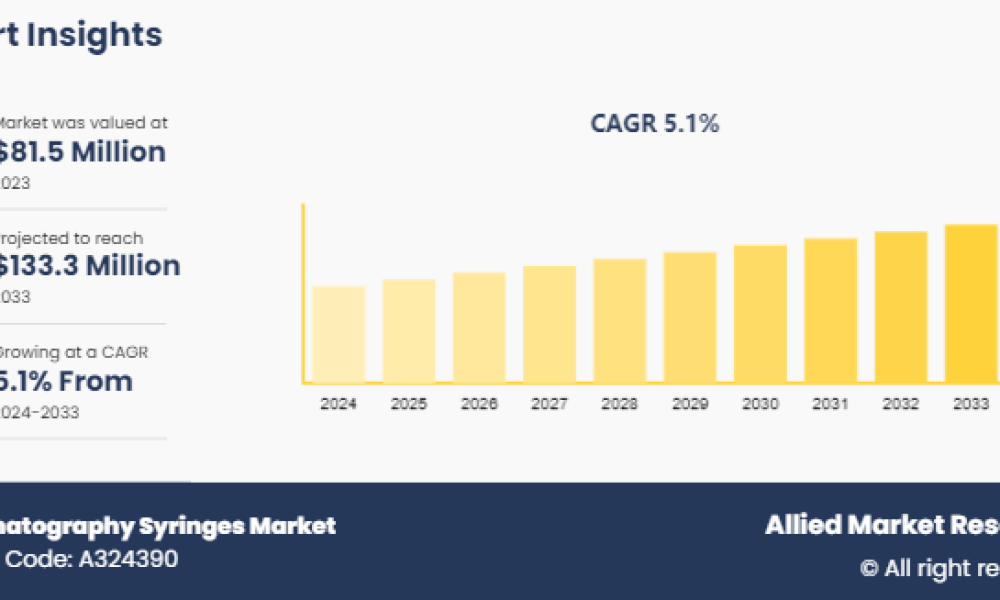
The global chromatography syringes market was valued at $81.5 million in 2023 and is projected to reach $133.3 million by 2033, expanding at a CAGR of 5.1% between 2024 and 2033. This growth is underpinned by the rising demand for high-quality pharmaceutical products, continuous technological innovations in chromatography, and increasing adoption of advanced analytical techniques across pharmaceutical, biotechnology, and research sectors.
What Are Chromatography Syringes?
Chromatography syringes are precision-engineered instruments designed for introducing liquid or gas samples into chromatographic systems such as gas chromatography (GC) and liquid chromatography (LC). They are essential for ensuring accurate sample delivery, minimal contamination, and reproducible analytical results.
Manufactured from high-grade materials like glass, stainless steel, and specialized polymers, these syringes are available in a variety of configurations — including fixed and removable needle types — and come in sizes suited for diverse laboratory needs.
Key design features include:
Smooth plunger movement to prevent sample retention.
High chemical resistance for durability.
Compatibility with autosamplers for high-throughput analysis.
Given the critical role precision plays in chromatography, proper maintenance and handling of syringes are vital to maintaining performance over time.
Get a Sample Copy of this Report: https://www.alliedmarketresearch.com/request-sample/A324390
Market Growth Drivers
1. Rising Demand for Pharmaceutical Quality Control
Chromatography plays a central role in drug development, quality assurance, and regulatory compliance. The shift toward personalized medicine and the rapid growth of biologic drugs have intensified the need for highly accurate chromatographic methods — in turn driving demand for specialized syringes.
2. Technological Advancements in Syringe Design
Modern chromatography syringes are benefiting from innovations such as:
Enhanced needle geometry for reduced sample carryover.
Improved plunger seals for consistent delivery.
Advanced materials for better chemical resistance and durability.
These enhancements not only improve analytical reliability but also reduce the risk of cross-contamination in sensitive assays.
3. Expanding Biotechnology Industry
Chromatography is indispensable in biotech research for analyzing proteins, nucleic acids, and metabolites. As genomics, proteomics, and metabolomics studies expand, the demand for high-precision syringes capable of handling complex samples has grown.
4. Growth in Research & Development Investments
Developing nations are investing heavily in R&D infrastructure, with increased funding for life sciences and pharmaceutical manufacturing. This trend is expected to expand the adoption of chromatography systems — and, by extension, chromatography syringes.
Parent Market Context
The chromatography market itself is on an upward trajectory, forecast to grow from $8.7 billion in 2020 to $15.34 billion by 2030 (CAGR 5.8%). Techniques like liquid chromatography-mass spectrometry (LC-MS) are gaining popularity due to their versatility and sensitivity, further boosting the demand for precise sample introduction tools.
Market Segmentation
By Product
Manual Syringes – Preferred for low-throughput, high-control applications.
Autosampler Syringes – Growing rapidly due to automation trends in analytical labs.
By Application
Gas Chromatography (GC)
High-Pressure Liquid Chromatography (HPLC)
Thin-Layer Chromatography (TLC)
By Technology
Partial Loop Filling
Complete Loop Filling
Reverse Loop Filling
By End User
Research Institutes
Pharmaceutical & Biotechnology Companies
Others (including environmental and food testing labs)
Regional Outlook
North America – Market Leader
North America holds the largest market share due to its strong pharmaceutical manufacturing base, high R&D spending, and widespread adoption of advanced analytical techniques.
The U.S. biopharmaceutical sector accounts for one-third of the global market and leads in R&D investment, ensuring continued demand for precision chromatography syringes.
Asia-Pacific – Fastest Growth
APAC is projected to experience significant growth thanks to:
Rapid expansion of pharma and biotech industries.
Rising healthcare investments.
Government incentives for R&D.
Notably, India’s biotechnology industry is forecast to reach $150 billion by 2025 and $300 billion by 2030, creating a strong market for chromatographic tools.
Europe
Strong focus on quality standards in pharmaceuticals and food testing, coupled with ongoing adoption of advanced chromatography methods.
LAMEA
Gradual growth is expected as laboratory infrastructure develops, particularly in the Middle East’s growing life sciences sector.
Industry Trends
High-Performance Liquid Chromatography (HPLC) Dominance – Now the gold standard for identifying and quantifying medicinal substances across discovery, development, and quality control.
Integration with Automation – Increasing use of autosamplers requires syringes that are fully compatible with robotic systems.
Specialized Needle Designs – New configurations for challenging sample types, including viscous or particulate-laden liquids.
Sustainability Considerations – Manufacturers are exploring eco-friendly materials and reusable designs to reduce laboratory waste.
Competitive Landscape
Major market participants include:
Agilent Technologies Inc.
Hamilton Company
Thermo Fisher Scientific Inc.
Gilson Inc.
GE Healthcare
PerkinElmer Inc.
Ace Glass Inc.
Valiant Co. Ltd.
Trajan Scientific
Valco Instruments Company Inc.
Other notable players: Restek Corporation, Stoelting Co., and Spectrum Chromatography and Medical.
Key strategies employed by leading companies include:
Product innovations targeting automation compatibility.
Strategic partnerships with chromatography system manufacturers.
Expansion into emerging markets with growing R&D infrastructure.
Future Outlook
Between now and 2033, the chromatography syringes market is set to benefit from:
Higher throughput demands in pharmaceutical quality control.
Increased reliance on biologics and complex molecule analysis.
Greater emphasis on lab automation to improve efficiency and reduce human error.
Manufacturers that can deliver precision, durability, and automation-ready designs will be well-positioned to capture market share.
Conclusion
The chromatography syringes market is entering a period of steady, innovation-driven growth. With demand rising across pharma, biotech, and research labs worldwide, this seemingly small but critical component will continue to play a pivotal role in ensuring the accuracy and reliability of modern analytical science. By 2033, the industry will not only be larger in size but also more technologically advanced, sustainable, and globally integrated.




