
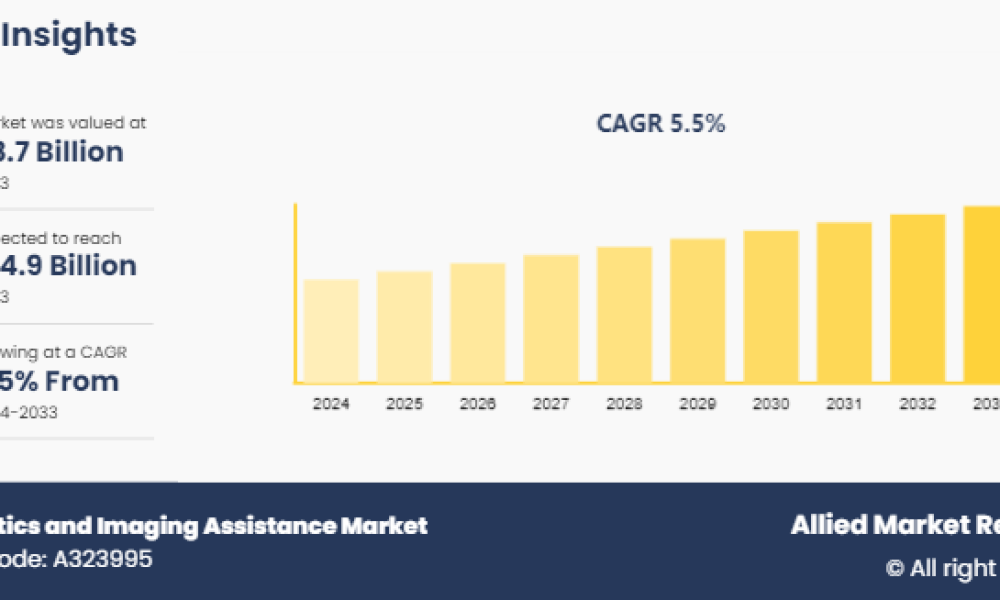
The global diagnostics and imaging assistance market was valued at $8.7 billion in 2023 and is projected to reach $14.9 billion by 2033, growing at a CAGR of 5.5% between 2024 and 2033. This growth is driven by advancements in imaging technologies, the rising prevalence of chronic diseases and cancer, and the expanding role of precision medicine in early diagnosis and treatment planning.
Market Overview and Definition
Diagnostics and imaging assistance refers to the use of advanced imaging modalities—such as X-ray, MRI, CT, ultrasound, and PET scans—to visualize internal structures of the body for diagnosis, monitoring, and treatment planning. Increasingly, AI and machine learning algorithms are being integrated into these systems to assist radiologists in detecting anomalies, interpreting results faster, and reducing diagnostic errors.
By combining human expertise with machine intelligence, these technologies enhance patient care, improve clinical decision-making, and enable earlier intervention in disease progression.
Get a Sample Copy of this Report: https://www.alliedmarketresearch.com/request-sample/A323995
Key Growth Drivers
1. Rising Prevalence of Chronic and Complex Diseases
Cancer, cardiovascular disorders, and neurological conditions are on the rise globally, creating sustained demand for advanced diagnostic tools. Early detection is critical for effective treatment, and imaging technologies are essential in screening, staging, and monitoring these conditions.
2. Technological Advancements in Imaging
Modern imaging systems now incorporate AI-driven automation, real-time data processing, and high-resolution imaging capabilities. These features improve workflow efficiency, reduce wait times, and increase diagnostic accuracy.
3. Aging Population and Higher Healthcare Utilization
The global geriatric population is expanding, and older adults are more likely to require regular diagnostic imaging for chronic disease management. This demographic shift is expected to significantly boost market demand.
4. Government and Organizational Initiatives
Healthcare infrastructure upgrades, public health investments, and R&D funding are enabling faster adoption of imaging technologies, particularly in developing markets.
Market Challenges
High Capital Costs – Advanced imaging systems such as MRI and PET-CT scanners require significant investment, limiting adoption in low-income regions.
Regulatory Complexity – Lengthy approval processes can delay market entry for innovative devices.
Workforce Limitations – Shortages of trained radiologists and technicians can restrict the effective use of advanced imaging tools.
Opportunities Ahead
Remote Diagnostics – Tele-radiology and cloud-based imaging analysis platforms can extend advanced diagnostics to underserved areas.
Insurance Coverage Expansion – Improved reimbursement policies in key markets are making high-end diagnostic tools more accessible.
Cost-Effective Innovations – Affordable, portable imaging solutions—such as India’s new low-cost MRI scanner—can drive penetration in emerging markets.
Healthcare Utilization Snapshot: NHS Imaging Activity (Jan 2022 – Jan 2023)
Data from NHS England highlights the scale of imaging in modern healthcare:
X-ray: 21.37 million scans (49.2% of all imaging)
Ultrasound: 9.97 million (23.0%)
CT scans: 6.65 million (15.3%)
MRI: 3.90 million (9.0%)
Other modalities (fluoroscopy, nuclear medicine, PET-CT, SPECT, medical photography): 0.1%–2.0% each
These numbers reflect the critical dependence on imaging for diagnosis and treatment planning, and underscore the need for AI-enabled systems to handle growing scan volumes efficiently.
Market Segmentation
By Type
X-ray
Magnetic Resonance Imaging (MRI)
Ultrasound
Computed Tomography (CT)
Others
By End User
Hospitals and Clinics
Ambulatory Surgical Centers
Diagnostic Centers
Others
By Region
North America
Europe
Asia-Pacific
LAMEA (Latin America, Middle East, Africa)
Regional Outlook
North America
Dominates the global market due to advanced healthcare infrastructure, high per-capita healthcare spending, and strong adoption of cutting-edge imaging technologies. Presence of major market players and ongoing R&D efforts strengthen regional growth.
Asia-Pacific
Fastest-growing region, benefiting from expanding healthcare investments, a growing middle class, and rising geriatric populations. Governments are also actively promoting local manufacturing of affordable imaging equipment.
Europe
Strong demand driven by national screening programs, advanced diagnostic networks, and policy support for AI adoption in healthcare.
LAMEA
Emerging market potential due to improving healthcare access and demand for non-invasive diagnostic solutions, although infrastructure gaps remain.
Industry Trends
Community Diagnostic Center Expansion in the UK – The government plans to open 160 CDCs by March 2024, increasing MRI and CT capacity and adding 9 million tests by 2025.
Affordable MRI Innovation in India – In August 2023, India launched its first indigenously developed lightweight MRI scanner, significantly reducing scan costs and expanding accessibility.
AI-Driven Imaging Installations – In May 2024, Canon Medical Systems introduced its AI-powered Aquilion Serve SP CT scanner in the U.S., promising faster workflows and reduced human error.
Competitive Landscape
Leading market players include:
Koninklijke Philips N.V.
Canon Medical Systems Corporation
Samsung Healthcare
GE HealthCare
Digital Diagnostics Inc.
Quibim
Lunit Inc.
Aidence
Subtle Medical, Inc.
NVIDIA Corporation
These companies are investing in AI integration, portable imaging solutions, and cloud-based analytics to improve performance and expand their global reach.
Future Outlook
From 2024–2033, the diagnostics and imaging assistance market will be shaped by three major forces:
AI Mainstreaming – Integration of AI across modalities to accelerate workflows and support radiologist decision-making.
Decentralized Diagnostics – Growth of point-of-care and remote imaging solutions to serve rural and underserved populations.
Personalized Imaging Protocols – Tailoring imaging schedules and techniques to patient-specific needs, enhancing precision medicine approaches.
With a projected market size of $14.9 billion by 2033, the sector is positioned for sustainable mid-single-digit growth, underpinned by a clear clinical necessity, technological momentum, and expanding geographic adoption.
Conclusion
The global diagnostics and imaging assistance market is in a pivotal growth phase. As chronic disease prevalence rises and precision medicine gains traction, imaging will remain at the heart of clinical care. While cost, regulatory, and workforce challenges persist, the combination of AI innovation, portable technology, and expanding infrastructure promises to broaden access and improve diagnostic outcomes worldwide.




