
Overview
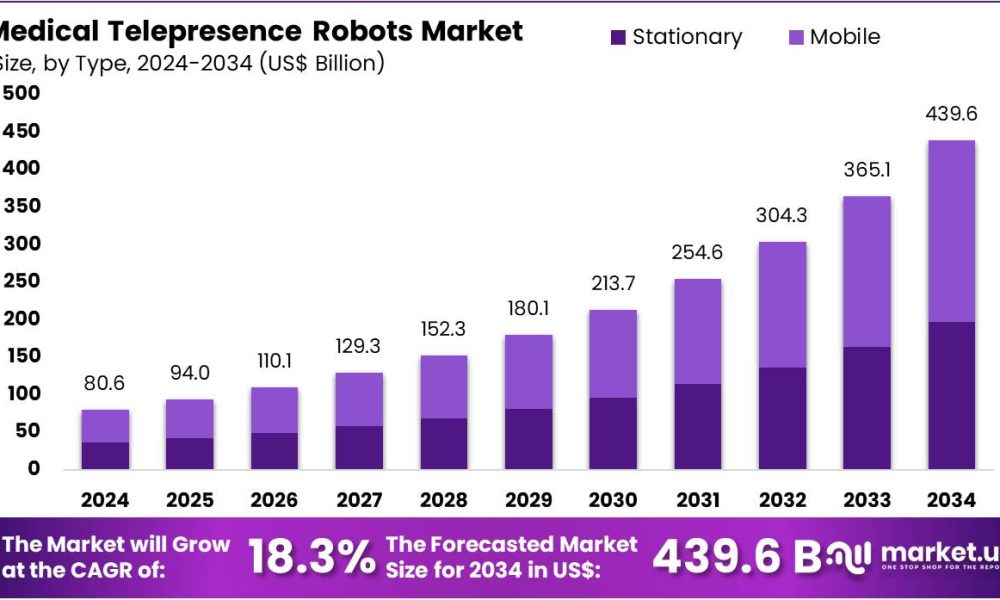
The Global Medical Telepresence Robots Market is projected to grow from USD 80.6 billion in 2024 to approximately USD 439.3 billion by 2034. This reflects a compound annual growth rate (CAGR) of 18.3% during the forecast period from 2025 to 2034. This growth is driven by increasing demand for remote care, rising healthcare digitization, and rapid advancements in robotics. Telepresence robots offer remote consultations, monitoring, and collaborative care. These solutions improve patient outcomes and support healthcare professionals across distances, especially in resource-limited or underserved areas.
Telemedicine adoption is accelerating globally, especially where healthcare access is limited. Telepresence robots enable real-time video and audio communication, mimicking in-person visits. Their ability to connect patients with specialists from afar is transforming traditional healthcare models. According to recent data, around 80% of individuals have used telemedicine at least once. This trend is most notable in rural and remote regions. The robots address gaps in healthcare delivery, offering timely interventions and reducing the strain on physical healthcare infrastructure.
Technological advancements are further enhancing the capabilities of medical telepresence robots. Innovations in artificial intelligence, robotics, and sensor systems are allowing autonomous navigation, facial recognition, and high-resolution imaging. These improvements are expanding their utility across various medical disciplines. For instance, Doximity’s survey shows 84% of physicians use telemedicine weekly, with psychiatrists leading daily use at 84%. These tools now support daily clinical workflows and are becoming essential components in modern healthcare settings.
The COVID-19 pandemic played a key role in boosting telepresence robot deployment. To minimize infection risks and ensure continuity of care, healthcare systems rapidly adopted these technologies. Robots reduced direct contact, safeguarding both patients and staff. In high-risk zones, their use proved invaluable. Hospitals managed remote consultations, patient check-ins, and staff coordination effectively. This shift highlighted the resilience and efficiency that telepresence robots bring to healthcare delivery, reinforcing their long-term value in future healthcare frameworks.
Despite their potential, high upfront costs remain a key barrier. Telepresence robots require significant investment for hardware, software integration, and maintenance. Smaller hospitals and clinics, especially in developing countries, may lack the funds to adopt such technology. This financial barrier slows market penetration, particularly in cost-sensitive regions. Addressing affordability through subsidies, government initiatives, or low-cost models could expand access. Overcoming this restraint will be critical to achieving broader adoption and realizing the full benefits of remote robotic healthcare.

Key Takeaways
- The global medical telepresence robots market was valued at US$ 80.60 billion and is forecasted to reach US$ 439.64 billion by 2034.
- This market is expected to grow at a robust CAGR of 18.3%, driven by rising demand for remote healthcare and technological advancements.
- Among types, mobile medical telepresence robots dominated the market by generating 55.2% of the total revenue, showcasing their operational flexibility and mobility.
- In terms of components, the camera segment led the market with a 23.8% revenue share, reflecting the critical role of visual technology in telepresence.
- The hospitals and assisted living facilities segment accounted for the highest end-use share at 69.3%, indicating strong adoption in structured healthcare environments.
- Regionally, North America emerged as the leading contributor, commanding 46.4% of the total market share due to advanced healthcare infrastructure and early tech adoption.
Get Sample: https://market.us/report/medical-telepresence-robots-market/request-sample/
Regional Analysis
In 2024, North America emerged as the dominant region in the global medical telepresence robots market. It captured the largest revenue share of 46.40%. This significant share is supported by the region’s advanced healthcare infrastructure and favorable government policies. Rising disposable incomes and the adoption of robotic solutions in hospitals are accelerating growth. Furthermore, frequent product innovations and the integration of AI in healthcare robotics are strengthening regional market expansion. These factors collectively support North America’s leadership in the medical telepresence space.
The United States contributes the largest portion of the North American market. This is driven by rising government investments and strong technological adoption in healthcare. Major players like Vecna Healthcare offer innovative solutions such as the VGo telepresence robot. This device enables remote, real-time audio and video interaction, especially in hospitals and care facilities. The U.S. market benefits from consistent product launches and growing awareness of telehealth solutions. These developments position the U.S. as a key driver of market advancement in the region.
Canada is expected to record the highest compound annual growth rate in the North American medical telepresence robots market. This growth is linked to its rapidly aging population and increasing rates of chronic illness. As per Springer Nature, Canada’s senior population is forecast to grow from 16.3% in 2016 to 25.4% by 2060. This demographic shift is raising demand for remote healthcare solutions. Telepresence robots are becoming essential tools in elder care and chronic disease management, supporting future market expansion in Canada.
Segmentation Analysis
In 2024, the mobile segment led the telepresence robot market and is expected to maintain strong growth throughout the forecast period. These robots offer advanced features such as obstacle avoidance, autonomous navigation, and virtual monitoring. Their ability to perform seamless teleconsultations and enhance patient care has accelerated their adoption across healthcare settings. Companies like Hill-Rom Services Inc. have used mobile robots to improve sales and education processes. As healthcare systems increasingly adopt remote interaction tools, mobile telepresence robots continue to transform medical workflows and service delivery.
The stationary segment is anticipated to grow at a steady pace due to its cost-effectiveness and ease of use. These robots are simpler in design, allowing users to control the camera and screen remotely. Their affordability makes them a preferred choice for institutions with budget constraints. The integration of stationary robots enables essential communication between healthcare providers and patients. Despite fewer features than mobile units, stationary models serve critical roles in telemonitoring and virtual care, especially in clinics and smaller healthcare settings.
In component analysis, cameras held the largest revenue share of 23.8% in 2024, due to their central role in enabling clear visual communication. High-definition cameras with pan, tilt, and zoom functions are in high demand. These tools support accurate remote diagnosis and monitoring. Meanwhile, sensors and control systems are projected to grow at the fastest pace, supported by increased investment in AI and IoT. The TEF-Health initiative in Europe is advancing the use of AI-enabled medical devices. Such developments highlight the growing reliance on smart technologies in remote healthcare delivery.
By Type
- Stationary
- Mobile
By Component
- Camera
- Display
- Speaker
- Microphone
- Power Source
- Sensors & Control System
By End-Use
- Hospitals & Assisted Living Facilities
- Home Use
Key Players Analysis
In 2024, North America emerged as the dominant region in the global medical telepresence robots market. It captured the largest revenue share of 46.40%. This significant share is supported by the region’s advanced healthcare infrastructure and favorable government policies. Rising disposable incomes and the adoption of robotic solutions in hospitals are accelerating growth. Furthermore, frequent product innovations and the integration of AI in healthcare robotics are strengthening regional market expansion. These factors collectively support North America’s leadership in the medical telepresence space.
The United States contributes the largest portion of the North American market. This is driven by rising government investments and strong technological adoption in healthcare. Major players like Vecna Healthcare offer innovative solutions such as the VGo telepresence robot. This device enables remote, real-time audio and video interaction, especially in hospitals and care facilities. The U.S. market benefits from consistent product launches and growing awareness of telehealth solutions. These developments position the U.S. as a key driver of market advancement in the region.
Canada is expected to record the highest compound annual growth rate in the North American medical telepresence robots market. This growth is linked to its rapidly aging population and increasing rates of chronic illness. As per Springer Nature, Canada’s senior population is forecast to grow from 16.3% in 2016 to 25.4% by 2060. This demographic shift is raising demand for remote healthcare solutions. Telepresence robots are becoming essential tools in elder care and chronic disease management, supporting future market expansion in Canada.
- Ava Robotics Inc.
- Amy Robotics
- Guangzhou Yingbo Intelligent Technology Co., Ltd.
- Axyn Robotics
- Blue Ocean Robotics
- Teladoc Health, Inc. (InTouch Health)
- OhmniLabs, Inc.
- VGo Communications, Inc.
- Rbot
- Xandex Inc.
Conclusion
The medical telepresence robots market is growing quickly due to rising demand for remote care and strong interest in healthcare technology. These robots are helping hospitals, clinics, and elder care facilities by enabling virtual consultations and reducing in-person contact. They support better patient outcomes, especially in rural and underserved areas. Innovations in artificial intelligence and robotics are making these robots more useful and easier to operate. Despite high upfront costs, their long-term value in improving care delivery is clear. With supportive government policies and growing adoption of telehealth, telepresence robots are expected to become a regular part of modern healthcare systems around the world.
Get in Touch with Us:
Market.us (Powered By Prudour Pvt. Ltd.)
Address: 420 Lexington Avenue, Suite 300, New York City, NY 10170, United States.
Contact No: +1 718 874 1545 (International), +91 78878 22626 (Asia).
Email: [email protected]
View More
Personal Health Record Software Market
Healthcare Internet of Things (IoT) Security Market



