
The global robotic EV charging (auto-connect) market is projected to expand at a 40.0% CAGR between 2026 and 2036, increasing from USD 210.0 million in 2026 to USD 6,074.0 million by 2036. Demand is being driven by the expansion of driverless vehicle operations that generate charging events without a human available to connect a charging cable.
Longer autonomous operating hours are creating a practical need for charging systems that can connect automatically after vehicles return to designated locations. According to the California Department of Motor Vehicles, permitted autonomous vehicles logged more than 9 million public-road test miles between December 2024 and November 2025, as reported in February 2026. Automatic connection can extend the capabilities of existing EV charging infrastructure at robotaxi and freight depots by removing the manual cable-handling step.
Commercial charging sites are also becoming more structured around predictable vehicle movements. European ports provide fixed lanes and repeat parking positions that can support extended automatic charging trials under normal operating conditions. South Korean airports combine controlled vehicle movement with nearby robotics teams, while USA freight depots require higher charging power and greater parking tolerance across trucks returning on tightly scheduled routes.
The USA Department of Transportation announced USD 635 million in January 2025 for 49 projects across 27 states, covering more than 11,500 charging ports and related fuel infrastructure. While such infrastructure expands charging access, each returning vehicle still creates a manual cable connection task unless automated charging is introduced. For high-utilization robotaxi and freight fleets, a missed charging session can affect vehicle readiness and disrupt subsequent route schedules.
What Are the Key Segments in the Robotic EV Charging (Auto-Connect) Market?
The robotic EV charging market is being shaped by connection technology, fleet application, hardware requirements, end-use ownership, and deployment models.
- Robotic Arm Auto-Connect – 46.0%: Robotic arm auto-connect is expected to represent the leading technology category in 2026, supported by its compatibility with standard side charging inlets and automated connection requirements at fleet depots.
- AV Fleet Depots – 36.0%: AV fleet depots represent the leading application segment as autonomous vehicles return to fixed locations repeatedly and require charging without depending on an onboard driver or fleet employee.
- Hardware – 58.0%: Hardware is projected to lead the component category in 2026, reflecting demand for robotic motion equipment, connection mechanisms, charging interfaces, and protective controls positioned near vehicles.
- Fleet Operators: Fleet operators represent an important end-use group as autonomous vehicle and commercial EV fleets require dependable charging availability to maintain planned route schedules.
- Direct Purchase, Service Contracts, and Managed Solutions: Different business models allow fleet and infrastructure operators to select between equipment ownership, contracted service coverage, and managed charging operations depending on site requirements.
Get detailed market forecasts, competitive benchmarking, and pricing trends:
https://www.futuremarketinsights.com/reports/sample/rep-gb-34062
Which Countries Are Showing the Strongest Growth in Robotic EV Charging?
South Korea: South Korea is projected to grow at a 41.0% CAGR between 2026 and 2036, representing the fastest-growing country in the supplied market comparison. Airport environments provide controlled vehicle movement, defined parking areas, and access to robotics expertise that can support extended automatic charging trials.
The combination of autonomous vehicle movement and structured charging locations creates opportunities for testing automatic connection systems under repeatable conditions. Suppliers must demonstrate reliable positioning tolerance and recovery when vehicles stop slightly outside their expected charging position.
United States: The United States is projected to expand at a 40.0% CAGR through 2036. Demand is being shaped by autonomous vehicle testing, freight depot electrification, and investments that expand charging infrastructure across multiple states.
The California Department of Motor Vehicles’ reported autonomous vehicle test mileage illustrates the increasing number of driverless operating events that can eventually require automated charging. Freight depots add another requirement because electric trucks may return according to tightly planned schedules, making charging reliability important for subsequent routes.
The USD 635 million in USA Department of Transportation awards announced in January 2025 further expands the charging infrastructure base. Robotic charging can complement this infrastructure by automating the connection process at high-utilization fleet locations.
European Union: The European Union is projected to grow at a 39.0% CAGR through 2036. European ports provide structured operating environments with fixed lanes and repeat parking positions, creating suitable conditions for testing automated charging across commercial vehicle movements.
Cross-site compatibility and reliable operation across different vehicle platforms are expected to remain important considerations. Suppliers must demonstrate that automated connection systems can accommodate variations in parking position and vehicle configuration without creating additional operational delays.
How Is Regional Demand Shaping the Robotic EV Charging Market?
Regional adoption is being influenced by the type of autonomous fleet activity, charging infrastructure, and operating environment available to technology providers. South Korean airports offer controlled environments for robotics trials, while USA freight depots require systems capable of handling higher-power charging and greater positioning variation.
European ports provide another structured environment where repeat vehicle movements can support automated charging trials. Across these regions, the commercial value of robotic EV charging depends on completed charging sessions and vehicle readiness rather than the number of charging robots installed.
As fleets become more autonomous, charging systems must also connect reliably with dispatch software, vehicle identification, charger management platforms, and fault-reporting systems. This makes software and service support important alongside physical connection hardware.
What Is Changing the Competitive Landscape?
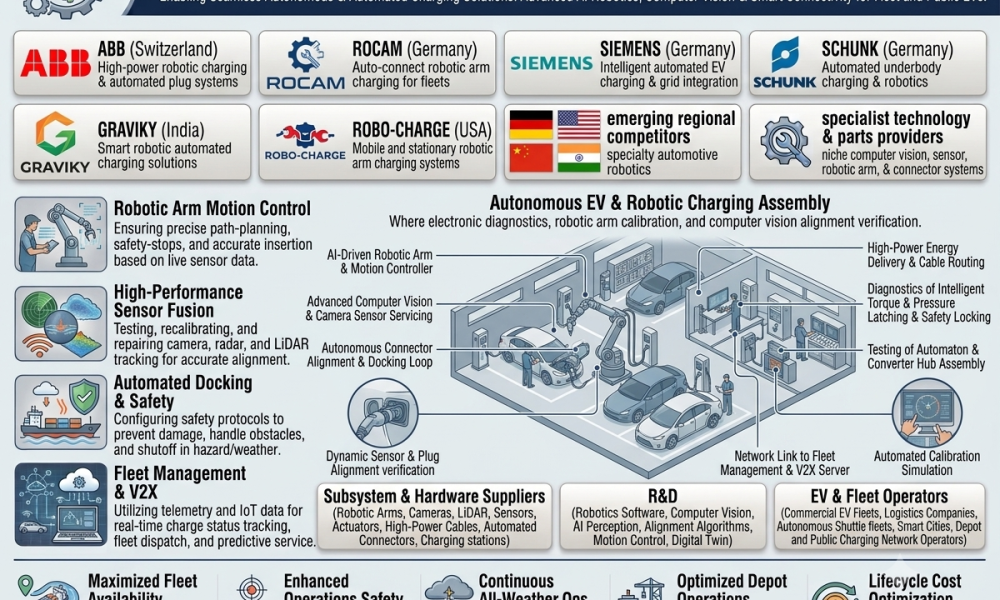
The competitive landscape includes robotic charging specialists, automotive robotics developers, wireless charging companies, and providers developing alternative automated energy-transfer technologies. Vendors are differentiating through connection mechanisms, positioning tolerance, charging compatibility, and integration with autonomous fleet operations.
Rocsys and Hyundai Motor Group Robotics LAB are expected to compete through robotic arm-based charging technologies and automotive robotics expertise. Their participation reflects increasing integration between vehicle automation and automated charging infrastructure.
Easelink and Volterio are anticipated to compete through automated vehicle-to-charger connection approaches designed to reduce dependence on manual cable handling. Their technologies address the need for charging systems that can accommodate recurring fleet charging operations.
Beam Global, HEVO, Electreon, and Mob-Energy are expected to broaden competition through wireless energy transfer, mobile charging delivery, and alternative automated charging architectures. These approaches can address different fleet environments where conventional cable connection may create operational constraints.
As commercial deployments expand, competition is expected to increasingly focus on charging reliability, fault recovery, vehicle compatibility, service response, and integration with fleet scheduling systems.
What Does the Analyst Say About the Robotic EV Charging (Auto-Connect) Market?
According to Nikhil Kaitwade, Principal Analyst at Future Market Insights, automated EV charging is moving from prototype demonstrations toward dependable day-to-day fleet operations.
“The automated EV charging robots market is progressing as fleet operators shift their attention from prototype demonstrations to dependable day-to-day charging operations. Commercial deployment is influenced by how consistently robotic charging systems recover from routine positioning errors, integrate with diverse vehicle fleets, and maintain high charger utilization with minimal operational disruption. Long-term market opportunities will favor providers that deliver reliable autonomous connection, transparent fault management, and scalable deployment models that support evolving fleet electrification strategies.”
What Is Driving Demand for Robotic EV Charging?
Driverless Vehicle Operations Increase Automated Charging Requirements
Autonomous vehicles can operate for extended periods without a driver present to connect a charging cable. As driverless fleets expand, automated connection becomes a practical requirement for maintaining vehicle readiness between scheduled trips.
The more frequently vehicles return to charging depots, the greater the operational value of eliminating manual cable handling. Robotic charging can connect vehicle positioning, charging, and fleet dispatch into a more automated operating sequence.
AV Fleet Depots Create Repeatable Charging Events
AV fleet depots are projected to account for 36.0% of the application segment in 2026. Fixed depot locations allow fleet operators to establish repeatable parking and charging procedures.
This environment can make it easier to validate automated connection accuracy, fault recovery, and charging-session completion before expanding the technology to less controlled public or mixed-use environments.
Charging Infrastructure Expansion Supports Automated Connection
The expansion of EV charging infrastructure creates additional locations where automated connection systems can potentially be integrated. The USA Department of Transportation’s January 2025 awards demonstrate continued investment in charging access across multiple states.
Robotic charging adds an automation layer to this infrastructure by addressing the physical connection task that remains after an EV arrives at a charging point.
Reliable Fault Recovery Protects Fleet Schedules
A missed charging session can leave an autonomous vehicle without sufficient energy for its next scheduled route. Fleet operators therefore need robotic charging systems that can identify positioning errors, report faults, and recover from routine connection problems.
Software-based fault reporting can help operators respond before a charging failure affects later dispatch schedules.
What Are the Key Market Restraints?
Automatic charging requires accurate alignment between the vehicle and charging mechanism. Differences in parking position, vehicle dimensions, charging inlet placement, and site layout can create connection challenges.
Fleet operators also need charging robots to work with diverse vehicle platforms and charging infrastructure. Compatibility requirements can increase deployment complexity, particularly when a depot operates multiple vehicle models or charging systems.
Another challenge is the need for dependable service support. High-utilization fleets cannot tolerate prolonged equipment downtime, making maintenance response and replacement-part availability important considerations when selecting automated charging systems.
What Opportunities Exist for Robotic EV Charging Manufacturers?
The transition toward driverless fleet operations creates opportunities for manufacturers that can demonstrate dependable automatic charging under real operating conditions. Suppliers that reduce positioning sensitivity and provide transparent fault management can address key concerns for fleet operators.
There is also an opportunity to combine charging hardware with fleet software and managed services. Connecting charging-session status with dispatch schedules can help operators identify vehicles that are not ready for their next assignment.
Alternative charging architectures also create opportunities. Robotic arms, underbody contact systems, stationary wireless charging, and mobile charging delivery can serve different operating environments, allowing suppliers to target specific fleet and infrastructure requirements.
Drive Your Business Growth Strategy: Checkout the Report for Key Insights!
https://www.futuremarketinsights.com/checkout/34062
How Is the Robotic EV Charging (Auto-Connect) Market Segmented?
The robotic EV charging industry is segmented by technology, application, component, end use, business model, and region.
By Technology: Side-mounted robotic connectors, underbody contact systems, mobile charging units, and battery swap-assist systems.
By Application: Autonomous depots, heavy-vehicle yards, public charging hubs, and managed port locations.
By Component: Hardware, software, and services.
By End Use: Fleet operators, infrastructure owners, and terminal operators.
By Business Model: Direct purchase, service contracts, and managed solutions.
By Region: North America, Europe, Asia Pacific, the Middle East and Africa, and Latin America.
The segmentation enables fleet operators, charging infrastructure owners, and technology providers to compare automated charging requirements according to connection technology, operating environment, ownership structure, and deployment model.
What Are the Drivers, Restraints and Opportunities in the Robotic EV Charging Market?
The commercial case for robotic EV charging increasingly depends on dependable vehicle connection, charging-session completion, fault recovery, and integration with autonomous fleet operations.
- Automated connection can eliminate manual cable handling for driverless vehicles returning to fleet depots.
- Hardware remains central to robotic charging through connection mechanisms, motion systems, and protective controls.
- Suppliers combining automatic connection, software-based fault reporting, fleet integration, and responsive service can address broader fleet charging requirements.
What Is the Robotic EV Charging (Auto-Connect) Market Demand Outlook?
Demand for robotic EV charging is expected to remain connected to the expansion of autonomous vehicle fleets and the increasing number of charging events occurring without a driver present. The market’s projected 40.0% CAGR from 2026 to 2036 reflects growing interest in automated charging at AV fleet depots, freight yards, ports, airports, and other structured operating environments.
The market is projected to increase from USD 210.0 million in 2026 to USD 6,074.0 million by 2036. As operators move from pilot projects toward recurring fleet deployment, procurement decisions are expected to depend increasingly on connection reliability, vehicle compatibility, fault recovery, charger utilization, and integration with fleet scheduling systems.
Why Is Robotic Arm Auto-Connect the Leading Technology?
Robotic arm auto-connect is projected to account for 46.0% of the technology segment in 2026. Its ability to connect with standard side-mounted charging inlets makes it suitable for fleet environments where vehicles repeatedly return to designated charging positions.
The technology’s commercial value depends on consistent connection performance despite routine differences in vehicle positioning. Automated alignment and reliable fault recovery are therefore important for maintaining charging schedules.
Why Are AV Fleet Depots Important?
AV fleet depots are projected to represent 36.0% of the application segment in 2026. These locations provide repeatable parking positions and predictable charging cycles that can support automated charging deployment.
As autonomous vehicles operate without onboard drivers, depot-based robotic charging can help connect vehicle arrival, charging, and dispatch processes into a more automated workflow.
Why Is Hardware the Leading Component?
Hardware is projected to account for 58.0% of the component category in 2026. Robotic motion systems, charging connectors, positioning mechanisms, and protective controls provide the physical infrastructure required to complete automated charging sessions.
Hardware reliability remains particularly important at high-utilization sites where repeated charging cycles increase equipment operating demands.
How Fast Are Key Countries Growing in the Robotic EV Charging Market?
South Korea is projected to grow at 41.0% CAGR, followed by the United States at 40.0% CAGR and the European Union at 39.0% CAGR between 2026 and 2036. Differences in airport automation trials, freight depot electrification, charging infrastructure expansion, and port-based testing environments are shaping the pace of robotic EV charging development across these markets.
About Future Market Insights
Future Market Insights (FMI) is an ESOMAR-certified business consulting and market research firm and a member of the Greater New York Chamber of Commerce. FMI provides market intelligence, syndicated research, consulting, and industry analysis across multiple sectors. Its research combines primary research, secondary research, and proprietary forecasting models to support strategic business decisions



