
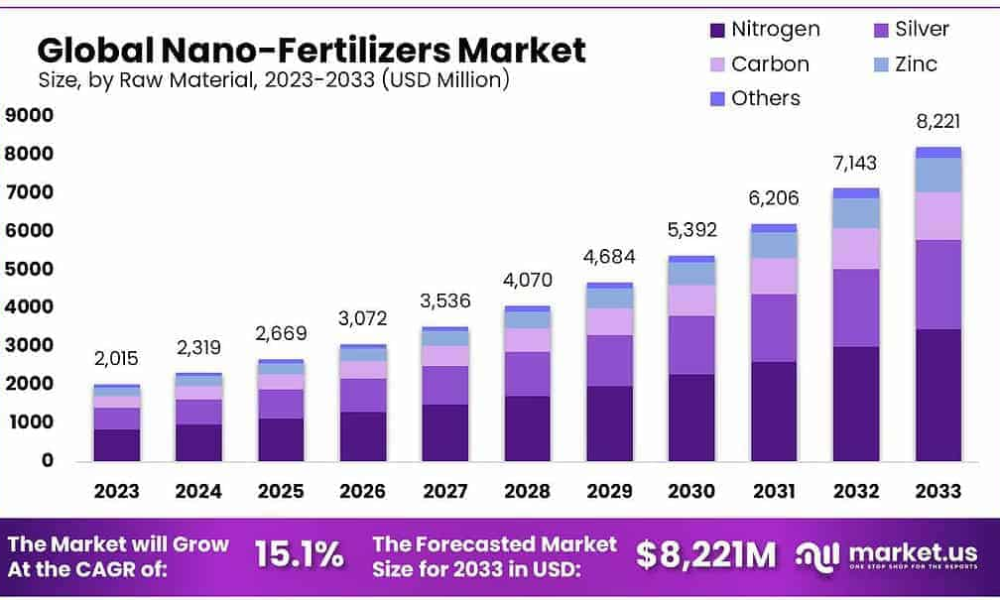
New York, NY – July 07, 2025 – The Global Nano-Fertilizers Market is gaining significant traction as farmers and agribusinesses seek advanced solutions to boost crop yields sustainably. Valued at USD 2,015 million in 2023, the market is projected to reach USD 8,221 million by 2033, growing at a strong CAGR of 15.1% from 2024 to 2033.
This rapid growth is driven by increasing demand for high-efficiency fertilizers that minimize environmental harm while improving nutrient absorption in plants. With shrinking arable land and rising food demand, the nano-fertilizers market offers a smart alternative by delivering nutrients directly to crops, reducing waste, and enhancing soil health. Their popularity is surging due to benefits like higher productivity, lower chemical usage, and cost-effectiveness in the long run.
Key growth factors include government support for sustainable farming, technological advancements in nanotechnology, and growing awareness among farmers. The market also presents lucrative opportunities in developing regions, where agricultural modernization is accelerating. Additionally, expanding organic farming and precision agriculture practices are expected to further drive market expansion. As a result, the nano-fertilizers market is poised for remarkable growth, offering both economic and environmental advantages.
Important Revelation
- Nano-Fertilizers Market size is expected to be worth around USD 8221 Mn by 2033, from USD 2015 Mn in 2023, growing at a CAGR of 15.1%.
- Nitrogen-based nano-fertilizers market held a dominant market position, capturing more than a 42.3% share.
- Nanoscale Fertilizers held a dominant market position, capturing more than a 53.4% share.
- Cereals & Grains held a dominant market position in the nano-fertilizers market sector, capturing more than a 48.5% share.
- Soil Method of Application for nano-fertilizers market held a dominant market position, capturing more than a 53.4% share.
- Metal category held a dominant market position in the nano-fertilizers market sector, capturing more than a 34.5% share.
- Asia Pacific (APAC) emerges as the dominant region in the nano-fertilizers market, commanding a 38.4% share with a market valuation of approximately USD 773.6 million.
➤ Download Exclusive Sample Of This Premium Report (Including Full TOC, Table & Figures): https://market.us/report/nano-fertilizers-market/request-sample/
Report Segmentation
By Raw Material
- In 2023, nitrogen-based nano-fertilizers led the market, holding over 42.3% of the share. Nitrogen’s vital role in boosting plant growth, photosynthesis, and overall health drives this dominance. These nano-fertilizers are designed for efficient nutrient release, minimizing waste and environmental harm. Silver nano-fertilizers, though a smaller segment, are gaining popularity due to their antimicrobial properties, which reduce plant diseases and enhance crop resilience, supporting sustainable agriculture.
- Carbon-based nano-fertilizers are another key player, acting as nutrient carriers to improve soil fertility and water retention. Their nano-scale structure increases surface area, enhancing soil and plant interactions. Zinc nano-fertilizers support critical plant functions like enzyme and chlorophyll production. Their targeted delivery is especially effective in zinc-deficient soils, improving nutrient efficiency.
By Category
- In 2023, nanoscale fertilizers dominated with a 53.4% market share. These nano-sized nutrients are optimized for efficient plant absorption, boosting growth and yields while reducing environmental impact. Their precision delivery lowers required doses compared to traditional fertilizers, appealing to eco-conscious farmers.
- Nanoscale additive fertilizers enhance conventional fertilizers by incorporating nano-sized additives for controlled nutrient release and improved soil management, supporting sustained plant growth. Nanoscale coating fertilizers use thin nutrient or protective layers to regulate nutrient release, aligning with plant uptake patterns. This reduces nutrient loss from leaching or volatilization, improving efficiency and environmental safety.
By Crop Type
- In 2023, cereals and grains led the nano-fertilizer market with a 48.5% share. Nano-fertilizers enhance nutrient uptake, increasing yields and reducing environmental impact for these globally critical staple crops. Oilseeds and pulses also benefit significantly, with nano-fertilizers improving germination, nutritional value, and oil/protein quality, enhancing economic value. Fruits and vegetables see notable advantages from nano-fertilizers, which improve produce color, taste, and nutrient content. They align with the growing demand for residue-free, organic produce, ensuring quality and environmental safety.
By Method of Application
- In 2023, soil application led with a 53.4% share, valued for its simplicity and effectiveness in delivering nutrients to the root zone, boosting crop yields, and fertilizer efficiency. Foliar or spray application is another key method, applying nano-fertilizers directly to leaves for rapid absorption. It’s ideal for quickly addressing nutrient deficiencies during critical growth stages. The soaking method, though less common, is crucial for specific crops. Soaking seeds or roots in nano-fertilizer solutions before planting enhances early growth, seed vigor, and root development, fostering resilient plants.
By Application
- In 2023, the metal category dominated the nano-fertilizer market with a 34.5% share, driven by enhanced nutrient uptake and resilience in metal-based crops used in biofortification and industrial applications. Plastic crops benefit from nano-fertilizers, which improve strength and durability for agricultural and commercial uses through precise nutrient delivery. Ceramic crops rely on nano-fertilizers for structural integrity and growth efficiency, with precise nutrient management addressing their sensitivity to imbalances.
Market Key Segmentation
By Raw Material
- Nitrogen
- Silver
- Carbon
- Zinc
- Others
By Category
- Nanoscale Fertilizer
- Nanoscale Additive Fertilizer
- Nanoscale Coating Fertilizer
By Crop Type
- Cereals & Grains
- Oilseeds & Pulses
- Fruits & Vegetables
- Others
By Method of Application
- Soil Method of Application
- Foliar or Spray Method of Application
- Soaking Method
By Application
- Plastic
- Metal
- Ceramic
- Others
Regional Analysis
APAC leads the nano-fertilizers market, holding a 38.4% share valued at approximately USD 773.6 million. This dominance stems from extensive agricultural activity, rapid population growth, and strong government backing for sustainable farming. China and India drive this growth, focusing on improving crop yields and food security while reducing environmental impact. North America ranks second, propelled by advanced technology and a supportive regulatory environment for nano-fertilizer adoption.
The U.S. and Canada lead, investing in R&D to blend nanotechnology with conventional farming, aiming to boost productivity and sustainability in their robust agricultural sector. Europe maintains a significant market presence, emphasizing sustainability and reduced chemical use in agriculture. Nano-fertilizers help meet strict environmental regulations, enhancing nutrient efficiency to support crop yields and soil health amid growing organic farming trends.
MEA, though smaller in market size, is growing due to expanding agricultural activities and the need to address arid conditions. Nano-fertilizers offer solutions for improving water and nutrient efficiency in challenging farming environments. Latin America is adopting nano-fertilizers to bolster its diverse agricultural exports and enhance productivity. Brazil and Argentina are key players, using nanotechnology to improve crop yields and tackle soil degradation.
Factors Affecting the Growth of the Nano-Fertilizers Market
- Rising Demand for Sustainable Agriculture: Growing awareness of environmental issues pushes farmers toward nano-fertilizers, which reduce nutrient waste and environmental harm. Their efficient nutrient delivery minimizes soil and water pollution, aligning with global sustainability goals and increasing adoption among eco-conscious farmers seeking high yields with less environmental impact.
- Technological Advancements in Nanotechnology: Innovations in nanotechnology improve nano-fertilizer efficiency, enabling precise nutrient release and better plant uptake. Advanced production methods lower costs and enhance scalability, making these fertilizers more accessible to farmers, driving market growth, and encouraging further research into novel nano-formulations.
- Increasing Food Demand: Rapid population growth fuels the need for higher crop yields. Nano-fertilizers enhance plant growth and productivity, helping farmers meet food demands efficiently. Their ability to deliver nutrients effectively supports intensive farming, making them a key solution for addressing global food security challenges.
- Soil Nutrient Deficiencies: Many agricultural regions face zinc, nitrogen, and other nutrient deficiencies in soil. Nano-fertilizers offer targeted delivery, addressing these shortages effectively. Their ability to improve nutrient absorption in plants boosts crop health and yields, driving demand in areas with poor soil quality.
- Government Support and Regulations: Governments promote nano-fertilizers through subsidies and policies supporting sustainable farming. Regulatory frameworks ensure safe production and use, boosting farmer confidence. Supportive policies encourage research and adoption, driving market growth while ensuring environmental and health safety standards are met.
Competitive Landscape
- Haifa Chemicals Ltd.
- Agrium Inc.
- Yara International ASA
- The Mosaic Company
- Israel Chemicals Ltd.
- SQM S.A.
- K+S AG
- The Potash Corporation of Saskatchewan Inc.
- Coromandel International Limited
- ICL Specialty Fertilizers
- EuroChem Group AG
- Gujarat State Fertilizers & Chemicals Limited
- Deepak Fertilisers and Petrochemicals Corporation Ltd.
- Rashtriya Chemicals & Fertilizers Limited
- Fertiberia S.A.
- Kribhco Fertilizers Limited
- Sinofert Holdings Limited
- Compo Expert GmbH
- The Scotts Miracle-Gro Company
- Kingenta Ecological Engineering Group Co., Ltd
Get in Touch with Us:
Market.us (Powered By Prudour Pvt. Ltd.)
Address: 420 Lexington Avenue, Suite 300, New York City, NY 10170, United States
Send Email: [email protected]
Refer More Related Reports:
Offshore Wind Turbine Installation Vessel Market
Cold Brew Coffee Market
Tea Market



