
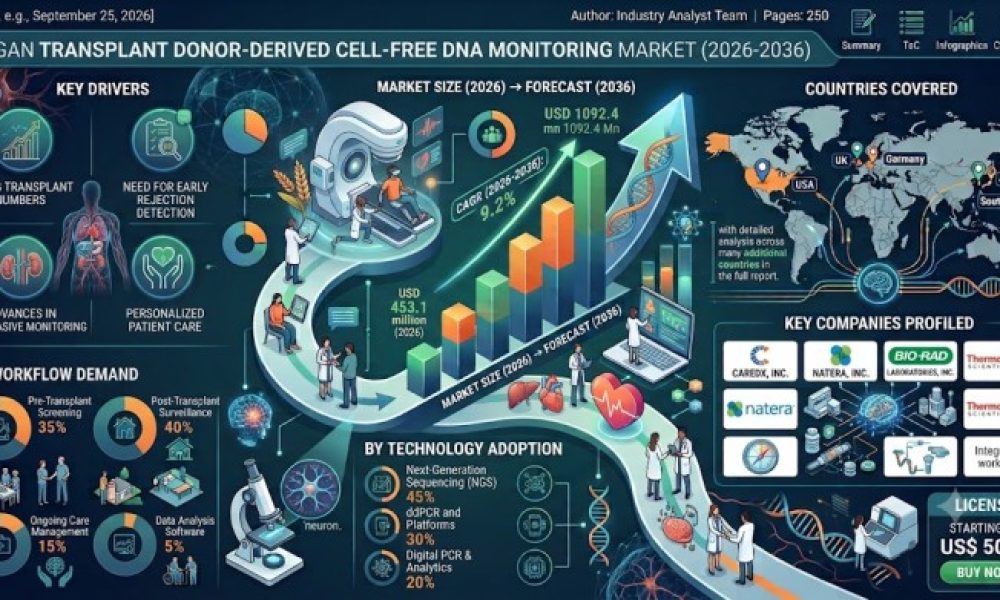
According to Future Market Insights, the global Organ Transplant Donor-Derived Cell-Free DNA Monitoring Market is valued at USD 453.1 million in 2026 and is projected to reach USD 1,092.4 million by 2036, expanding at a 9.2% CAGR during the forecast period.
Demand is being supported by transplant teams using serial donor-derived cell-free DNA (dd-cfDNA) measurements to identify potential graft injury earlier and guide decisions around further diagnostic review. The approach complements, rather than completely replaces, conventional tissue biopsy. Clinical evidence and expanding reimbursement pathways are also supporting broader use of molecular surveillance in post-transplant care.
Natera reported in April 2024 on its ProActive kidney cohort involving 1,631 recipients followed for at least 18 months, while a finalized MolDx coverage policy reported in July 2026 includes up to 12 surveillance tests during the first year for heart and lung recipients.
👉 Get Detailed Market Forecasts, Competitive Benchmarking, and Pricing Trends:
https://www.futuremarketinsights.com/reports/sample/rep-gb-34128
Global Segment Leaders
- Targeted Next-Generation Sequencing (NGS): 42.7% share in 2026 — Leads the technology segment through scalable SNP-based donor-fragment discrimination across serial samples.
- Kidney Transplant Monitoring: 40.2% share in 2026 — Benefits from established surveillance evidence and a substantial population requiring repeated graft assessment.
- Acute Rejection Monitoring: 35.0% share in 2026 — Demand is supported by the need for timely molecular evidence when graft injury is suspected.
- Transplant Centers: 30.4% share in 2026 — These facilities coordinate sample collection, molecular interpretation, graft-function assessment, and follow-up decisions across multidisciplinary transplant teams.
Country-Level Performance
- Japan – 9.7% CAGR (2026–2036): Centralized transplant follow-up and specialist interpretation.
- Germany – 8.5% CAGR (2026–2036): Molecular research, validation activity, and university-hospital pathways.
- South Korea – 8.0% CAGR (2026–2036): Concentrated specialist networks and molecular laboratory access.
- United Kingdom – 7.8% CAGR (2026–2036): Structured transplant pathways and selective testing linked to graft-function concerns.
- United States – 7.1% CAGR (2026–2036): Extensive transplant-center coverage and established testing access.
Japan records the highest CAGR among the five profiled countries, with centralized specialist institutions supporting serial graft monitoring. Germany follows at 8.5%, supported by research-intensive transplant pathways and clinical familiarity with donor-specific antibody assessment.
South Korea is projected to expand at 8.0%, while the United Kingdom is forecast at 7.8% amid established transplant services and measured reimbursement review. The United States records a 7.1% CAGR, supported by its extensive transplant-center network and a large recipient population requiring longitudinal surveillance.
Market Drivers, Restraints and Opportunities
Serial monitoring strengthens demand: Repeated dd-cfDNA testing allows clinical teams to track molecular changes over time and connect those changes with biopsy timing, graft function, and treatment decisions.
Threshold variability remains a restraint: Different organ types can show overlapping injury signals, making isolated results more difficult to interpret. The report also notes reimbursement uncertainty and inconsistent care protocols as potential barriers to repeated testing.
Integrated monitoring creates an opportunity: Combining dd-cfDNA trends with organ-function measures and treatment history can support longitudinal risk assessment and more selective use of invasive diagnostic procedures.
Clinical evidence continues to shape adoption. CareDx reported in June 2026 on a KOAR cohort of 1,258 adult kidney recipients linking longitudinal dd-cfDNA elevation with subsequent graft dysfunction and loss. At the same time, pooled evidence cited by FMI indicates that sensitivity limitations mean negative results still require interpretation alongside biopsy and other clinical information.
👉 Access the Complete Report in PDF Format:
https://www.futuremarketinsights.com/reports/brochure/rep-gb-34128
Competitive Landscape
Competition is concentrated among commercial monitoring providers and molecular platform suppliers. Natera, Inc. and CareDx, Inc. operate commercial dd-cfDNA monitoring portfolios, while Thermo Fisher Scientific Inc. and Bio-Rad Laboratories, Inc. contribute molecular assay and laboratory platform capabilities.
Natera competes through its multi-organ Prospera portfolio and continuing clinical evidence programs across kidney, lung, and heart transplantation. CareDx is active through AlloSure kidney and lung services supported by large registry studies. Platform suppliers compete through assay compatibility, sequencing infrastructure, technical support, and laboratory capabilities.
Key Developments
- July 2025: CareDx announced international prospective validation of AlloSure Plus using more than 2,700 renal-transplant biopsies. The company said its AI-powered platform combines dd-cfDNA with conventional clinical information for personalized rejection-risk assessment.
- January 2026: Natera reported a prospective lung-transplant study involving 78 recipients in which clinicians omitted a nine-month biopsy for more than 75% of low-risk participants.
- June 2026: Natera and Eledon Pharmaceuticals announced the selection of Prospera for a planned Phase 3 kidney-transplant trial involving approximately 600 recipients across more than 100 centers.
Analyst Perspective
“Long-term adoption of donor-derived cell-free DNA monitoring will depend on its ability to improve post-transplant surveillance through timely and actionable clinical insights. Transplant centers are evaluating how serial testing complements biopsy decisions, supports early graft injury detection, and integrates into established monitoring protocols.
Companies that strengthen clinical validation, expand laboratory access, and support evidence-based interpretation will be better positioned to drive sustained adoption across transplant programs.”
Access Full Report: https://www.futuremarketinsights.com/reports/organ-transplant-donor-derived-cell-free-dna-monitoring-market
— Anurag Sharma, Principal Consultant for Healthcare, Future Market Insights
Report Scope
The Organ Transplant Donor-Derived Cell-Free DNA Monitoring Market report covers:
- Technology: Targeted Next-Generation Sequencing, SNP-based Assays, Quantitative PCR, and dPCR
- Transplant Type: Kidney, Heart, Lung, Liver, and Multi-Organ Transplant
- Application: Acute Rejection Monitoring, Routine Post-Transplant Surveillance, Immunosuppression Management, and Graft Injury Assessment
- End User: Transplant Centers, Hospitals, Diagnostic Laboratories, and Academic & Research Institutes
- Regions: North America, Latin America, Europe, East Asia, South Asia, Oceania, and Middle East & Africa
- Forecast Period: 2026–2036
- Market Size: USD 453.1 million in 2026
- Forecast Value: USD 1,092.4 million in 2036
- CAGR:2%
The complete report covers Japan, Germany, South Korea, the United Kingdom, and the United States, with revenue measured in USD million and forecasts based on a hybrid bottom-up and top-down assessment.
About Future Market Insights
Future Market Insights (FMI) is a leading provider of market research and consulting services, offering syndicated and customized research across industries including healthcare, pharmaceuticals, and biotechnology.
About Future Market Insights (FMI)
Future Market Insights (FMI) is a global market intelligence and consulting firm providing comprehensive market research, competitive intelligence, and strategic business insights across industries. The firm delivers detailed forecasts, technology analysis, and data-driven recommendations that support informed decision-making for manufacturers, investors, distributors, and policymakers worldwide.
For Press & Corporate Inquiries
Rahul Singh
AVP – Marketing and Growth Strategy
Future Market Insights, Inc.
+91 8600020075



