
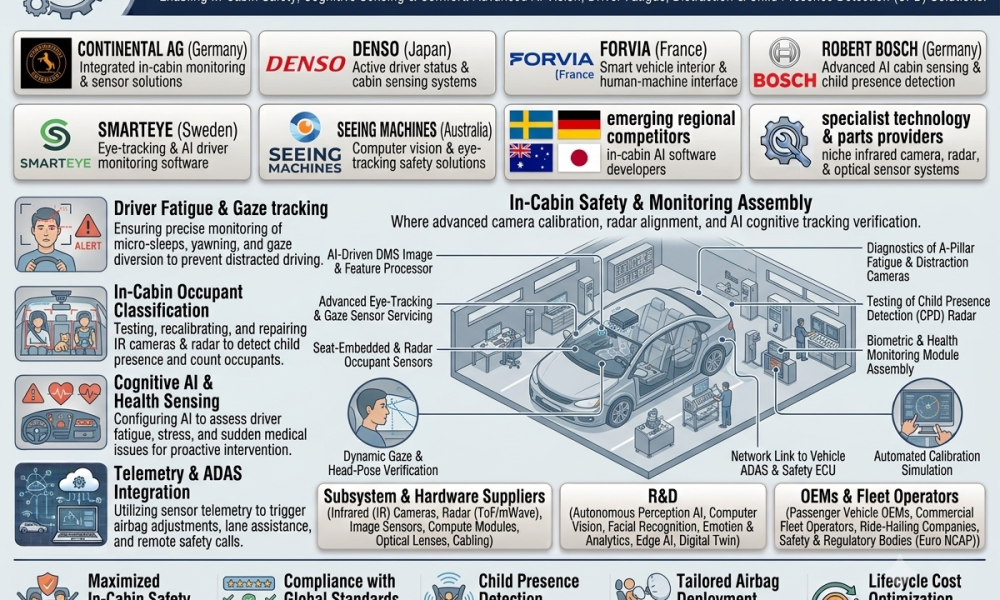
The global driver and occupant monitoring systems (DMS-OMS) market is projected to expand at a 17.5% CAGR between 2026 and 2036, increasing from USD 2.6 billion in 2026 to USD 13.0 billion by 2036. Automakers are increasingly integrating smart cameras, cabin software, and sensing technologies directly into vehicle platforms to monitor driver attention and occupant conditions while maintaining a clean and unobtrusive cabin environment.
Regulatory requirements are becoming an important catalyst for wider installation. European Commission rules published in June 2026 apply advanced driver distraction warning requirements to unlimited-series new vehicles starting July 7, 2026. These compliance requirements are increasing the importance of eye-tracking, attention detection, and validated driver monitoring capabilities for vehicle manufacturers seeking type approval across European markets.
Consumer safety assessment programs are adding further pressure for manufacturers to strengthen cabin monitoring capabilities. Euro NCAP’s October 2025 Driver Engagement protocol places direct driver monitoring within its 2026 Safe Driving assessment, encouraging automakers to combine gaze tracking, driver availability, and related safety functions within validated vehicle systems.
What Are the Key Segments in the Driver & Occupant Monitoring Systems (DMS-OMS) Market?
The DMS-OMS market is being shaped by integration strategy, vehicle application, monitoring function, and the growing role of software and sensing technologies.
- OEM-Integrated Systems – 62.0%: OEM-integrated systems represent the leading integration category in 2026, reflecting automakers’ need for factory calibration, platform-level software control, and compliance with vehicle type-approval requirements.
- Passenger Cars – 58.0%: Passenger cars account for the leading vehicle segment share in 2026 as regulatory requirements and consumer safety assessments increasingly influence high-volume vehicle programs.
- Driver Monitoring – 46.0%: Driver monitoring leads the function category, supported by growing requirements for detecting fatigue, distraction, gaze direction, and driver availability.
- Smart Cameras and Cabin Sensing: Camera-based monitoring remains central to DMS-OMS architectures, while radar and additional sensing technologies are expanding capabilities into occupant-position assessment and child presence detection.
- Software and IP: Software validation, detection algorithms, calibration accuracy, and platform compatibility are becoming important purchasing considerations as automakers seek reusable cabin intelligence across multiple vehicle programs.
Get detailed market forecasts, competitive benchmarking, and pricing trends:
https://www.futuremarketinsights.com/reports/sample/rep-gb-34060
Which Countries Are Showing the Strongest Growth in Driver & Occupant Monitoring Systems?
China: China is projected to grow at a 20.5% CAGR between 2026 and 2036, making it the fastest-growing market in the supplied country comparison. Vehicle manufacturers are emphasizing localized sensing technologies and rapid integration cycles to support faster vehicle launches. Growing cabin intelligence requirements are also creating opportunities for suppliers that can combine sensing hardware with scalable automotive software.
European Union: The European Union is projected to expand at an 18.5% CAGR through 2036. Regulatory requirements are an important demand catalyst, particularly as advanced driver distraction warning requirements apply to new vehicles. European automakers are also emphasizing multi-driver testing, software validation, and platform longevity to ensure monitoring systems remain effective across vehicle variants and operating conditions.
United States: The United States is projected to grow at a 17.0% CAGR through 2036. Increasing attention to connected-cabin safety, driver availability, and occupant protection is supporting demand for integrated monitoring technologies. Vehicle manufacturers are evaluating camera-based and software-defined systems that can support multiple safety functions without requiring extensive changes to vehicle interiors.
South Korea: South Korea is projected to expand at a 16.5% CAGR through 2036. Automakers and technology suppliers are focusing on localized sensors, fast platform integration, and cabin intelligence capabilities. The country’s established automotive electronics ecosystem supports development of compact sensing architectures and software-integrated monitoring functions.
Japan: Japan is projected to grow at a 16.0% CAGR through 2036. Automakers are emphasizing platform longevity, multi-driver validation, and consistent monitoring performance. Demand is increasingly connected to the need for monitoring systems that can operate reliably across different driver characteristics and vehicle configurations.
How Is Regional Demand Shaping the Driver & Occupant Monitoring Systems Market?
Regional demand is being shaped by differences in regulatory timing, safety-rating requirements, vehicle development cycles, and technology localization. Europe is placing strong emphasis on compliance with advanced driver distraction requirements, while China is combining safety technology adoption with rapid vehicle launch schedules and localized engineering.
The United States, South Korea, and Japan are also developing demand around integrated cabin intelligence. Across major automotive markets, automakers are moving toward systems that can combine driver attention monitoring with broader occupant sensing without creating additional dashboard complexity.
What Is Changing the Competitive Landscape?
The competitive landscape includes automotive software developers, sensing specialists, Tier-1 suppliers, and established automotive technology companies. Vendors are differentiating through camera performance, software maturity, sensor fusion, calibration capabilities, and access to vehicle platform programs.
Smart Eye and Seeing Machines are expected to compete through specialized driver monitoring technologies and software capabilities. Their market positioning reflects the increasing importance of gaze tracking, attention assessment, and driver-state detection within modern vehicle safety architectures.
Robert Bosch and AUMOVIO are anticipated to compete through broad automotive electronics portfolios and integration capabilities. Their ability to connect sensing, software, electronic control systems, and vehicle-level technologies can support automakers seeking consolidated cabin monitoring solutions.
Cipia Vision, DENSO, Magna, FORVIA HELLA, and Valeo are also participating in the evolving cabin-sensing ecosystem. Their capabilities span camera technologies, vehicle electronics, lighting and sensing systems, and broader Tier-1 integration, enabling monitoring functions to be incorporated into multiple vehicle platforms.
Competition is increasingly shifting from individual camera hardware toward complete monitoring architectures. Automakers are assessing whether suppliers can provide validated software, reliable detection across different cabin conditions, reusable architectures, and ongoing technical support throughout vehicle development cycles.
What Does the Analyst Say About the Driver & Occupant Monitoring Systems Market?
According to Nikhil Kaitwade, Principal Consultant for Automotive at Future Market Insights, the Driver & Occupant Monitoring Systems market is evolving from component sourcing to platform-level cabin intelligence, with automakers placing greater emphasis on software maturity and regulatory readiness than on camera hardware alone.
“The Driver & Occupant Monitoring Systems (DMS-OMS) market is evolving from component sourcing to platform-level cabin intelligence, with automakers placing greater emphasis on software maturity and regulatory readiness than on camera hardware alone. Market adoption will be shaped by detection accuracy across diverse driving conditions, the ability to reuse software across vehicle platforms, and compliance with evolving safety requirements. Sensor fusion and scalable software architectures are expected to play a larger role as occupant monitoring expands beyond driver attention into broader in-cabin safety functions.”
What Is Driving Demand for Driver & Occupant Monitoring Systems?
Regulatory Compliance Accelerates DMS Adoption
Mandatory safety requirements are becoming a direct driver of DMS deployment. European regulatory changes requiring advanced driver distraction warning capabilities increase the need for eye-tracking and attention-detection systems that can be validated as part of vehicle type-approval processes.
Safety Ratings Increase Commercial Pressure
Safety-rating programs are extending the influence of driver monitoring beyond legal compliance. Euro NCAP’s Driver Engagement protocol places driver monitoring within its 2026 Safe Driving assessment, encouraging manufacturers to incorporate validated driver attention and availability functions into new vehicle platforms.
Cabin Intelligence Expands Beyond Driver Monitoring
DMS-OMS technologies are increasingly moving beyond fatigue and distraction detection. Occupant monitoring can support child presence detection, occupant-position assessment, seatbelt-related functions, airbag optimization, and impairment detection, expanding the number of safety applications supported by the same cabin sensing architecture.
Software Reuse Supports Platform Development
Automakers are seeking software architectures that can be reused across vehicle platforms and model variants. Reusable algorithms and scalable sensing systems can reduce repeated development work while helping manufacturers maintain consistent monitoring performance across different cabin layouts and vehicle configurations.
What Are the Key Market Restraints?
Achieving consistent detection accuracy across different lighting conditions, driver characteristics, cabin layouts, and operating environments remains a technical challenge. Camera placement, occlusion, facial orientation, eyewear, and changing cabin conditions can influence monitoring performance and require extensive validation.
Software validation and calibration also add complexity to vehicle development. DMS-OMS functions must operate reliably with vehicle electronics and software architectures while meeting applicable safety and regulatory requirements. This can increase development timelines and qualification requirements for manufacturers and suppliers.
Integration costs can also become a consideration when automakers expand from driver monitoring toward broader occupant sensing. Additional cameras, radar sensors, processing capability, and software functions must be integrated without creating excessive hardware complexity or negatively affecting vehicle design.
What Opportunities Exist for DMS-OMS Manufacturers?
The transition toward platform-level cabin intelligence creates opportunities for suppliers that can deliver integrated hardware and software solutions. Vendors capable of combining driver monitoring, occupant sensing, radar, camera processing, and software validation can address a broader portion of automaker requirements.
There is also an opportunity to develop scalable architectures that support multiple vehicle platforms. Automakers can benefit from reusable software frameworks that maintain monitoring performance across different cabin designs, vehicle categories, and regional safety requirements.
Sensor fusion represents another opportunity. Combining cameras with interior radar and additional sensing technologies can expand monitoring capabilities beyond gaze and distraction detection toward occupant position, child presence, and broader cabin safety functions.
Drive Your Business Growth Strategy: Checkout the Report for Key Insights!
https://www.futuremarketinsights.com/checkout/34060
How Is the Driver & Occupant Monitoring Systems Market Segmented?
The driver and occupant monitoring systems industry is segmented by technology, application, component, end use, sales channel, and region.
By Technology: Driver monitoring, occupant monitoring, interior radar sensing, and health or impairment detection.
By Application: Drowsiness and distraction detection, child presence detection, seatbelt and airbag optimization, and impairment detection.
By Component: Software and IP, cameras and silicon, and services.
By End Use: Passenger cars, trucks and fleets, buses, and aftermarket users.
By Sales Channel: OEM-integrated systems, Tier-1 bundled systems, aftermarket kits, and fleet retrofit programs.
By Region: North America, Latin America, Western Europe, Eastern Europe, East Asia, South Asia and Pacific, Middle East, and Africa.
The segmentation enables automotive stakeholders to assess demand according to sensing technology, safety application, vehicle category, integration strategy, and regional regulatory requirements.
What Are the Drivers, Restraints and Opportunities in the Driver & Occupant Monitoring Systems Market?
The commercial case for DMS-OMS is increasingly tied to regulatory readiness, software validation, and the ability to extend cabin sensing across multiple vehicle safety functions.
- Mandatory driver distraction and engagement requirements are encouraging automakers to integrate validated monitoring technologies into new vehicle platforms.
- Software maturity, calibration accuracy, and sensor fusion are becoming important criteria for supplier selection.
- Expanding occupant monitoring applications create opportunities for scalable systems capable of supporting multiple cabin safety functions.
What Is the Driver & Occupant Monitoring Systems Market Demand Outlook?
Demand for driver and occupant monitoring systems is expected to remain closely linked to regulatory requirements, vehicle safety assessments, and the broader transition toward software-defined cabin architectures. The market’s projected 17.5% CAGR from 2026 to 2036 reflects increasing integration of monitoring functions into standard vehicle platforms.
The market is projected to increase from USD 2.6 billion in 2026 to USD 13.0 billion by 2036. As automakers move toward broader cabin intelligence, supplier selection is expected to increasingly depend on detection accuracy, software reuse, regulatory compliance, and compatibility with vehicle electronics.
Why Are OEM-Integrated Systems the Leading Integration Type?
OEM-integrated systems are projected to account for 62.0% of the market in 2026. Factory-level integration gives automakers greater control over calibration, software validation, vehicle electronics compatibility, and type-approval requirements.
OEM integration also allows driver and occupant monitoring functions to be incorporated into vehicle development from the beginning rather than added as separate aftermarket safety systems.
Why Are Passenger Cars the Leading Vehicle Segment?
Passenger cars are projected to account for 58.0% of the market in 2026. High-volume passenger vehicle programs face substantial exposure to evolving safety regulations and consumer safety assessments, encouraging manufacturers to incorporate driver and occupant monitoring technologies directly into standard vehicle architectures.
Why Is Driver Monitoring the Leading Function?
Driver monitoring is projected to hold 46.0% of the market in 2026. Requirements related to fatigue, distraction, gaze direction, and driver availability are creating a strong foundation for DMS adoption, while the same sensing architecture can increasingly support additional occupant safety applications.
How Fast Are Key Countries Growing in the Driver & Occupant Monitoring Systems Market?
China is projected to grow at 20.5% CAGR, followed by the European Union at 18.5%, the United States at 17.0%, South Korea at 16.5%, and Japan at 16.0% between 2026 and 2036. Differences in regulatory implementation, safety-rating requirements, localized sensor development, platform engineering strategies, and vehicle launch cycles are shaping the pace of DMS-OMS adoption across these markets.
About Future Market Insights
Future Market Insights (FMI) is a global market intelligence and consulting organization providing syndicated research, custom research, and advisory services across automotive, technology, industrial, chemicals, packaging, energy, and other sectors. FMI research supports business leaders, investors, manufacturers, and industry stakeholders with market forecasts, competitive intelligence, and strategic insights.



