
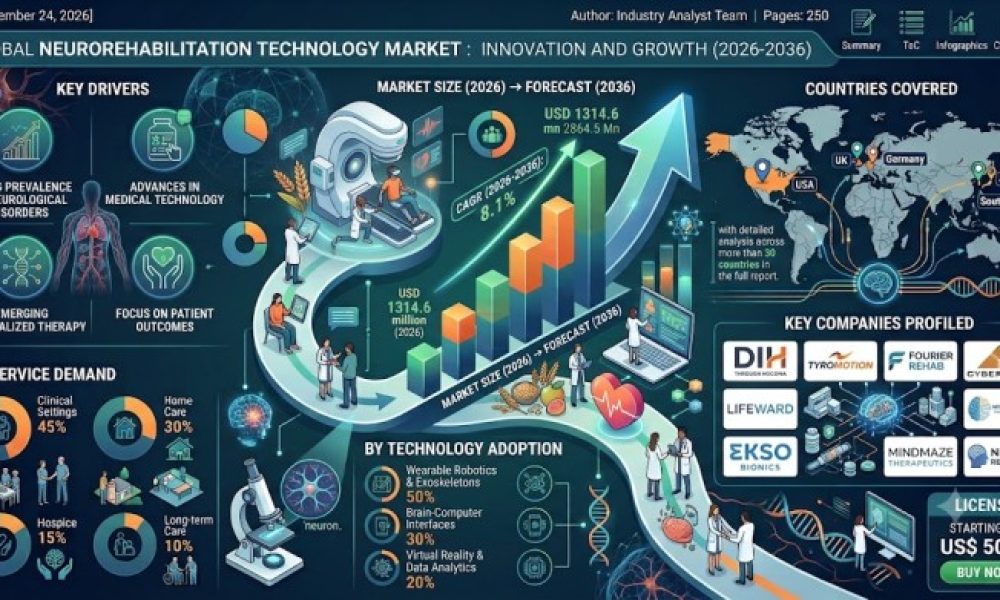
NEWARK, Del., Sept. 25, 2026 — According to Future Market Insights, the global neurorehabilitation technology market is projected to increase from USD 1,314.6 million in 2026 to USD 2,864.5 million by 2036, expanding at a CAGR of 8.1% during the forecast period. The market is being supported by neurological services seeking greater therapy repetition without adding equivalent clinician hours, while maintaining therapist control and measurable patient progression. The World Health Organization reported in May 2025 that an estimated 2.4 billion people worldwide may benefit from rehabilitation services, reinforcing the need for scalable rehabilitation delivery models.
👉 Get Detailed Market Forecasts, Competitive Benchmarking, and Pricing Trends:
https://www.futuremarketinsights.com/reports/sample/rep-gb-34126
Global Segment Leaders
- Technology – Robotic Rehabilitation: 36.4% share in 2026. Robotic systems support guided movement and repeatable motor training while allowing therapists to adjust assistance across recovery stages.
- Application – Stroke Rehabilitation: 38.7% share in 2026. Stroke recovery requires sustained gait and upper-limb practice across inpatient and outpatient rehabilitation pathways.
- End User – Hospitals: 39.8% share in 2026. Hospitals concentrate neurologists, rehabilitation physicians, therapists, and technical support teams capable of managing complex rehabilitation equipment.
- Product Type – Hardware: 37.0% share in 2026. Robotic joints, sensing components, wearable frames, and other physical systems represent the largest product category, although installation and maintenance add to ownership requirements.
Country-Level Performance
- UK – 9.7% CAGR: Integrated stroke-delivery networks and seven-day community rehabilitation services connect hospital discharge with home-based care.
- USA – 8.8% CAGR: Hospital capital budgets, coded therapy services, and regulated-device purchasing support adoption, while complete clinical documentation remains important for therapy reimbursement.
- Japan – 8.6% CAGR: Dedicated recovery wards and multidisciplinary staffing support rehabilitation technology deployment; about 95,000 recovery beds operated across 1,620 institutions in 2023.
- Germany – 8.3% CAGR: A substantial rehabilitation-facility base supports institutional utilization; Germany operated 1,067 prevention or rehabilitation facilities with 160,697 beds during 2024.
- South Korea – 7.3% CAGR: National health-technology review and selective reimbursement are supporting defined robotic rehabilitation procedures, including coverage criteria for electromyography-driven hand robot-assisted rehabilitation.
FMI’s published country CAGRs cover the 2026–2036 forecast period, ranging from 7.3% in South Korea to 9.7% in the UK.
Regional Context
The UK records the highest CAGR among the five profiled markets at 9.7%, followed by the USA at 8.8% and Japan at 8.6%. Germany is projected to grow at 8.3%, while South Korea records 7.3%.
The UK market benefits from coordinated public rehabilitation pathways. In the USA, adoption is linked to institutional purchasing and therapy-service documentation. Japan’s recovery wards provide concentrated treatment environments, while Germany’s large rehabilitation-facility base supports equipment utilization across decentralized provider networks. South Korea’s market is shaped by health-technology review and defined reimbursement pathways.
The full report covers North America, Latin America, Western Europe, Eastern Europe, East Asia, South Asia and Pacific, and the Middle East and Africa, with country analysis covering the USA, UK, Germany, Japan, South Korea, and more than 30 countries within the complete study.
👉 Access the Complete Report in PDF Format:
https://www.futuremarketinsights.com/reports/brochure/rep-gb-34126
Market Drivers, Restraints and Opportunities
The neurological disease burden is creating sustained demand for rehabilitation services requiring repeated motor and cognitive therapy. The World Health Organization reported in March 2024 that more than three billion people lived with a neurological condition worldwide during 2021. Neurorehabilitation technologies can increase treatment repetition while retaining patient-specific progression decisions under clinical supervision.
Workforce availability and specialist training remain constraints. Advanced rehabilitation systems require trained operators, fitting procedures, technical support, and dependable maintenance. FMI cites WHO data indicating that many lower-income countries had fewer than 10 skilled rehabilitation practitioners per million residents in April 2024. Equipment deployment therefore depends on implementation and service infrastructure as well as capital availability.
Connected rehabilitation creates an opportunity to extend selected therapy activities beyond hospitals. In March 2026, the Centers for Medicare & Medicaid Services added three remote therapeutic monitoring codes to the U.S. 2026 therapy-services framework for qualified reporting and review. Connected systems can link supervised treatment with structured home practice and remote clinical review, provided escalation responsibilities remain with clinicians.
Competitive Landscape
The competitive landscape includes DIH through Hocoma, Tyromotion, Fourier Rehab, CYBERDYNE, Lifeward, Ekso Bionics, MindMaze Therapeutics, and Neuro Rehab VR. The companies span institutional robotic rehabilitation, wearable mobility systems, exoskeletons, digital therapy, immersive rehabilitation, and connected care platforms.
DIH through Hocoma and Tyromotion provide broad robotic rehabilitation portfolios, while Fourier Rehab combines upper-limb and gait systems with a connected digital platform. CYBERDYNE focuses on wearable gait systems, while Ekso Bionics provides clinic-based exoskeletons. Lifeward combines clinical and personal mobility products, while MindMaze Therapeutics and Neuro Rehab VR focus on software-led and immersive therapy.
Key Developments
- May 2026: ChronoScale Corporation’s board committed to a plan to divest its wholly owned Ekso Bionics subsidiary and focus operations on its cloud business. A July 2026 holding-company transaction subsequently made ChronoScale Holdings Corporation the publicly traded parent of ChronoScale Corporation.
- March 2025: Lifeward received U.S. FDA clearance for the ReWalk 7 personal exoskeleton for individuals with spinal cord injury. Access remains dependent on assessment, training, and applicable reimbursement pathways.
- January 2025: CYBERDYNE obtained Japanese manufacturing and marketing approval for a small-size Medical HAL Lower Limb Type B, extending access to patients approximately 100 to 150 cm tall who could not use the standard model.
- June 2025: Fourier Rehab and Brooks Rehabilitation signed a strategic memorandum of understanding to advance research in robotic neurorehabilitation.
Analyst Perspective
“The commercial outlook for rehabilitation technologies will be shaped by sustained clinical utilization rather than technical capability alone. Healthcare organizations are increasingly distinguishing therapeutic outcomes from operational performance, recognizing that both influence investment decisions in different ways. Successful adoption will require clearly defined patient selection, structured implementation, and dependable service support that minimizes disruption while enabling rehabilitation programs to operate efficiently over the long term.”
— Anurag Sharma, Principal Analyst, Future Market Insights
About Future Market Insights
Future Market Insights (FMI) is a leading provider of market research and consulting services, offering syndicated and customized research across industries including healthcare, medical devices, and biotechnology.
Access Full Report: https://www.futuremarketinsights.com/reports/neurorehabilitation-technology-market
Related Reports:
About Future Market Insights (FMI)
Future Market Insights (FMI) is a global market intelligence and consulting firm providing comprehensive market research, competitive intelligence, and strategic business insights across industries. The firm delivers detailed forecasts, technology analysis, and data-driven recommendations that support informed decision-making for manufacturers, investors, distributors, and policymakers worldwide.
For Press & Corporate Inquiries
Rahul Singh
AVP – Marketing and Growth Strategy
Future Market Insights, Inc.
+91 8600020075



