
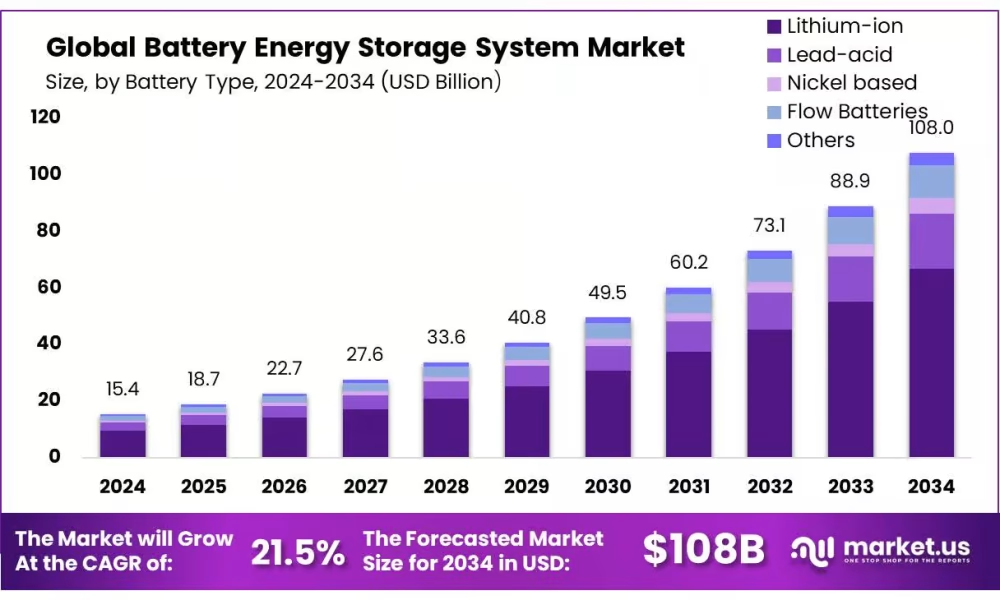
According to Market.us, the global Battery Energy Storage Systems (BESS) market size is expected to be worth around USD 108.0 billion by 2034, up from USD 15.4 billion in 2024, growing at a CAGR of 21.5% during the forecast period from 2025 to 2034. This growth is primarily driven by the increasing need to integrate renewable energy sources, enhance grid reliability, and support the global transition away from fossil fuels.
In 2023, global grid-scale battery capacity stood at approximately 50 GW and is anticipated to surpass 250 GW by 2030, indicating rapid deployment across regions. The commercial and industrial sectors are also adopting BESS to reduce energy costs and ensure power continuity. Meanwhile, the electric vehicle boom is fueling demand for second-life battery solutions, supporting a circular battery economy.
The continued decline in lithium-ion battery prices—dropping nearly 90% since 2010 to around $137/kWh in 2023—is making BESS more cost-effective. Policy support, such as the U.S. Inflation Reduction Act and the EU Green Deal Industrial Plan, is providing substantial incentives for infrastructure expansion. Looking ahead, significant growth is anticipated in decentralized energy systems, virtual power plants, and AI-enhanced storage technologies, which will offer improved efficiency and new market opportunities.
Key Takeaways
- Battery Energy Storage Systems market size is expected to be worth around USD 108.0 billion by 2034, from USD 15.4 billion in 2024, growing at a CAGR of 21.5%.
- Lithium-ion held a dominant market position, capturing more than a 62.10% share.
- Above 500 MWh held a dominant market position, capturing more than a 37.20% share.
- On-grid systems held a dominant market position, capturing more than a 74.20% share.
- Third-party-owned systems held a dominant market position, capturing more than a 43.20% share.
- Utility segment held a dominant market position, capturing more than a 52.10% share.
Access a Complimentary Sample of This Premium Report: https://market.us/report/battery-energy-storage-systems-market/request-sample/
Factors Affecting the Growth of the Battery Energy Storage Systems Market
Rise in Renewable Energy Integration: The increasing global shift towards solar and wind power has created a strong need for energy storage solutions to manage intermittent supply and ensure grid stability. Battery energy storage systems play a critical role in storing excess energy and delivering it during periods of low generation.
Grid Modernization and Reliability Needs: Aging infrastructure and frequent power outages are pushing utilities to modernize the grid. BESS helps enhance grid flexibility, manage peak loads, and provide backup during disruptions, making it a key component of future-ready energy networks.
Declining Battery Costs and Technology Advancements: Technological improvements and economies of scale have significantly reduced battery production costs, especially for lithium-ion systems. Ongoing innovations in battery chemistry, energy density, and life cycle are further boosting adoption across sectors.
Policy Support and Government Incentives: Supportive regulations, subsidies, and tax benefits from various governments are accelerating the deployment of BESS. Policies aimed at decarbonization and energy resilience are encouraging both public and private investments in storage infrastructure.
Growth in Electric Vehicle Adoption and Second-Life Battery Use: The widespread adoption of electric vehicles is expanding the supply of used batteries, which are being repurposed for stationary energy storage. This trend supports the development of a circular economy and provides cost-effective storage options for diverse applications.
Key Market Segmentation
By Battery Type Analysis
In 2024, lithium-ion batteries dominated the global battery energy storage system (BESS) market, accounting for over 62.10% of the total share. This leadership was driven by their superior energy density, extended lifespan, and efficient charge-discharge capabilities, making them ideal for both grid-scale and commercial applications. Lead-acid batteries, although facing a declining share, continued to be used in off-grid systems due to their low cost and recyclability, despite limitations in efficiency and durability.
Nickel-based batteries, including NiCd and NiMH, maintained a marginal presence, primarily serving industrial sectors that require robust performance under extreme conditions. Meanwhile, flow batteries, especially Vanadium Redox Flow Batteries (VRFB), saw growing adoption in long-duration energy storage projects.
By Capacity Analysis
In 2024, the Above 500 MWh segment led the global battery energy storage system (BESS) market, securing over 37.20% of the total share. This dominance was driven by increasing investments in large-scale storage for utility and grid applications, aimed at improving grid reliability and supporting renewable energy integration.
The 100 to 500 MWh segment followed with a substantial market share, favored for its optimal balance between capacity and cost, making it suitable for commercial, industrial, and mid-scale grid stabilization projects.
The Below 100 MWh segment also held a notable portion of the market in 2024, supported by rising demand from small commercial facilities, community energy projects, and EV charging stations. Its application in backup power and decentralized energy systems further fueled its growth.
By Connection Type Analysis
In 2024, on-grid battery energy storage systems (BESS) dominated the global market, accounting for over 74.20% of the total share. This strong position was driven by the growing integration of BESS with public electricity grids to manage peak demand, stabilize power supply, and store surplus energy from renewable sources.
In contrast, off-grid systems held a smaller market share but remained crucial for delivering energy in remote and underserved regions. These systems supported standalone applications such as rural households, isolated industrial operations, and emergency backup for essential infrastructure, highlighting their importance in areas lacking reliable grid access.
By Ownership Analysis
In 2024, third-party-owned battery energy storage systems (BESS) led the global market, securing over 43.20% of the share. This growth was driven by energy service companies offering storage solutions without upfront costs, attracting commercial and industrial clients seeking cost savings and reliability.
Customer-owned systems also held a significant market share, supported by homeowners and businesses aiming for energy independence and greater control. This segment benefited from government incentives such as tax credits and rebates. Utility-owned systems remained vital in 2024, with investments focused on grid-scale applications to manage load, support renewable integration, and enhance overall grid stability.
By Application Analysis
In 2024, the utility segment dominated the global battery energy storage system (BESS) market, accounting for over 52.10% of the total share. This leadership was driven by widespread adoption of large-scale storage solutions by utilities to manage peak loads, stabilize the grid, and support renewable energy integration. The commercial and industrial segment also experienced strong growth, as businesses adopted BESS for demand charge management, backup power, and sustainability initiatives.
In the transportation sector, battery storage supported electric vehicle (EV) charging infrastructure by balancing loads and storing excess renewable energy for off-peak vehicle charging, aligned with the rising electrification of transport. Critical infrastructure, including hospitals, military bases, and data centers, increasingly relies on BESS for uninterrupted power and energy security, contributing to notable market growth.
Key Market Segments
By Battery Type
- Lithium-ion
- Lithium Cobalt Oxide (LCO)
- Lithium Manganese Oxide (LMO)
- Lithium Nickel Manganese Cobalt Oxide (NMC)
- Lithium Nickel Cobalt Aluminum Oxide (NCA)
- Lithium Iron Phosphate (LFP)
- Lithium Titanate Oxide (LTO)
- Lead-acid
- Nickel based
- Flow Batteries
- Others
By Capacity
- Below 100 MWh
- 100 to 500 MWh
- Above 500 MWh
By Connection Type
- On-grid
- Off-grid
By Ownership
- Third-party-owned
- Customer-owned
- Utility-owned
By Application
- Utility
- Commercial & Industrial
- Transportation
- Critical Infrastructure
- Infrastructure & Commercial Buildings
- Others
- Residential
Regional Analysis
The Asia-Pacific (APAC) region led the global Battery Energy Storage Systems (BESS) market in 2024, holding a dominant 48.30% share valued at around USD 7.4 billion. This leadership was driven by rapid industrial growth, expanding renewable energy initiatives, and strong government backing. China emerged as the frontrunner due to its robust battery production capacity and large-scale renewable projects, while Japan, South Korea, and India contributed significantly through investments in lithium-ion technology and smart grid systems.
North America followed, fueled by increasing renewable energy adoption, grid modernization, and favorable policies, with the U.S. leading in utility-scale battery deployments and setting ambitious energy storage goals. In Europe, steady growth was observed, supported by strict carbon reduction targets and EU initiatives like the Green Deal, with Germany, the U.K., and France at the forefront.
Germany’s market alone is projected to surpass USD 5 billion by 2030. Meanwhile, the Middle East & Africa and Latin America are emerging as promising markets, with countries like Saudi Arabia, the UAE, Brazil, and Chile focusing on solar-plus-storage projects to strengthen grid resilience and diversify their energy mix.
Market Key Players
- BYD Co. Ltd.
- General Electric
- Panasonic Corporation
- LG Energy Solution Ltd
- Tesla Inc
- Contemporary Amperex Technology Co., Limited.
- Samsung SDI Co., Ltd.
- AEG
- Varta AG
- Delta Electronics, Inc.
- Hitachi Energy Ltd.
- Honeywell International Inc.
- Siemens AG
- Toshiba Corporation
- Mitsubishi Heavy Industries, Ltd.
- Other Key Players
Get in Touch with Us:
Market.us (Powered By Prudour Pvt. Ltd.)
Address: 420 Lexington Avenue, Suite 300 New York City, NY 10170, United States
Send Email: [email protected]
Refer More Related Reports:



