
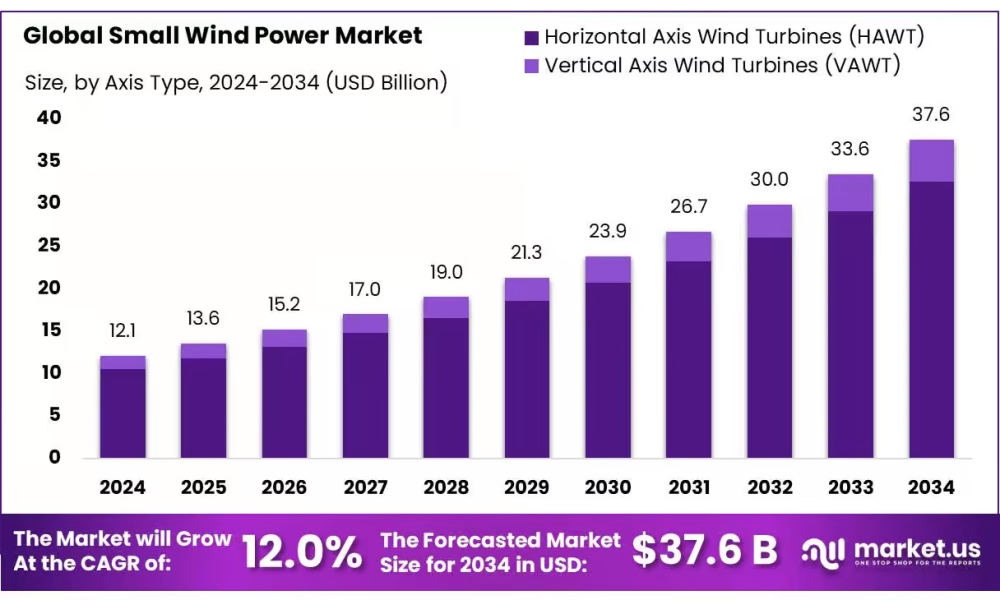
According to Market.us, the Global Small Wind Power Market size is expected to be worth around USD 37.6 billion by 2034, rising from USD 12.1 billion in 2024, growing at a CAGR of 12.0% during the forecast period from 2025 to 2034.
The growth of the small wind power market can be attributed to the increasing emphasis on decentralized energy solutions, favorable policy frameworks, and the rising adoption of clean energy in rural and off-grid areas. In particular, distributed wind systems are gaining popularity among commercial and agricultural users due to their cost-efficiency and potential to reduce reliance on grid electricity.
According to a 2023 report by the Pacific Northwest National Laboratory, commercial customers accounted for 42% of distributed wind projects in the U.S., while agricultural users represented 34%, reflecting growing interest from sectors with high energy demands in remote locations.
Incentive mechanisms continue to bolster this trend. In 2023, distributed wind projects across ten U.S. states received approximately USD 12.4 million in support through state-level incentives, production tax credits, and USDA REAP grants. Additionally, the U.S. Department of Energy’s RAISE initiative committed USD 4 million toward the testing and commercialization of distributed wind technologies, particularly benefiting the agricultural sector.
Further, the Inflation Reduction Act (IRA) allocated USD 144 million in 2024 to underutilized technologies via USDA REAP, with a joint USDA-DOE program introduced to enhance farmers’ income through small wind installations.
Key Takeaways
- The global small wind power market was valued at US$ 12.1 billion in 2024.
- The global small wind power market is projected to grow at a CAGR of 12.0% and is estimated to reach US$ 37.6 billion by 2034.
- Among axis types, Horizontal Axis Wind Turbines (HAWT) accounted for the largest market share of 87.4%.
- Among grid types, on-grid accounted for the majority of the market share at 81.2%.
- By capacity, 10 KW To 100 KW accounted for the largest market share of 48.5%.
- By application, commercial accounted for the majority of the market share at 49.3%.
- Asia Pacific is estimated as the largest market for small wind power with a share of 46.3% of the market share.
Access a Complimentary Sample of This Premium Report: https://market.us/report/global-small-wind-power-market/request-sample/
Factors Affecting the Growth of the Small Wind Power Market
Supportive Government Policies and Incentives: Government initiatives such as grants, tax credits, feed-in tariffs, and renewable energy targets are playing a critical role in encouraging the adoption of small wind systems. Programs focused on rural electrification, sustainable agriculture, and energy transition are particularly influential in driving installations in remote and off-grid areas.
Rising Demand for Decentralized and Clean Energy Solutions: The shift toward decentralized energy generation, especially in agricultural, residential, and commercial sectors, is fostering the adoption of small wind turbines. Their ability to operate independently of centralized grids makes them attractive in regions with unreliable or no access to conventional electricity infrastructure.
Technological Advancements in Turbine Design and Efficiency: Continuous innovation in turbine blade design, materials, and energy storage integration has significantly improved the performance and reliability of small wind systems. These technological developments have made small wind power a more feasible and competitive option for end users.
Cost Reduction in Installation and Maintenance: Declining costs of small wind turbines and improvements in installation techniques are making these systems more accessible. Reduced maintenance requirements and longer operational lifespans have further enhanced their economic viability, especially in rural and agricultural settings.
Increased Participation of Agricultural and Commercial Sectors: There is a growing trend among farmers and businesses to adopt small wind power for energy savings and sustainability. Distributed wind systems offer opportunities for reducing operational expenses and, in some cases, generating additional income through excess energy sales or incentive programs.
Key Market Segmentation
By Axis Type Analysis
In 2024, the Horizontal Axis Wind Turbines (HAWT) segment accounted for a dominant 87.4% share of the small wind power market. This significant share is attributed to HAWT’s well-established technology, high efficiency, and greater power generation capability compared to Vertical Axis Wind Turbines (VAWT).
Widely deployed in both onshore and offshore applications, HAWTs are the preferred choice for utility-scale projects due to their scalability and high capacity factor. Continued advancements in turbine design and materials have further strengthened their market position.
By Grid Type Analysis
In 2024, the on-grid segment held a dominant 67.4% share of the small wind power market. This is largely due to its compatibility with existing electrical infrastructure and the ability to supply excess power back to the grid, supported by financial incentives like net metering and feed-in tariffs.
On-grid systems also benefit from cost efficiencies and growing support from renewable energy policies, making them a preferred choice for residential and commercial users. Government regulations favoring grid-connected renewable systems have further contributed to the segment’s growth.
By Capacity Analysis
In 2024, the 10 KW to 100 KW capacity segment dominated the small wind power market with a 48.5% share. This segment’s strong position is attributed to its versatility across residential, commercial, and industrial applications. It offers a balanced solution for users needing higher energy output than smaller systems while remaining more cost-effective than large-scale turbines.
Enhanced turbine efficiency, technological improvements, and supportive government incentives have further boosted demand for this capacity range among those seeking reliable and sustainable energy alternatives.
By Application Analysis
In 2024, the commercial segment held the largest share of the small wind power market at 49.3%. This dominance is driven by rising adoption among businesses and industries aiming to cut energy costs and enhance sustainability. With higher energy demands, commercial facilities such as offices, warehouses, and factories are increasingly investing in small wind turbines.
Factors such as government incentives, growing emphasis on corporate social responsibility, and the potential for long-term savings have further strengthened the appeal of wind energy in this sector, supporting its leading market position.
Key Market Segments
By Axis Type
- Horizontal Axis Wind Turbines (HAWT)
- Vertical Axis Wind Turbines (VAWT)
By Grid Type
- On-Grid
- Off-Grid
By Capacity
- Up To 1 KW
- 1 KW – 10 KW
- 10 KW To 100 KW
By Application
- Residential
- Commercial
- Utility
Geopolitical Impact Analysis
Geopolitical factors significantly influence the small wind power market by affecting supply chains, trade policies, and renewable energy adoption. Rising global demand for wind energy, driven by climate goals and energy security concerns, has positioned wind turbine technology as a strategic priority.
However, geopolitical tensions—such as those between the U.S. and China—have disrupted the supply of key materials like polysilicon, impacting the cost and availability of components including turbine towers, nacelles, rotors, and generators. These disruptions have caused market volatility and pricing fluctuations. Moreover, government energy policies shaped by geopolitical priorities play a vital role; nations focusing on energy independence are increasingly offering subsidies and incentives to expand wind power capacity.
In contrast, politically unstable regions face barriers to adoption due to infrastructure limitations and uncertain policy environments. On a global scale, geopolitical collaboration is also fostering international partnerships and technology exchanges, especially in emerging markets. These dynamics underscore how geopolitical conditions directly shape the growth and accessibility of small wind power technologies worldwide.
Top Key Players
- ABB Ltd.
- Aeolos Wind Energy
- Bergey Wind Power Co
- City Windmills
- Endurance Wind Power Inc.
- Ennera Energy and Mobility, S.L.
- Eocycle Technologies Inc.
- Evance Wind Turbines Ltd.
- Gaia-Wind Ltd.
- Kestrel Wind Turbines
- Kingspan Group PLC
- Northern Power Systems Corp.
- Polaris America LLC
- Qingdao Anhua New Energy Equipment Co., Ltd.
- Quietrevolution Ltd.
- Raum Energy Inc.
- Ryse Energy
- SD Wind Energy Limited
- Shanghai Ghrepower Green Energy Co., Ltd.
- Siemens AG
- Sinovel Wind Group Co., Ltd.
- Southwest Windpower Inc.
- Superwind GmbH
- TUGE Energia
- UGE International Ltd.
- Unitron Energy Systems Pvt. Ltd.
- VENSYS Energy AG
- Vestas Wind Systems A/S
- Wind Energy Solutions
- Windflow Technology Ltd.
- XZERES Corporation
- Xzeres Wind Corp.
- Zephyr Corporation
- Zkenergy Science & Technology CO., LTD.
Get in Touch with Us:
Market.us (Powered By Prudour Pvt. Ltd.)
Address: 420 Lexington Avenue, Suite 300 New York City, NY 10170, United States
Send Email: [email protected]
Refer More Related Reports:



