
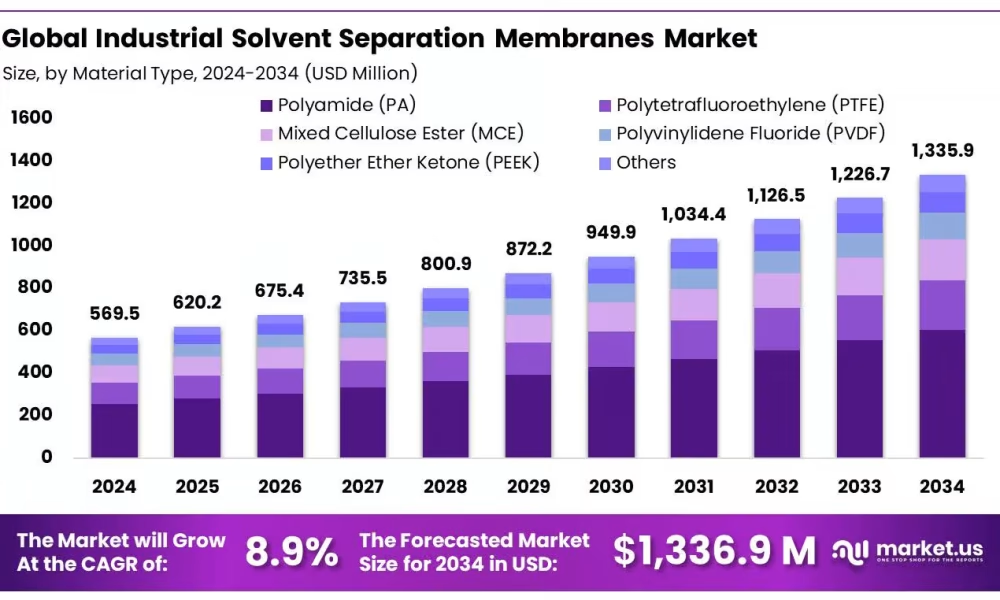
According to Market.us, The Global Industrial Solvent Separation Membranes Market is projected to reach approximately USD 1,336.9 Million by 2034, rising from USD 569.5 Million in 2024, and expanding at a CAGR of 8.9% between 2025 and 2034. This upward trend is being driven by the pressing need for more sustainable and energy-efficient alternatives to conventional separation processes.
Currently, fractional distillation of crude oil alone accounts for close to 1% of global energy consumption and contributes around 6% to total carbon emissions, indicating a significant environmental burden.
In contrast, membrane-based solvent separation technologies present a more eco-friendly solution with notable efficiency gains. A relevant example is ExxonMobil’s W.R. Grace Field facility, which applies membrane processes in dewaxing lubrication oils, resulting in a 20% drop in energy consumption, annual avoidance of 20,000 tons of greenhouse gas emissions, and significant water savings amounting to millions of gallons per day.
These results emphasize the operational and environmental advantages of switching to membrane solutions. Furthermore, the U.S. Department of Energy’s Industrial Heat Earthshot program targets an 85% reduction in industrial heat-related greenhouse gas emissions by 2035, underlining the pivotal role that solvent separation membranes will play in achieving large-scale decarbonization objectives.
Key Takeaways
- The global industrial solvent separation membranes market was valued at USD 569.5 million in 2024.
- The global industrial solvent separation membranes market is projected to grow at a CAGR of 8.9% and is estimated to reach USD 1,336.9 million by 2034.
- Among material type, polyamide accounted for the largest market share of 45.3%. Due to its excellent chemical resistance, and superior membrane-forming properties
- Among technology, reverse osmosis accounted for the majority of the market share at 54.1%. Due to its superior ability to remove a wide range of organic solvents and impurities.
- By Application, Halogenated Solvents accounted for the largest market share of 44.4%. Due to their widespread use in pharmaceutical, chemical, and electronics industries, where high-purity solvents are essential for precision applications
- By End-Use, Chemicals accounted for the majority of the market share at 58.5% Due to its high demand for solvent recovery, purification, and reuse in large-scale production processes.
- North America is estimated as the largest market for Industrial Solvent Separation Membranes with a share of 39.1% of the market share.
Access a Complimentary Sample of This Premium Report: https://market.us/report/industrial-solvent-separation-membranes-market/request-sample/
Factors Affecting the Growth of the Industrial Solvent Separation Membranes Market
Rising Focus on Energy Efficiency and Carbon Reduction: The increasing global emphasis on energy conservation and reducing greenhouse gas emissions is a major driver for the adoption of solvent separation membranes. These membranes offer a more energy-efficient alternative to conventional thermal separation methods like distillation, which are highly energy-intensive.
Stringent Environmental and Regulatory Policies: Governments and regulatory bodies across various regions are implementing stricter environmental standards to control industrial pollution and solvent emissions. This regulatory push is encouraging industries to adopt cleaner separation technologies such as membrane-based processes.
Technological Advancements in Membrane Materials: Ongoing innovations in membrane materials—such as polymeric, ceramic, and hybrid composites—are enhancing the efficiency, selectivity, and chemical resistance of separation membranes. These improvements are expanding their applicability across complex industrial solvent separation tasks.
Growth in End-Use Industries: The demand for solvent separation membranes is strongly influenced by growth in sectors such as pharmaceuticals, petrochemicals, chemicals, and food processing. The rising need for high-purity solvents and efficient solvent recovery systems in these industries supports market expansion.
Industrial Decarbonization Initiatives: Many countries and corporations are investing in decarbonization strategies to transition toward low-carbon industrial operations. Solvent separation membranes are being integrated into these strategies due to their role in reducing energy usage, waste generation, and carbon output in production processes.
Key Market Segmentation
By Material Type Analysis
In 2024, the polyamide segment accounted for a significant 45.3% revenue share in the industrial solvent separation membranes market. This dominance is attributed to its strong chemical resistance, high mechanical strength, and excellent membrane-forming ability.
Polyamide membranes are particularly effective in pharmaceutical and chemical processing due to their ability to handle aggressive solvents and deliver precise molecular separations. Their compatibility with nanofiltration and reverse osmosis technologies, along with high flux performance, further supports their widespread industrial use.
By Technology Analysis
In 2024, reverse osmosis (RO) technology led the industrial solvent separation membranes market with a dominant 54.1% share. Its leadership is driven by high separation efficiency, broad applicability in removing organic solvents and impurities, and strong adoption across sectors such as chemicals, pharmaceuticals, and food & beverages. Improvements in membrane durability and energy-efficient RO systems have further reinforced its role as a cost-effective and sustainable option for solvent recovery and purification.
By Application Analysis
In 2024, halogenated solvents dominated the industrial solvent separation membranes market with a 44.4% share. This was driven by their extensive use in pharmaceuticals, chemicals, and electronics, where high-purity solvents are critical. The demand for efficient, selective separation technologies and stricter environmental regulations on solvent emissions has boosted the adoption of membrane systems for solvent recovery and waste reduction.
By End-Use Analysis
In 2024, the chemicals segment led the industrial solvent separation membranes market with a 58.5% share. This dominance stems from the sector’s high demand for solvent recovery, purification, and reuse in large-scale operations. Membrane technologies are widely adopted by chemical manufacturers to improve efficiency, reduce waste, and meet strict environmental regulations, especially in the production of specialty and fine chemicals.
Key Market Segments
By Material type
- Polyamide (PA)
- Polytetrafluoroethylene (PTFE)
- Mixed Cellulose Ester (MCE)
- Polyvinylidene Fluoride (PVDF)
- Polyether Ether Ketone (PEEK)
- Others
By Technology
- Ultrafiltration
- Microfiltration
- Nanofiltration
- Reverse Osmosis
By Application
- Halogenated Solvents
- Dichloromethane
- Tetrachloroethylene
- Others
- Non-aqueous Solvents
- Alcohols
- Ketones
- Others
- C6 Hydrocarbons or Higher
- Heptane
- Hexane
- Alkylbenzene
- Others
By End-Use
- Chemicals
- Pharmaceutical
- Food & Beverage
- Paints & Coatings
- Others
Geopolitical Impact Analysis
Recent geopolitical developments have significantly influenced the global industrial solvent separation membranes market, with supply chain disruptions—particularly for key raw materials like polyamide and PTFE—raising production costs and causing manufacturing delays.
Tensions between major economies, especially the U.S. and China, have heightened trade restrictions and impacted industries such as chemicals, pharmaceuticals, food & beverage, and paints & coatings. At the same time, stricter environmental regulations across North America, Europe, and parts of Asia-Pacific have accelerated the adoption of membrane-based technologies.
In response to geopolitical risks, manufacturers are increasingly diversifying suppliers and investing in local production. This shift is especially prominent in Asia-Pacific, where rapid industrial growth and government-led initiatives aim to enhance domestic manufacturing resilience and reduce reliance on global supply chains.
The Major Players in The Industry
- Evonik Industries AG
- Novamem Ltd.
- Pall Corporation
- Sartorius AG
- SolSep BV
- Asahi Kasei Corporation
- Hawach Scientific Co., Ltd.
- Membrane Solutions, LLC.
- BORSIG GmbH
- SepPure Technologies
- Other Key Players
Get in Touch with Us:
Market.us (Powered By Prudour Pvt. Ltd.)
Address: 420 Lexington Avenue, Suite 300 New York City, NY 10170, United States
Send Email: [email protected]
Refer More Related Reports:



