
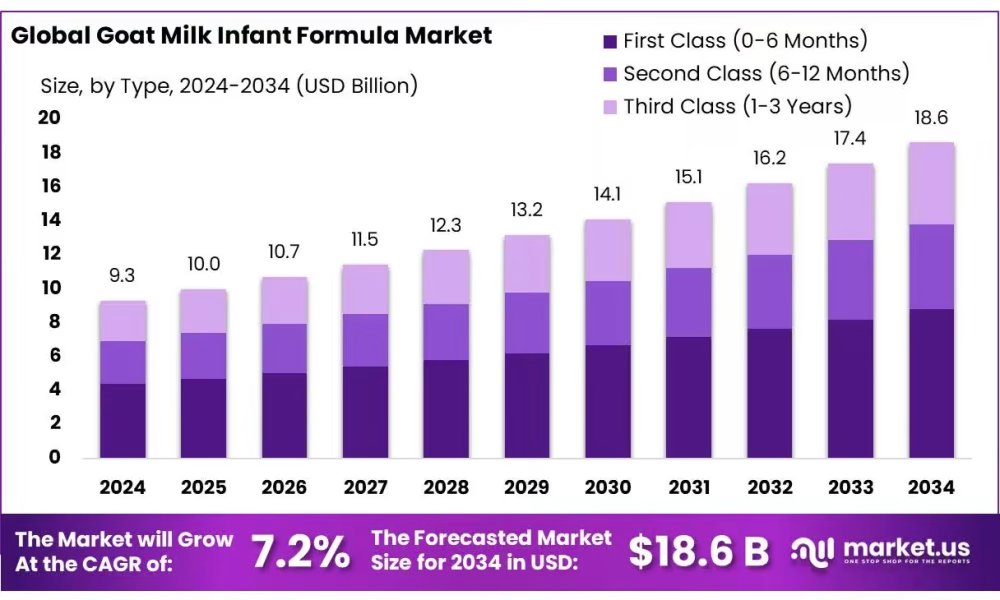
According to market.us, The global goat milk infant formula market is projected to witness substantial growth, with its valuation anticipated to rise from USD 9.3 billion in 2024 to approximately USD 18.6 billion by 2034. This growth reflects a compound annual growth rate (CAGR) of 7.2% between 2025 and 2034. The rising preference for goat milk-based nutrition, particularly among infants with digestive discomfort or cow milk protein intolerance, is a key factor driving this expansion.
In India, the goat milk infant formula sector is progressing steadily, supported by the nation’s mature dairy infrastructure and targeted government initiatives. The National Programme for Dairy Development (NPDD) is instrumental in improving milk quality and fostering organized procurement systems.
For example, in Bihar, 29 projects have received approval under NPDD, with a sanctioned investment of ₹380.43 crore, including ₹263.24 crore in grant assistance. Additionally, the White Revolution 2.0 program aims to rejuvenate the dairy sector by enhancing breeding practices, veterinary care, and rural dairy infrastructure.
India is poised to play a significant role in the global goat milk infant formula market. The rising incidence of lactose intolerance and allergies to cow milk among infants is encouraging consumers to opt for goat milk-based alternatives. Government support through financial incentives and subsidies for organic and A2 milk farming is further promoting investment in high-quality dairy products.
Key Takeaways
- Goat Milk Infant Formula Market size is expected to be worth around USD 18.6 Billion by 2034, from USD 9.3 Billion in 2024, growing at a CAGR of 7.2%.
- First Class (0-6 Months) held a dominant market position, capturing more than a 47.2% share in the Goat Milk Infant Formula market.
- Supermarkets/Hypermarkets held a dominant market position, capturing more than a 54.3% share.
- Bottle Packaging held a dominant market position, capturing more than a 61.8% share in the Goat Milk Infant Formula market.
- Asia-Pacific (APAC) region is one of the most significant and rapidly growing markets for goat milk infant formula, holding a dominant share of 43.5% in 2024, valued at approximately USD 4 billion.
Access a Complimentary Sample of This Premium Report: https://market.us/report/global-goat-milk-infant-formula-market/request-sample/
Factors Affecting the Growth of the Goat Milk Infant Formula Market
Rising Prevalence of Cow Milk Allergies and Lactose Sensitivities: The increasing number of infants experiencing adverse reactions to cow milk protein has led to a shift toward alternative dairy sources. Goat milk is often easier to digest due to its unique protein and fat structure, making it a preferred choice among parents seeking hypoallergenic nutrition options.
Changing Consumer Preferences for Natural and Digestible Infant Nutrition: There is growing awareness among consumers regarding the nutritional benefits of goat milk, including its digestibility, natural composition, and closer resemblance to human milk in terms of oligosaccharide content. This shift in preference is significantly influencing product demand in the infant formula segment.
Government Support for Dairy Sector Development: Public sector initiatives aimed at strengthening dairy farming, such as subsidies, low-interest loans, and rural infrastructure development, are encouraging the production and processing of goat milk. This support is facilitating greater access to high-quality raw milk and fostering growth in value-added products like infant formula.
Expansion of Organized Retail and E-commerce Channels: The growing presence of organized retail chains and digital marketplaces has improved the availability and visibility of goat milk infant formula. Consumers now have better access to niche and premium nutrition products, which is boosting overall market penetration.
Technological Advancements in Goat Milk Processing: Innovation in dairy technologies, including improved pasteurization, homogenization, and formulation methods, is enhancing the nutritional quality and safety of goat milk-based formulas. These advancements are helping manufacturers meet regulatory standards while maintaining product integrity, thereby strengthening consumer confidence and market adoption.
Key Market Segmentation
By Type Analysis
In 2024, the First Class (0–6 Months) segment accounted for over 47.2% of the goat milk infant formula market, making it the leading category. This dominance is driven by growing parental awareness of goat milk’s nutritional benefits during early infancy, particularly its digestibility for sensitive stomachs.
The segment continues to see rising demand, with this trend expected to persist through 2025, as more parents prioritize balanced and health-focused nutrition during a baby’s critical initial development phase.
By Distribution Channel Analysis
In 2024, supermarkets and hypermarkets led the goat milk infant formula market with a dominant share of over 54.3%. Their widespread availability and ease of access make them the primary choice for parents purchasing infant nutrition products.
This segment has consistently grown year over year, and it is expected to retain its leading position in 2025. The broad selection of brands, competitive pricing, and promotional offers continue to drive consumer preference for this distribution channel.
By Packaging Type Analysis
In 2024, bottle packaging dominated the goat milk infant formula market, securing over 61.8% of the total share. Its strong preference among parents is due to its convenience, portability, and ability to maintain product freshness.
This packaging format simplifies feeding and supports hygiene, which is essential for infant care. The segment is expected to sustain its growth into 2025, driven by rising demand for ready-to-feed and pre-measured options that offer both practicality and safety.
Key Market Segments
By Type
- First Class (0-6 Months)
- Second Class (6-12 Months)
- Third Class (1-3 Years)
By Distribution Channel
- Supermarkets/Hypermarkets
- Retail Stores
- Online Selling
- Others
By Packaging Type
- Bottle Packaging
- Tetra Packaging
Opportunity
Government support is playing a crucial role in accelerating the growth of the goat milk infant formula market by promoting goat milk production. Various nations are implementing favorable policies and financial assistance to strengthen the supply chain.
In India, initiatives in partnership with NABARD and regional banks are offering subsidies ranging from 25% to 35% on goat farming projects. These incentives are designed to attract more farmers into goat husbandry, ensuring a consistent and scalable supply of goat milk for infant formula manufacturing.
In the United States, programs like WIC have approved goat milk-based infant formulas, highlighting their compliance with FDA nutritional and safety standards. This inclusion not only enhances accessibility for low-income families but also supports greater market acceptance of goat milk nutrition.
Such initiatives are expanding the availability of high-quality goat milk and creating a more resilient supply network. As a result, the market is well-positioned to meet growing consumer demand and support the production of specialized infant nutrition products.
Trends
The goat milk infant formula market is witnessing strong momentum, driven by increasing regulatory recognition and government-backed initiatives. In 2023, the U.S. FDA and the American Academy of Pediatrics officially included goat milk as an approved base for infant formula. This update followed the successful import of goat milk formulas during the 2022 shortage, ensuring they complied with U.S. safety and nutritional benchmarks.
On the production side, government support remains a key growth catalyst. In India, targeted subsidies and loan schemes are encouraging farmers to enter goat farming, thereby expanding the raw milk supply essential for formula production. These measures not only promote rural development but also help ensure the consistent availability of goat milk-based products.
Together, regulatory approvals and farming incentives are broadening access to alternative infant nutrition. As health authorities adapt to evolving consumer needs and governments invest in dairy infrastructure, the market for goat milk infant formula is expected to advance steadily, offering safe and diversified options for infant care.
Top Key Players in the Market
- Dairy Goat Co-operative (N.Z.) Limited
- Danone
- AUSNUTRIA
- Little Bundle
- Danalac
- Orient EuroPharma Co., Ltd.
- Bubs Organic, LLC.
- Kabrita
- MT. CAPRA
- Oli6
- Formuland Inc.
- Aotearoa Nutrients
- Nannycare Ltd.
Get in Touch with Us:
Market.us (Powered By Prudour Pvt. Ltd.)
Address: 420 Lexington Avenue, Suite 300 New York City, NY 10170, United States
Send Email: [email protected]
Refer More Related Reports:



