

Overview
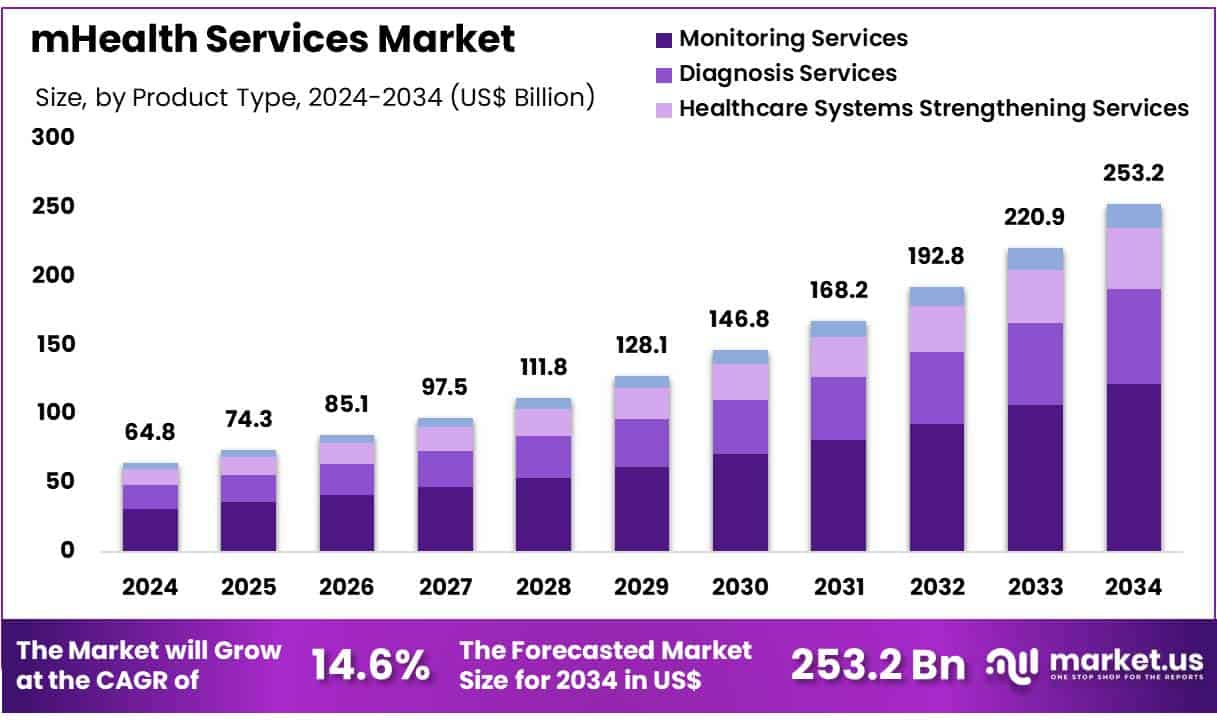
Global mHealth Services Market size is expected to be worth around US$ 253.2 Billion by 2034 from US$ 64.8 Billion in 2024, growing at a CAGR of 14.6% during the forecast period 2025 to 2034. In 2024, North America led the market, achieving over 41.2% share with a revenue of US$ 26.7 Billion.
The global mHealth (mobile health) services market is experiencing accelerated growth, driven by increasing smartphone penetration, rising healthcare digitization, and the growing need for remote patient monitoring and chronic disease management. mHealth services include a broad range of mobile-based medical solutions such as health tracking apps, SMS alerts, teleconsultations, diagnostic support, medication reminders, and wearable device integration.
As healthcare systems worldwide face mounting pressure to improve patient access and reduce care delivery costs, mobile platforms have emerged as a key enabler of personalized, real-time health support. mHealth services are particularly valuable in managing non-communicable diseases such as diabetes, hypertension, and cardiovascular conditions conditions that require continuous monitoring and engagement.
Government initiatives promoting digital health adoption, including the World Health Organization’s Global Digital Health Strategy and national eHealth frameworks, are further propelling market expansion. In addition, the integration of AI-driven analytics, 5G connectivity, and cloud infrastructure is enhancing service efficiency and patient outcomes.
Emerging economies in Asia-Pacific and Africa are witnessing increased uptake of mHealth services due to improving mobile network infrastructure and growing awareness about preventive healthcare. Meanwhile, North America remains a dominant region, owing to its advanced digital health ecosystem and favorable reimbursement models. As the demand for accessible, cost-effective healthcare rises, the global mHealth services market is expected to play a central role in reshaping modern care delivery models.
Click here to get a Sample report copy @ https://market.us/report/mhealth-services-market/free-sample/
Key Takeaways
- In 2024, the global mHealth services market generated a revenue of USD 64.8 billion and is projected to reach USD 253.2 billion by 2033, expanding at a compound annual growth rate (CAGR) of 14.6% during the forecast period.
- By product type, the market is segmented into monitoring services, diagnostic services, healthcare systems strengthening services, and others. Among these, monitoring services emerged as the dominant segment, accounting for 48.3% of the market share in 2023, driven by rising demand for remote patient monitoring and chronic disease management.
- Based on participants, the market includes mobile operators, device vendors, content players, and healthcare providers. Mobile operators held the leading position with a market share of 52.4%, reflecting their crucial role in connectivity and service delivery infrastructure.
- In terms of application, the market is categorized into general healthcare & fitness, medication information, healthcare management, and others. The general healthcare & fitness segment led the market, capturing 44.6% of total revenue, supported by widespread use of wellness apps and fitness trackers.
- Regarding end-users, segmentation includes healthcare providers, patients, and others. Healthcare providers dominated the segment, accounting for 62.1% of revenue, due to increasing integration of mobile health technologies in clinical workflows.
- Geographically, North America maintained its leadership position with a market share of 41.2% in 2023, attributed to advanced digital infrastructure and favorable policy support.
Segmentation Analysis
- Product Type Analysis: The monitoring services segment accounted for 48.3% of the market share, driven by rising demand for real-time health tracking. The proliferation of wearable technologies such as fitness trackers and smartwatches is accelerating growth by providing continuous data on vital metrics like heart rate and activity levels. Increasing cases of chronic diseases and the shift toward preventive care are prompting healthcare providers to adopt remote monitoring, supporting proactive treatment and reducing hospital admissions, thus reinforcing segment dominance.
- Participants Analysis: Mobile operators captured 52.4% of the market share as they increasingly integrate healthcare solutions into their service models. These operators are expanding access to mHealth services through robust mobile networks, particularly in underserved regions. The widespread use of smartphones for health tracking and consultations is further driving adoption. Collaborations with healthcare providers and tech firms are expected to generate customized mHealth platforms, while the rollout of 4G and 5G networks enhances the quality and reach of mobile-based healthcare services.
- Application Analysis: The general healthcare and fitness segment led with a 44.6% revenue share, supported by growing interest in preventive health and lifestyle management. Consumers are increasingly using mobile apps to monitor fitness, nutrition, and overall wellness. Rising awareness about physical health, alongside sedentary work habits, is fueling demand for digital fitness tools. The integration of wearable-generated health data into mobile platforms is enhancing personalization and user experience, positioning this segment for sustained and robust future growth.
- End-user Analysis: Healthcare providers held a dominant 62.1% share, reflecting their growing reliance on mobile health solutions for improved care delivery. mHealth services are being adopted for remote monitoring, virtual consultations, and real-time access to clinical data. These technologies support efficiency, reduce operational costs, and enable outreach in rural or underserved areas. Regulatory demands and the push for better patient engagement are reinforcing digital health adoption among providers, making them central stakeholders in the expanding mHealth ecosystem.
Market Segments
Product Type
- Monitoring services
- Diagnosis services
- Healthcare systems strengthening services
- Others
Participants
- Mobile operators
- Device vendors
- Content players
- Healthcare providers
Application
- General healthcare & fitness
- Medication information
- Healthcare management
- Others
End-user
- Healthcare providers
- Patients
- Others
To Purchase this Premium Report @ https://market.us/purchase-report/?report_id=148985
Regional Analysis
North America led the global mHealth services market in 2023, capturing a revenue share of 41.2%. This dominance is attributed to high smartphone penetration and the rapid expansion of telehealth infrastructure. According to the Centers for Disease Control and Prevention (CDC), there was a notable rise in telehealth utilization among adults between 2022 and 2023.
The growing number of healthcare providers offering mobile-based solutions has further fueled market growth in the region. Additionally, regulatory support from the U.S. Food and Drug Administration (FDA), including guidance on mobile medical apps, has facilitated the approval and adoption of mHealth technologies across various healthcare settings.
Meanwhile, the Asia Pacific region is projected to register the highest compound annual growth rate (CAGR) during the forecast period. This growth is driven by rising smartphone adoption and strong government support for digital healthcare infrastructure. Initiatives such as India’s National Digital Health Mission are creating a robust ecosystem for digital health services.
Moreover, increasing prevalence of chronic diseases and investments in health tech startups are encouraging the use of remote monitoring and mobile health applications across emerging markets like India and China.
Key Players Analysis
Key players in the global mHealth services market are driving growth through strategic collaborations, technological advancements, and regional expansion. These companies are partnering with healthcare providers, insurers, and digital platforms to integrate mobile health solutions into clinical workflows, thereby improving care delivery and patient engagement. Emphasis is placed on leveraging emerging technologies such as artificial intelligence, wearable devices, and telemedicine platforms to enable real-time monitoring and personalized healthcare services.
Market leaders are also actively expanding into emerging economies, capitalizing on rising smartphone usage and improved internet connectivity to reach underserved communities. Compliance with international regulatory standards and implementation of robust data protection frameworks further enhance credibility and facilitate global adoption of mHealth solutions.
Among the prominent players, Apple Inc. holds a strong position in the mHealth services sector. The company’s ecosystem incorporates health-centric innovations, such as the Apple Watch and HealthKit, enabling users to track key health parameters. Apple’s collaboration with healthcare providers and research institutions supports advancements in medical studies and digital health. By prioritizing innovation and user data privacy, Apple continues to lead in shaping the future of mobile health technologies.
Market Key Players
- Vodafone Group Plc
- Veradigm LLC
- Qualcomm Technologies, Inc
- Orange
- Google Inc
- Garmin Ltd
- AT&T
- Apple Inc
Market Dynamics
- Market Driver: The increasing global burden of chronic diseases such as diabetes, hypertension, and cardiovascular disorders is a primary driver for the mHealth services market. Mobile health technologies enable continuous monitoring, early diagnosis, and timely intervention, reducing hospital visits and improving patient outcomes. The growing need for cost effective and accessible healthcare, especially in remote and underserved regions, is further accelerating adoption among healthcare providers, patients, and insurers, thereby driving sustained market growth.
- Market Trend: A key trend in the mHealth services market is the integration of wearable technologies and AI-powered analytics into mobile health platforms. Devices such as smartwatches and fitness trackers now provide real-time health data, while artificial intelligence supports predictive health insights and decision-making. This trend is transforming preventive care and chronic disease management by enhancing personalization, user engagement, and clinical efficiency. The convergence of digital tools is reshaping healthcare delivery and creating a more connected health ecosystem.
- Market Opportunity: Emerging markets present a significant growth opportunity for the mHealth services sector. Increasing smartphone penetration, improving internet access, and supportive government initiatives in regions like Asia-Pacific, Latin America, and Africa are creating favorable conditions for mobile health expansion. Public health campaigns and investments in digital infrastructure further enhance adoption. These regions offer untapped potential for reaching large populations with limited access to traditional healthcare, making mHealth a viable solution for scaling affordable and accessible care.
Conclusion
The global mHealth services market is poised for robust growth, fueled by rising smartphone usage, expanding telehealth infrastructure, and increasing demand for cost-effective healthcare delivery. With strong government support, technological innovation, and growing chronic disease prevalence, mobile health platforms are transforming healthcare access and patient engagement.
North America leads the market, while Asia-Pacific shows the highest growth potential. Strategic partnerships, wearable integration, and AI adoption are reshaping care delivery models. As digital health ecosystems mature, mHealth services are expected to play a central role in global healthcare modernization and equitable access to real-time, personalized medical support.
View More Reports:
Healthcare Interoperability Solutions Market to Hit USD 14.7 Billion by 2034
Healthcare Interoperability Solutions Market to Hit USD 14.7 Billion by 2034
Electrophysiology Market Set for 15.2% CAGR Through 2034
Radiology Information Systems Market To Reach USD 3.6 Billion By 2034
Radiology Information Systems Market To Reach USD 3.6 Billion By 2034



